Exploring the Meaning of Hoti in Greek
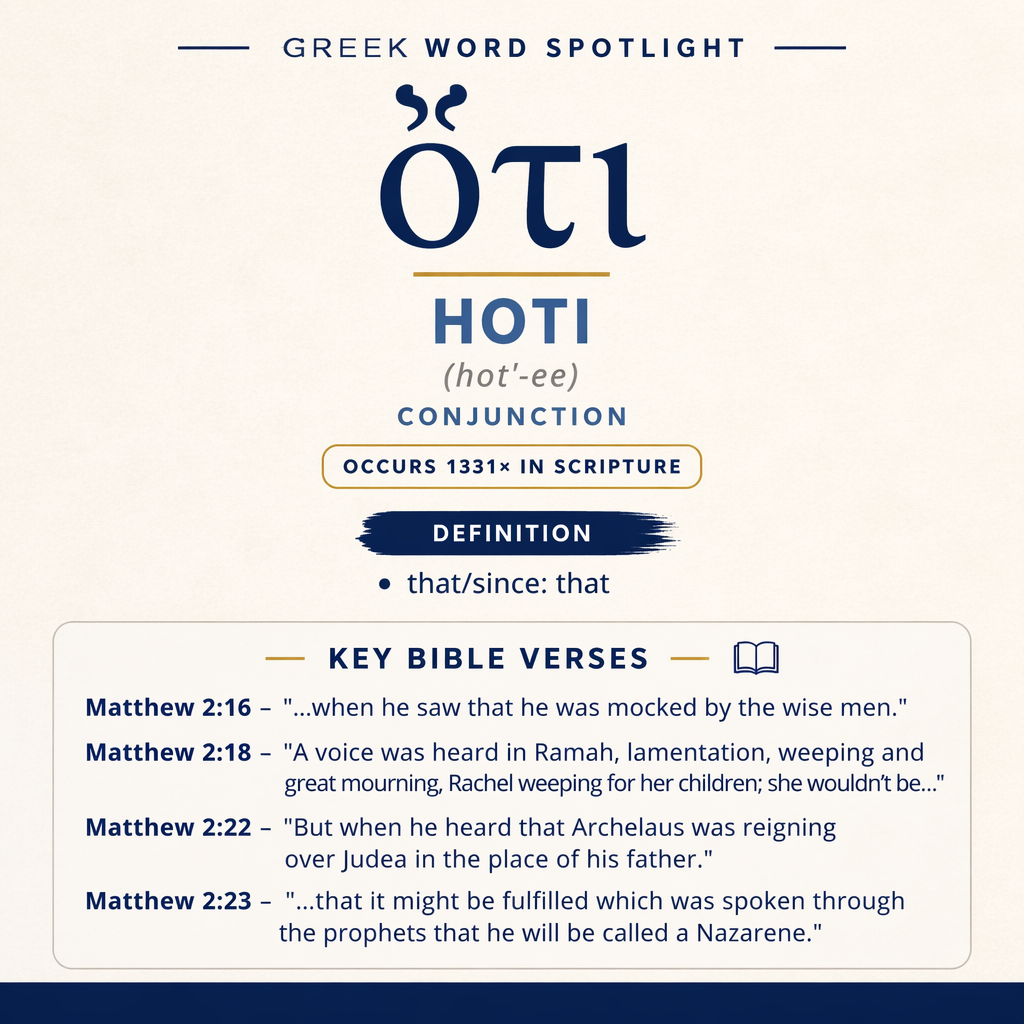
ὅτι means “that/since: that” in Greek and appears 1,331 times in Scripture, including in Matthew 2–5.
Core Meaning
ὅτι is defined as “that/since: that.” It commonly introduces a statement or reason in the cited verses.
Learn More →Scripture Frequency
This word occurs 1,331 times in Scripture. The provided examples include multiple uses across Matthew chapters 2–5.
Learn More →Matthew Examples
In Matthew 2:16 and 4:12 it appears with “when he saw/heard that…”. In Matthew 5:3 it appears in “for theirs is the Kingdom of Heaven.”
Learn More →ὅτι expresses a link of content or cause in the sense “that/since: that.” In the passages below it regularly introduces what someone perceived, heard, said, or what Scripture was understood to be saying, and it can also supply the stated reason attached to an announcement.
Occurrences
Matthew 2:16 — “Then Herod, when he saw that he was mocked by the wise men, was exceedingly angry, and sent out, and killed all the male children who were in Bethlehem and in all the surrounding countryside, from two years old and under, according to the exact time which he had learned from the wise men.”
Here ὅτι marks the content of Herod’s perception: he “saw that he was mocked.” The conjunction ties a recognized fact (as he interpreted the wise men’s actions) to the ensuing reaction, giving the narrative a hinge from observation to violent decision.
Matthew 2:18 — “A voice was heard in Ramah, lamentation, weeping and great mourning, Rachel weeping for her children; she wouldn’t be comforted, because they are no more.”
In this lament, ὅτι introduces the reason for Rachel’s refusal of comfort: “because they are no more.” The line presents the ground of the mourning as a stated cause, not merely an emotion without explanation.
Matthew 2:22 — “But when he heard that Archelaus was reigning over Judea in the place of his father, Herod, he was afraid to go there. Being warned in a dream, he withdrew into the region of Galilee,”
ὅτι introduces what was heard: the specific report that “Archelaus was reigning over Judea.” The conjunction functions as a reporting link, clarifying that the fear arises from a particular piece of news about rule and succession.
Matthew 2:23 — “and came and lived in a city called Nazareth; that it might be fulfilled which was spoken through the prophets that he will be called a Nazarene.”
This verse contains two ὅτι-clauses with distinct roles. The first (“that it might be fulfilled…”) presents the stated purpose/result of settling in Nazareth in relation to fulfillment. The second (“…through the prophets that he will be called a Nazarene”) introduces the content of what was spoken, presenting the prophetic wording as a clause introduced by ὅτι.
Matthew 3:9 — “Don’t think to yourselves, ‘We have Abraham for our father,’ for I tell you that God is able to raise up children to Abraham from these stones.”
ὅτι here introduces the content of the speaker’s assertion: “I tell you that God is able….” The conjunction carries the force of direct instruction—what follows is the proposition that confronts the hearers’ assumption about ancestry.
Matthew 4:6 — “and said to him, “If you are the Son of God, throw yourself down, for it is written, ‘He will command his angels concerning you,’ and, ‘On their hands they will bear you up, so that you don’t dash your foot against a stone.’ ”
In this temptation scene, ὅτι introduces what is claimed on the basis of Scripture: “for it is written….” The conjunction supports an argument by bringing forward a written citation as the stated ground for the urged action, connecting the command (“throw yourself down”) with the appeal to written words.
Matthew 4:12 — “Now when Jesus heard that John was delivered up, he withdrew into Galilee.”
Again ὅτι introduces a report: Jesus “heard that John was delivered up.” The conjunction presents the content that triggers a movement—withdrawal into Galilee—so the narrative shift is anchored to a specific heard event.
Matthew 5:3 — “Blessed are the poor in spirit, for theirs is the Kingdom of Heaven.”
In the Beatitudes, ὅτι stands behind the explanatory “for,” attaching the blessing to its stated basis: “theirs is the Kingdom of Heaven.” The conjunction gives the blessing a reasoned structure, where the declaration of blessedness is paired with a grounding clause.
Matthew 5:4 — “Blessed are those who mourn, for they shall be comforted.”
ὅτι again introduces the ground attached to the blessing: “for they shall be comforted.” The conjunction makes the second clause function as the justification that supports the first pronouncement.
Matthew 5:5 — “Blessed are the gentle, for they shall inherit the earth.”
Here the conjunction supplies the stated reason attached to the blessing, linking “Blessed are the gentle” with the promised outcome “they shall inherit the earth.” The logic of the line depends on the ὅτι-clause to carry the explanatory weight.
Matthew 5:6 — “Blessed are those who hunger and thirst after righteousness, for they shall be filled.”
ὅτι functions in the same pattern: the clause “for they shall be filled” is presented as the reasoned basis for pronouncing blessedness. It frames the promise as the explanatory counterpart to the condition described.
Matthew 5:7 — “Blessed are the merciful, for they shall obtain mercy.”
Once more ὅτι introduces the grounding clause: “for they shall obtain mercy.” The conjunction ties the ethical description (“the merciful”) to the stated corresponding outcome, presenting the second clause as what supports the first.

Sense and Usage
Across these scenes, ὅτι performs two closely related jobs that fall under “that/since: that.” First, it introduces content—what someone sees, hears, tells, or cites. This use appears in narrative reporting (“he saw that…,” “he heard that…,” “I tell you that…”) and in the introduction of a written citation (“for it is written…”). In each case the conjunction functions like a grammatical gateway: it turns what follows into the object of perception, report, or proclamation. Herod’s anger is connected to a perceived slight; fear is connected to a heard political reality; withdrawal is connected to a heard arrest; an assertion about God’s ability is delivered as the content of a direct address; a quotation is brought forward as the content of what “is written.”
Second, ὅτι supplies a reasoned basis for a preceding statement, corresponding to “since/because/for” within the limits of the given gloss. This use is especially clear in the lament (“because they are no more”) and in the repeated Beatitude structure (“Blessed are… for…”). In those lines, ὅτι does not introduce a new event to be reported; rather, it attaches an explanatory clause that grounds what precedes. The effect is to shape the discourse as warranted speech: grief is anchored to the absence of children, and blessedness is anchored to a declared future or present reality (“theirs is…,” “they shall…”). The conjunction thus helps the reader hear these pronouncements as more than slogans; they are statements with attached grounds.
Matthew 2:23 shows how both functions can operate in close proximity. One ὅτι-clause connects a settlement to fulfillment (“that it might be fulfilled…”), while another ὅτι-clause introduces what the prophets are represented as saying (“that he will be called…”). In this way ὅτι can steer a sentence either toward purpose/fulfillment logic or toward reported speech content, depending on what it connects and how the surrounding verbs frame the clause.
Imagery in Context
Though ὅτι is a small linking word, the passages show how it carries the weight of explanation. It binds a ruler’s perception to the tragedy that follows, binds news of reign and arrest to fear and withdrawal, binds an argument to a written citation, and binds blessings and lament to their stated grounds. In these texts, major turns in action and meaning are often introduced by the simple move from statement to ὅτι-clause: what happened, what was heard, and why it matters.
Sources: Lexical data from Strong’s Exhaustive Concordance and the Translators Brief Lexicon of Extended Strongs for Greek (STEPBible, CC BY). Occurrence data from the Translators Amalgamated Greek New Testament (STEPBible, CC BY). Scripture quotations from the World English Bible (public domain).