
Exploring the Meaning of Orgilos in Greek
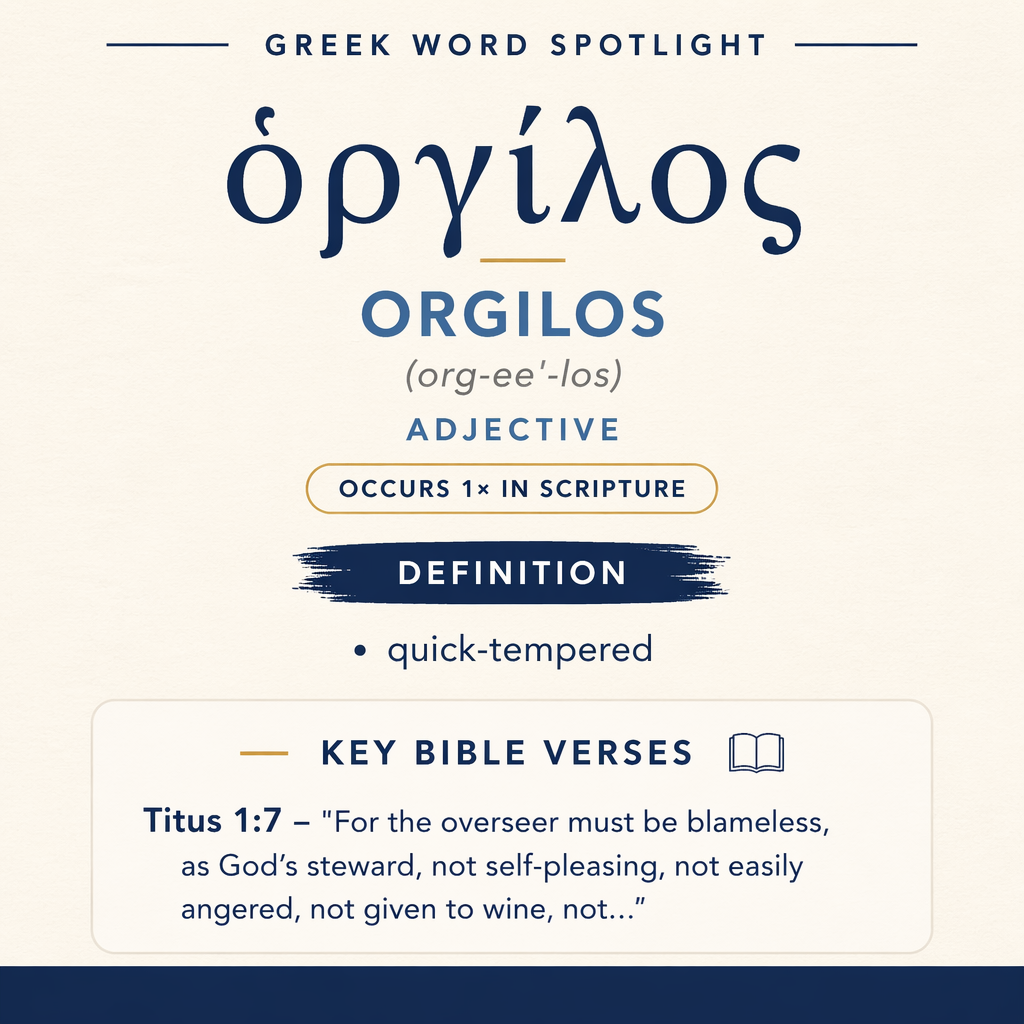
ὀργίλος means “quick-tempered” and appears once in Scripture, in Titus 1:7.
ὀργίλος means “quick-tempered” and appears in the qualifications listed for an overseer in Titus 1:7. In that context it marks a disposition that must not characterize one who serves as God’s steward.
Root and Related Words
ὀργίλος is related to orge (ὀργή), “wrath” (Strong’s G3709). The adjective form draws on this “wrath” word-family to describe a person characterized by readiness for such an outburst.

Occurrences
Titus 1:7 — “For the overseer must be blameless, as God’s steward, not self-pleasing, not easily angered, not given to wine, not violent, not greedy for dishonest gain;”
Here ὀργίλος stands within a tightly packed list of negatives that set boundaries around the life of “the overseer.” The verse frames the overseer’s role as accountable service: he is “God’s steward,” and so his conduct must fit a trust placed in him. Within that moral profile, “not easily angered” specifies a temperament that is not governed by rapid flare-ups.
The placement of the term alongside “not self-pleasing” connects quick temper to a self-centered posture: a person who insists on his own way can be prone to sudden irritation when opposed. Likewise, the proximity to “not given to wine” and “not violent” portrays a spectrum of destructive behaviors; quick temper belongs to the same cluster of traits that can damage others, whether expressed verbally, relationally, or physically. The sequence also suggests that anger can be a gateway to other harms—what begins as a hot response can spill into harshness, intimidation, or force, which the verse explicitly excludes in “not violent.”
Because the verse is describing an office with responsibility, ὀργίλος is not treated as a private quirk but as a disqualifying pattern. The adjective functions as a character descriptor: the overseer must not be someone marked by impulsive anger, since stewardship calls for steadiness, restraint, and a manner of leadership that does not turn quickly into heat.
Sense and Usage
As an adjective meaning “quick-tempered,” ὀργίλος points to speed and readiness: the person so described is prone to anger that ignites rapidly rather than being slow to rise. In Titus 1:7 the concern is not merely that anger exists—anger can arise in many situations—but that a leader not be characterized by hair-trigger reactions that make him “easily angered.” The focus falls on temperament as a settled tendency, since the qualification addresses what an overseer is like, not simply what he does on a single occasion.
The immediate context gives the term a practical, pastoral shape. The overseer must be “blameless,” and the list that follows sketches attitudes and actions that commonly erode blamelessness. Quick temper undermines good stewardship because it distorts judgment and damages trust: a steward acts on behalf of another, and a leader under God’s authority must be able to receive pressure, contradiction, and disappointment without erupting. The verse does not define the mechanics of anger, but by coupling “not easily angered” with other restraints it portrays quick temper as socially disruptive and ethically risky.
The collocation with “not violent” also shows that ὀργίλος is not limited to internal emotion; it is the kind of temper that tends toward outward expression. Even when it does not become physical violence, quick temper can create an atmosphere where conflict escalates. The verse aims to prevent that atmosphere from taking root in the life of the overseer, whose calling involves guiding others rather than dominating them.
Finally, the presence of “not greedy for dishonest gain” at the end of the list sets quick temper within broader integrity. Titus 1:7 is not assembling unrelated flaws but drawing a composite portrait of an unfit steward—self-directed, unrestrained, and capable of harm. In that portrait, ὀργίλος contributes the note of volatility: a volatility that would compromise the overseer’s ability to act consistently and fairly.
Imagery
Titus 1:7 evokes the picture of a household steward whose demeanor is as important as his actions. Within that implied setting, ὀργίλος carries the imagery of a sudden flare—an anger that flashes quickly—and contrasts it with the steady, controlled presence expected of one entrusted with oversight.
Sources: Lexical data from Strong’s Exhaustive Concordance and the Translators Brief Lexicon of Extended Strongs for Greek (STEPBible, CC BY). Occurrence data from the Translators Amalgamated Greek New Testament (STEPBible, CC BY). Scripture quotations from the World English Bible (public domain).




