Exploring the Meaning of Opisthen in Greek
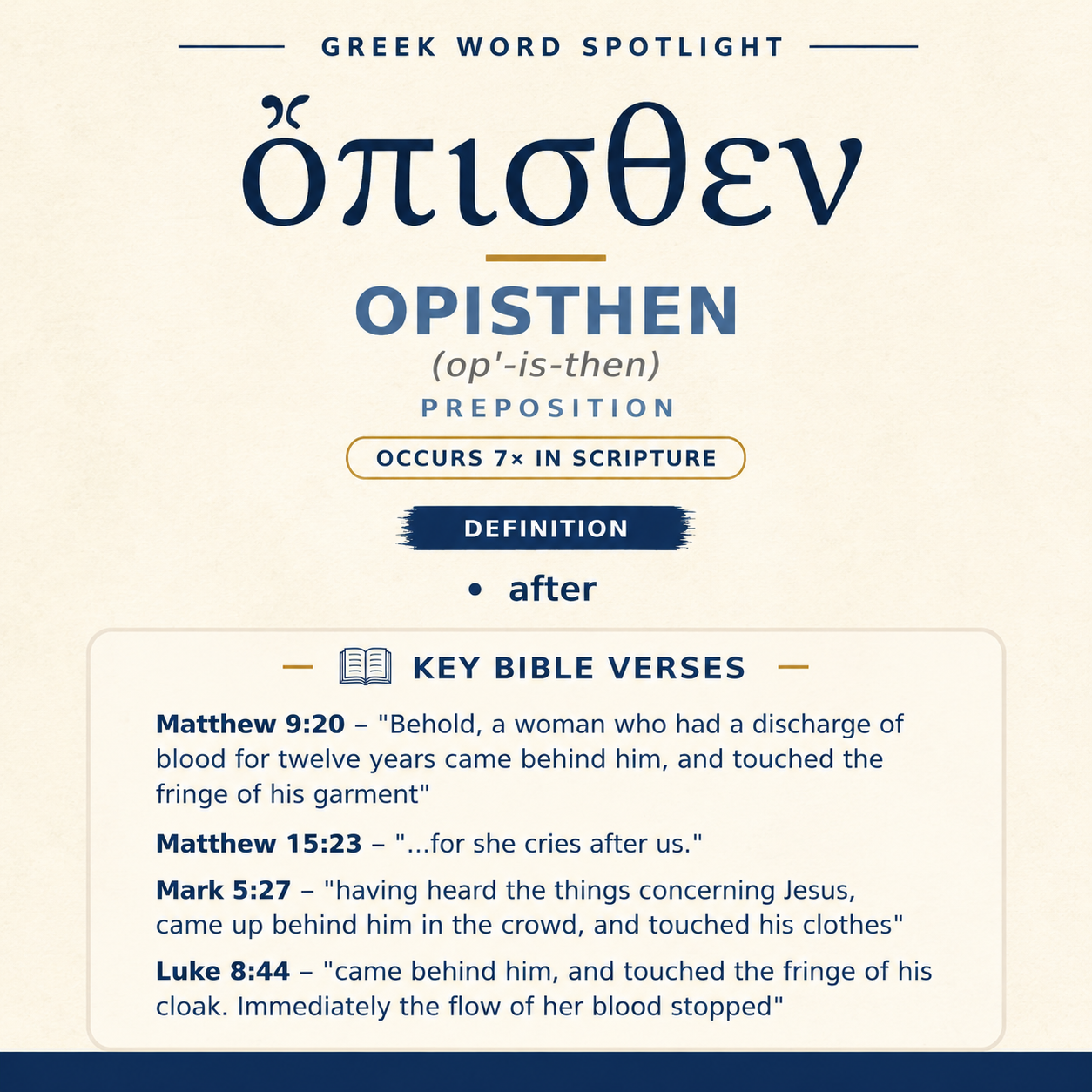
ὄπισθεν means “after” and appears seven times in Scripture, including Matthew, Mark, Luke, and Revelation.
Core Meaning
ὄπισθεν is defined as “after.” In the Gospels it appears in contexts describing someone coming behind or after.
Learn More →Gospel Examples
It is used in Matthew 9:20, Mark 5:27, and Luke 8:44 of a woman coming behind Jesus to touch his garment. In Matthew 15:23 it describes someone crying after the disciples.
Learn More →Other Occurrences
ὄπισθεν also occurs in Luke 23:26, Revelation 4:6, and Revelation 5:1. These references account for its total of seven Scripture occurrences.
Learn More →ὄπισθεν expresses the idea of being “after” in relation to someone or something, often locating an action or position in the space that follows another. In the New Testament passages where it appears, it repeatedly marks what happens from behind or in the wake of another, and it also helps describe what lies on the far side of an object or scene.
Occurrences
Matthew 9:20 — “Behold, a woman who had a discharge of blood for twelve years came behind him, and touched the fringe of his garment;”
Here ὄπισθεν places the woman’s approach “after” Jesus in a spatial sense: she comes up from the rear rather than confronting him face-to-face. The word supports the narrative detail that her touch is discreet—she reaches for “the fringe of his garment” while positioned behind him, so her act occurs in the space following his movement.
Matthew 15:23 — “But he answered her not a word. His disciples came and begged him, saying, “Send her away; for she cries after us.””
In this scene, ὄπισθεν attaches to the verb of crying out, portraying the woman’s persistent calling as something that follows the disciples. The word makes the pursuit audible and continuous: the cries are not merely directed toward them in a moment, but are heard “after us,” trailing them as they go.
Mark 5:27 — “having heard the things concerning Jesus, came up behind him in the crowd, and touched his clothes.”
As in Matthew 9, ὄπισθεν sets the woman’s approach “after” Jesus—this time explicitly “in the crowd.” The word works with the crowd setting to show how the touch occurs from the rear where she can get close without stopping him or drawing immediate attention, and it emphasizes the direction of her movement: she closes in on him from behind.
Luke 8:44 — “came behind him, and touched the fringe of his cloak. Immediately the flow of her blood stopped.”
Luke uses ὄπισθεν to define the woman’s position relative to Jesus at the moment of contact: she is located behind him when she touches “the fringe of his cloak.” The word helps structure the sequence—approach from behind, touch at the edge of the cloak, then the immediate change in her condition—by anchoring the contact in the space “after” him.
Luke 23:26 — “When they led him away, they grabbed one Simon of Cyrene, coming from the country, and laid on him the cross, to carry it after Jesus.”
Here ὄπισθεν describes Simon’s assigned place in the procession: he carries the cross “after Jesus.” The word gives the movement an ordered direction—Jesus is led ahead, Simon follows behind bearing the cross—so the reader envisions a line of travel where Simon’s burden is borne in the space and path that come after Jesus.
Revelation 4:6 — “Before the throne was something like a sea of glass, similar to crystal. In the middle of the throne, and around the throne were four living creatures full of eyes before and behind.”
In this visionary description, ὄπισθεν appears paired with “before,” framing the creatures as “full of eyes” on both sides—what is in front and what is after/behind. The word contributes to the portrayal of their unusual completeness of sight: they are described as filled with eyes not only facing forward but also in what lies behind them.
Revelation 5:1 — “I saw, in the right hand of him who sat on the throne, a book written inside and outside, sealed shut with seven seals.”
In this depiction of the book, ὄπισθεν supports the statement about writing “inside and outside” by contributing the sense of what is on the far side—what stands “after” the visible front. The word helps describe the book as written not only where one would first look but also on the surface that lies beyond, so the object is presented as marked on both sides.

Sense and Usage
Across these passages, ὄπισθεν consistently organizes relationships by placing an action or location in what comes “after.” In the narrative scenes from the Gospels, that “after” is most naturally heard as the space behind a moving person or group. The repeated phrasing “came behind him” (Matthew 9:20; Mark 5:27; Luke 8:44) uses ὄπισθεν to give the reader a clear directional picture: the woman approaches Jesus from the rear. That spatial choice shapes how the action feels within each story: the contact is made at the “fringe” of a garment or cloak, and ὄπισθεν reinforces that the touch is at the trailing edge as one approaches from behind.
Matthew 15:23 shifts from bodily position to the way sound follows movement. “She cries after us” uses ὄπισθεν to place the woman’s cries in the disciples’ wake. Rather than describing a stationary appeal, the word makes the cries track with the disciples’ motion—what comes after them, as though the sound is pursuing their retreat.
Luke 23:26 uses ὄπισθεν to specify order in a forced procession: Simon carries the cross “after Jesus.” The term establishes sequence and placement at once. The reader is not left with a general idea that Simon bears the cross somewhere nearby; ὄπισθεν assigns him the following position, marking his role as one who comes after, moving in the same direction as the one ahead.
In Revelation, ὄπισθεν continues to express “after” but in a descriptive rather than narrative way. In Revelation 4:6 it balances “before” to depict the living creatures as filled with eyes on both the front-facing and rear-facing sides. The word therefore contributes to a spatial totality: what is before and what is behind are both included in the description. In Revelation 5:1 the term helps characterize the book as written not only where the viewer first expects writing (“inside”) but also on the other side (“outside”), so that the book’s surfaces are described as fully inscribed—what is accessible at the front and what lies beyond it.
Seen together, these uses show that ὄπισθεν can locate persons, actions, and features in what follows another reference point: the follower’s position behind a leader, a cry that trails those who move away, eyes that occupy the rear side as well as the front, and writing that extends to the far side of a book. In each case, the word is not a mere extra detail; it governs how the scene is oriented—where bodies stand, how movement is ordered, and which sides of an object or creature are being described.
Imagery
The word’s imagery repeatedly draws attention to what is normally less seen: the rear approach in a crowd (Mark 5:27), a touch at the fringe (Luke 8:44), the follower’s place in a solemn line of travel (Luke 23:26), and the backside included in a visionary inventory (“before and behind,” Revelation 4:6). Even when the scene is not about pursuit on foot, ὄπισθεν keeps the reader aware of the “after” side of things—what lies behind a person or on the far side of an object—so that the narrative and the visions alike are given depth and direction.
Sources: Lexical data from Strong’s Exhaustive Concordance and the Translators Brief Lexicon of Extended Strongs for Greek (STEPBible, CC BY). Occurrence data from the Translators Amalgamated Greek New Testament (STEPBible, CC BY). Scripture quotations from the World English Bible (public domain).