Exploring the Meaning of Homologeo in Greek
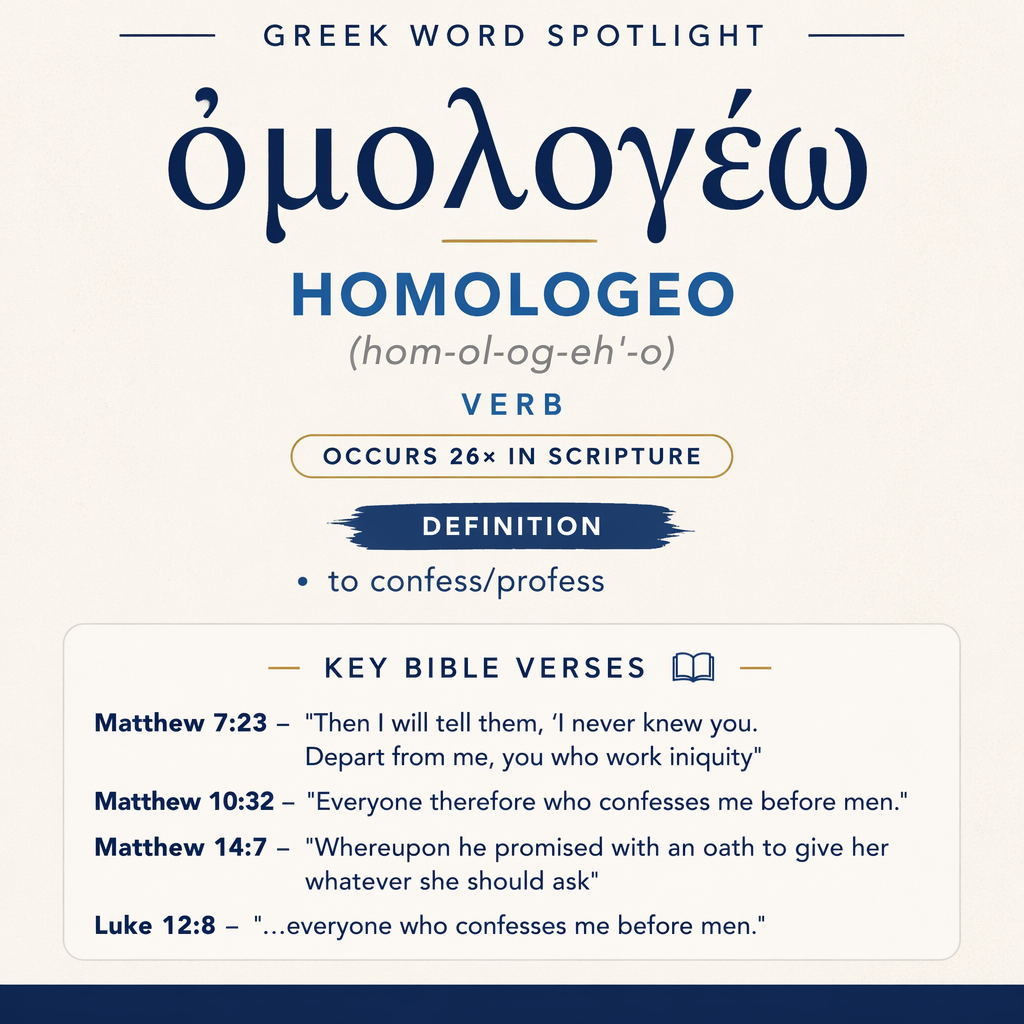
ὁμολογέω (Homologeo) means “to confess/profess” and occurs 26 times in Scripture, including Matthew 10:32, Luke 12:8, and John 1:20.
Core Meaning
ὁμολογέω is defined as “to confess/profess.” In the listed passages it is used for confessing or not confessing.
Learn More →Gospel Examples
In Matthew 10:32 and Luke 12:8, it describes confessing Jesus before others. John 1:20 uses it of John’s open declaration, “I am not the Christ.”
Learn More →Acts Mentions
ὁμολογέω appears in Acts 7:17 in the context of God’s sworn promise to Abraham. The word is part of a statement about that promise drawing near.
Learn More →ὁμολογέω expresses the act of confessing or professing, whether as a public acknowledgment, a verbal declaration, or an open alignment with a claim. In the passages below it appears in sayings of Jesus, in narrative scenes where speech carries consequences, and in apostolic testimony where confession is tied to belief and identity.
Occurrences
Matthew 7:23 — Then I will tell them, ‘I never knew you. Depart from me, you who work iniquity.’
Here ὁμολογέω frames a decisive, spoken response from Jesus: he “will tell them.” In the scene’s logic, verbal profession is not a neutral act; it is an utterance that exposes relationship (“I never knew you”) and issues a verdict (“Depart from me”). The force of the verb lies in an authoritative, public declaration that clarifies standing and separates those addressed from the speaker.

Matthew 10:32 — Everyone therefore who confesses me before men, I will also confess him before my Father who is in heaven.
ὁμολογέω marks reciprocal confession: a person “confesses” Jesus “before men,” and Jesus in turn “will also confess him” in the heavenly court. The verse places confession in the arena of witnesses (“before men”) and sets it in parallel with a corresponding profession “before my Father who is in heaven.” The verb thus carries the weight of open identification, not merely private agreement.
Matthew 14:7 — Whereupon he promised with an oath to give her whatever she should ask.
In this narrative moment, ὁμολογέω functions as a pledged verbal commitment: a promise “with an oath.” The stress falls on speech that binds the speaker, making a public commitment that can be invoked (“to give her whatever she should ask”). Confession/profession here operates in the register of sworn declaration rather than doctrinal acknowledgment.
Luke 12:8 — “I tell you, everyone who confesses me before men, the Son of Man will also confess before the angels of God;
This saying mirrors the dynamic found in Matthew: confession “before men” is answered by confession “before the angels of God.” ὁμολογέω highlights the public, accountable character of profession—speech made in a human setting is echoed in a heavenly setting. The verb’s contribution is to set confession as an act that carries across audiences, from earthly observers to celestial witnesses.
John 1:20 — He declared, and didn’t deny, but he declared, “I am not the Christ.”
ὁμολογέω appears here in a tightly structured statement about speaking plainly: “He declared, and didn’t deny, but he declared.” The repeated emphasis on forthright declaration frames the content (“I am not the Christ”) as a clear confession. The verb contributes the idea of an unambiguous, accountable profession—speech that refuses evasion and is set against denial.
John 9:22 — His parents said these things because they feared the Jews; for the Jews had already agreed that if any man would confess him as Christ, he would be put out of the synagogue.
ὁμολογέω is placed in a context of social pressure and consequence: to “confess him as Christ” triggers exclusion (“put out of the synagogue”). Confession is portrayed as an identifiable act—something others can recognize and act upon. The verse shows confession/profession as costly public acknowledgment, with communal penalties attached to the spoken alignment.
John 12:42 — Nevertheless even many of the rulers believed in him, but because of the Pharisees they didn’t confess it, so that they wouldn’t be put out of the synagogue,
This occurrence sets inward belief alongside outward confession: “many of the rulers believed in him,” yet “they didn’t confess it.” ὁμολογέω marks the externalizing step they avoid, and the motive is explicit: fear of exclusion (“so that they wouldn’t be put out of the synagogue”). The verb thus signals the transition from private conviction to public profession, and how that transition may be restrained by social cost.
Acts 7:17 — “But as the time of the promise came close which God had sworn to Abraham, the people grew and multiplied in Egypt,
In this speech, ὁμολογέω relates to a sworn promise: God “had sworn to Abraham.” The verb supports the idea of solemnly professed commitment, expressed through oath language and remembered as a defining point in the community’s story. Confession/profession here is not an admission of fault but an affirmed pledge that anchors expectation.
Acts 23:8 — For the Sadducees say that there is no resurrection, nor angel, nor spirit; but the Pharisees confess all of these.
ὁμολογέω functions as a marker of stated doctrinal alignment within a dispute: one group “say[s]” certain realities are absent, while another group “confess[es] all of these.” The verb contributes the notion of open affirmation—publicly professing a set of claims (“resurrection,” “angel,” “spirit”) as part of group identity and debate.
Acts 24:14 — But this I confess to you, that after the Way, which they call a sect, so I serve the God of our fathers, believing all things which are according to the law, and which are written in the prophets;
Here ὁμολογέω introduces Paul’s personal testimony in a legal setting: “this I confess to you.” The confession is not framed as shameful but as direct acknowledgment of allegiance and practice—“after the Way… so I serve the God of our fathers,” coupled with stated belief. The verb highlights candor and ownership: Paul openly professes the path he follows and the content he believes, even while noting how others label it (“which they call a sect”).
Romans 10:9 — that if you will confess with your mouth that Jesus is Lord, and believe in your heart that God raised him from the dead, you will be saved.
ὁμολογέω is explicitly connected to spoken words: “confess with your mouth.” The content of the confession is given (“that Jesus is Lord”), and it is paired with heart-belief about God raising him from the dead. The verse presents confession as articulated profession, not merely internal assent, and places it alongside belief as part of the stated path to salvation.
Romans 10:10 — For with the heart, one believes resulting in righteousness; and with the mouth confession is made resulting in salvation.
This line reinforces the mouth/heart pairing by turning confession into a stated outcome: “with the mouth confession is made resulting in salvation.” ὁμολογέω (and its noun idea expressed here as “confession”) is treated as a concrete act—something done with the mouth—linked to an effect (“resulting in salvation”). The verse clarifies how profession functions: it is the verbal counterpart to inward belief, each described in its own sphere (“heart,” “mouth”).

Sense and Usage
Across these passages, ὁμολογέω consistently involves confession/profession as an outward, accountable form of speech. Sometimes it is a declaration that defines relationship and destiny, as when Jesus speaks a final word of disowning and dismissal (Matthew 7:23). Sometimes it is reciprocal identification: public confession before human witnesses corresponds to confession in a heavenly setting, whether “before my Father who is in heaven” (Matthew 10:32) or “before the angels of God” (Luke 12:8). In these sayings, the verb presents profession as an act that places a person within a recognized network of witnesses and acknowledgments.
In John’s narrative scenes, ὁμολογέω highlights the clarity or restraint of human speech under pressure. John 1:20 depicts forthright declaration set against denial: the speaker “declared, and didn’t deny,” making confession the mode of honest public speech. John 9:22 and John 12:42 develop a social dimension: confession “as Christ” is not merely a statement of opinion but an act with communal consequences—being “put out of the synagogue.” The verb therefore can function as a threshold between private belief and public identification, and those texts illustrate how fear of consequence can prevent profession even where belief exists.
In Acts, ὁμολογέω can denote open affirmation in contested settings. Acts 23:8 uses it for a group’s stated position in theological dispute, where “confess” contrasts with the opposing “say.” Acts 24:14 uses it for personal testimony under accusation: confession is candid ownership of one’s way of life and convictions, expressed directly to an authority. Alongside these, oath language (Matthew 14:7; Acts 7:17) shows the verb operating in the realm of pledged commitment, where words bind the speaker and define expectation.
Romans 10:9–10 ties confession to embodied speech: “with your mouth,” “with the mouth.” Here profession is not left vague; the confession has specified content (“that Jesus is Lord”) and is paired with heart-belief. These verses present confession as the outward articulation that corresponds to inward trust, each described as producing an outcome (“resulting in righteousness… resulting in salvation”). In this cluster, ὁμολογέω functions as a public, verbal owning of a claim, not as mere internal agreement.
Imagery
The passages attach ὁμολογέω to scenes where words are heard by others and carry real effects: courts and councils where parties take positions (Acts 23:8; Acts 24:14), communal boundaries that can exclude (John 9:22; John 12:42), and heavenly audiences where earthly confession is echoed (Matthew 10:32; Luke 12:8). Even where the setting is as personal as “with your mouth” (Romans 10:9–10), confession is portrayed as speech that steps into the open, making allegiance and belief audible and answerable.
Sources: Lexical data from Strong’s Exhaustive Concordance and the Translators Brief Lexicon of Extended Strongs for Greek (STEPBible, CC BY). Occurrence data from the Translators Amalgamated Greek New Testament (STEPBible, CC BY). Scripture quotations from the World English Bible (public domain).