Exploring the Meaning of Nike in Greek
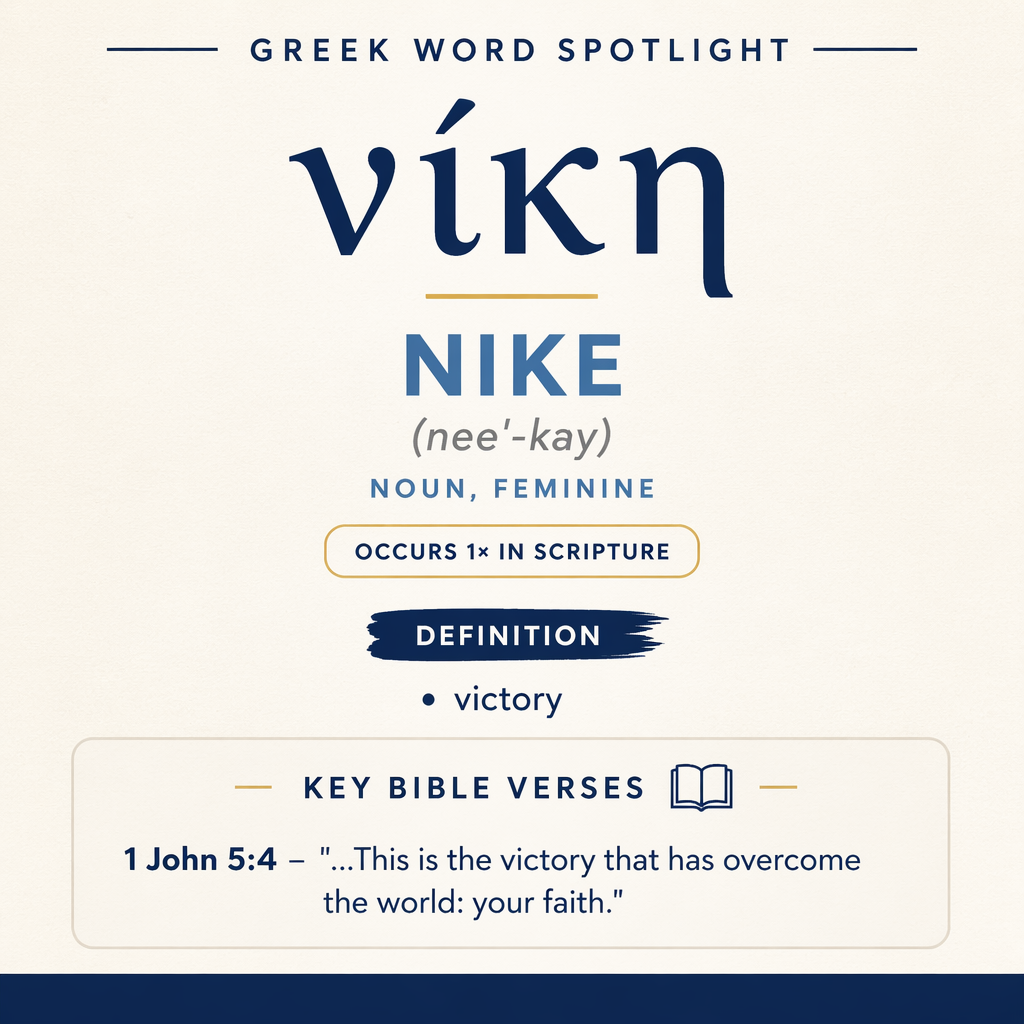
νίκη means “victory” and appears once in Scripture, in 1 John 5:4.
Verse Context
In 1 John 5:4, νίκη identifies “the victory” that has overcome the world. The verse names this victory as “your faith.”
Learn More →νίκη means “victory” and appears in the New Testament in 1 John 5:4. In its single attestation it names the decisive result of overcoming, and it is framed as something already accomplished.
Occurrences
“For whatever is born of God overcomes the world. This is the victory that has overcome the world: your faith.” (1 John 5:4)
In this sentence, νίκη functions as a label for the successful outcome of a conflict described with the verb “overcomes.” The verse first states a general claim—“whatever is born of God overcomes the world”—and then identifies what that overcoming amounts to: “This is the victory that has overcome the world: your faith.” By naming “victory,” the author is not merely repeating the idea of overcoming; the noun turns the action into a concrete, identifiable result that can be pointed to (“This is…”). It gathers the preceding claim into a single, stable term: the overcoming is not presented as uncertain or partial but as a completed achievement.
The clause “that has overcome the world” attaches victory to an already-realized overcoming. The “world” is the object being overcome in both clauses, so νίκη stands in close parallel to the overcoming itself, but with a slightly different emphasis: “overcomes” describes what happens; “victory” names what that happening is, viewed from its successful end. The final apposition, “your faith,” ties the victory to a specific reality in the community being addressed. In this context, νίκη is not an abstract trophy detached from the struggle; it is directly associated with “your faith” as the identifiable feature through which the overcoming is spoken of as victory.

Sense and Usage
The sense of νίκη (“victory”) in 1 John 5:4 is shaped by two surrounding features in the verse: (1) the repeated language of overcoming, and (2) the way victory is pointed out and defined. The verse moves from a broad statement (“whatever is born of God overcomes the world”) to a clarifying identification (“This is the victory…”). That structure shows νίκη operating as a summarizing noun: it gathers up the claim about overcoming into a named outcome that can be recognized and affirmed.
Because νίκη appears with the phrase “that has overcome the world,” it is presented as effective victory—victory that is not merely hoped for, but described as having already done what victory does in this verse: overcome. The text thus speaks of victory in a way that is inherently connected to action and result. The victory is not portrayed as a separate entity alongside overcoming; rather, it is victory precisely as the successful overcoming of “the world.”
The demonstrative phrasing “This is the victory…” gives νίκη a defining, almost explanatory role. The author does not leave the word as a vague concept; the sentence immediately anchors it in “your faith.” This connection makes νίκη a term with a distinct referent in the author’s argument. “Your faith” is placed as the identifying content of “the victory,” so the noun functions as a headline under which the author places a concrete designation. In this usage, νίκη is not introduced as a general ideal but as something that can be directly indicated to the audience as belonging to them (“your”).
Within the verse’s logic, νίκη also provides a way to speak about overcoming without focusing on the process or duration of struggle. The verb “overcomes” can evoke ongoing contest, but “victory” naturally directs attention to the decisive outcome. The author’s choice to say “This is the victory…” after stating that what is born of God overcomes the world gives the statement a settled tone: the overcoming is construed as something with a determinate end, and νίκη is the term that names that end. The effect is to present overcoming not as a fragile achievement but as something that can be described with the completed identity of victory.
Finally, νίκη in this verse is framed as communal and possessive: “your faith.” The victory is not described as belonging to a distant champion, nor is it attributed to an impersonal force; it is spoken of in relation to those addressed. The noun “victory” thus participates in the verse’s pastoral assurance by making the overcoming of the world speakable as a recognized reality, defined for the hearers in the form of “your faith.”
Imagery
The verse’s imagery is that of contest and triumph, expressed in the simple opposition between overcoming and “the world.” νίκη supplies the picture’s finishing stroke: it is the named outcome of the overcoming, the settled result that stands when the contest is spoken of as concluded—“the victory that has overcome the world.”
Sources: Lexical data from Strong’s Exhaustive Concordance and the Translators Brief Lexicon of Extended Strongs for Greek (STEPBible, CC BY). Occurrence data from the Translators Amalgamated Greek New Testament (STEPBible, CC BY). Scripture quotations from the World English Bible (public domain).