Exploring the Meaning of Nestis in Greek
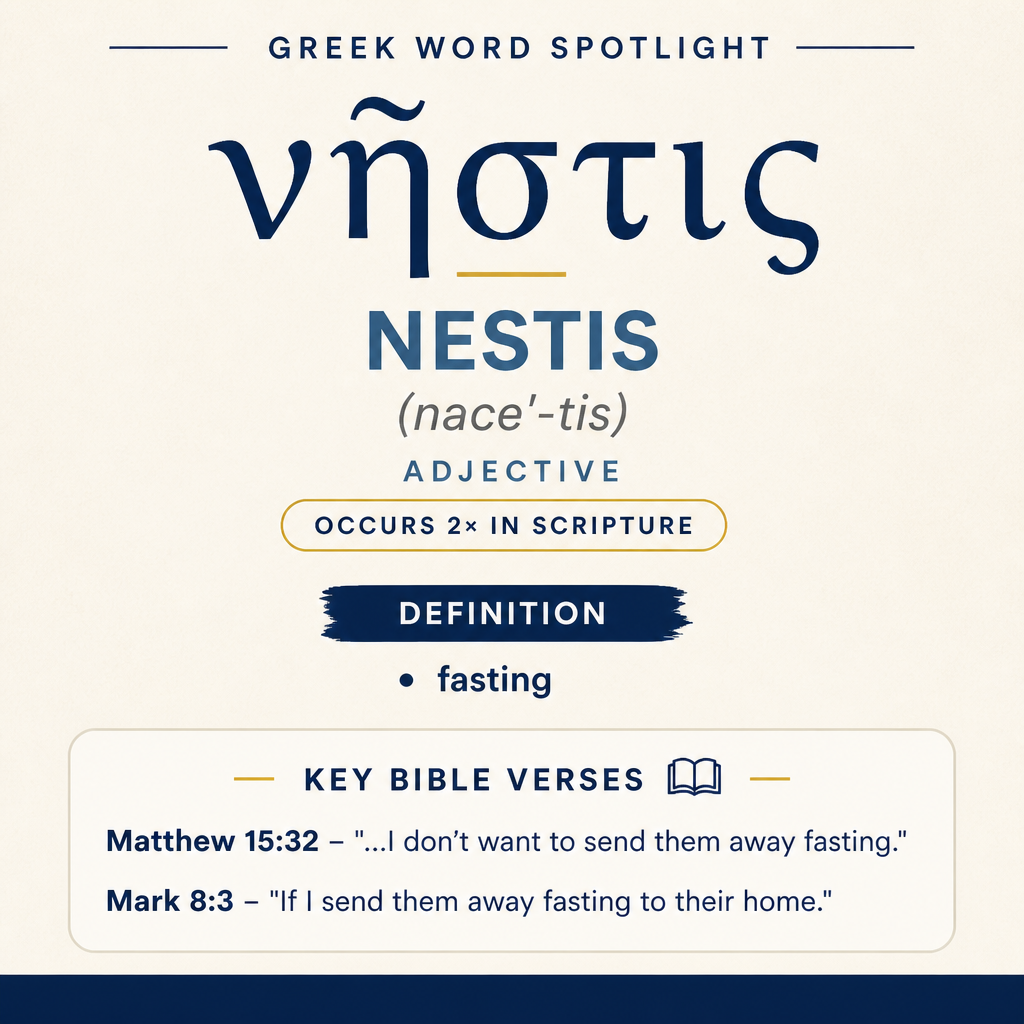
νῆστις (Nestis) means “fasting” and appears twice in Scripture: Matthew 15:32 and Mark 8:3.
Scripture Occurrences
This word occurs 2 times in Scripture. The references are Matthew 15:32 and Mark 8:3.
Learn More →Context in Gospels
In Mark 8:3, Jesus warns that sending people away fasting could cause them to faint on the way. In Matthew 15:32, Jesus notes the multitude has continued with him three days.
Learn More →νῆστις describes the condition of being “fasting,” and it appears in two closely parallel sayings of Jesus about sending hungry crowds away. In both scenes, the word marks the people’s state as they would begin their journey home without food.
Root and Related Words
νῆστις is related to esthio (ἐσθίω), “to eat” (Strong’s G2068). This link helps frame the adjective in terms of food intake: the word choice in the Gospels places attention on the absence of eating in a concrete, bodily situation.
Occurrences
Matthew 15:32: Jesus summoned his disciples and said, “I have compassion on the multitude, because they continue with me now three days and have nothing to eat. I don’t want to send them away fasting, or they might faint on the way.”
Here νῆστις belongs to Jesus’ stated concern for “the multitude.” The crowd’s need is described in plain physical terms: they have stayed with him “three days” and now “have nothing to eat.” Within that setting, “send them away fasting” presents not merely an empty stomach at a single moment but a condition that would extend into travel—leaving the place of gathering and starting “on the way” without having eaten. The word thus functions as a practical qualifier of the sending: the question is not only whether to dismiss the people, but whether to dismiss them while in a state characterized by not eating. Jesus connects that condition directly to a foreseeable outcome: “or they might faint on the way.” νῆστις, in this sentence, serves to highlight vulnerability and risk; it names the bodily state that makes collapse plausible during the journey.
The placement of νῆστις also sharpens the tone of compassion. Jesus does not speak abstractly of hardship; he specifies a scenario in which the people’s present lack (“nothing to eat”) would become an ongoing deprivation if they are sent away in that condition. The adjective therefore helps communicate that the concern is immediate and concrete, rooted in the realities of hunger, distance, and fatigue implied by travel.

Mark 8:3: If I send them away fasting to their home, they will faint on the way, for some of them have come a long way.”
Mark’s parallel presents νῆστις in a conditional statement: “If I send them away fasting to their home.” The word again modifies the act of sending, setting the condition under which the dismissal would occur. The destination “to their home” adds specificity: the issue is not simply leaving the gathering, but reaching a place of safety and provision. In this scene νῆστις marks the critical factor that threatens that outcome. The result is stated with certainty: “they will faint on the way.” Whereas Matthew phrases the danger as something that “might” happen, Mark’s wording presents it as the predictable consequence of sending them in that state.
Mark also supplies an additional reason: “for some of them have come a long way.” That travel detail gives νῆστις a wider physical horizon. The adjective describes the state at the start of the return journey, and the “long way” implies sustained exertion and time before reaching food or rest. In that context, “fasting” is not a private or hidden status; it is a condition with public, observable effects in the group’s ability to make it home. νῆστις, as used here, becomes part of a chain of practical reasoning: long distance plus lack of eating produces weakness, and weakness on the road leads to fainting.
Sense and Usage
Across these two occurrences, νῆστις operates as a situational descriptor tied to hunger and travel. The word does not appear as a general label for a religious practice or an inner discipline within these sayings; rather, it functions as an adjective that characterizes the crowd’s outward condition at a particular moment—specifically, the state in which they would be dismissed from Jesus’ presence and sent toward home. The repeated pairing with “on the way” keeps the sense grounded in movement and distance: “fasting” is the condition that accompanies the journey and shapes what may happen during it.
In both passages, νῆστις is closely linked with the immediate absence of food. Matthew states plainly that the crowd “have nothing to eat,” and Jesus’ concern is that they not be sent away “fasting.” Mark assumes the same situation and adds the pressing detail that some “have come a long way.” In this usage, νῆστις marks more than a momentary emptiness; it identifies a state that can persist and intensify during travel, exposing people to physical collapse. The adjective therefore carries a concrete, bodily nuance in these contexts: it evokes weakness that follows from not eating, and it supports the logic behind Jesus’ decision-making about the crowd’s welfare.
The word’s placement in Jesus’ speech also shows how it can frame compassion in practical terms. Compassion is expressed not only by noticing need but by refusing to take an action that would prolong or worsen that need. By naming the condition—sending them away “fasting”—Jesus defines the specific harm he intends to prevent. νῆστις thus contributes to the narrative by turning a general concern for people into an explicit description of a risky situation: hungry people starting a journey without food.
Imagery
In Matthew and Mark, νῆστις carries the imagery of a road begun on an empty stomach. The word sits beside phrases like “on the way,” “to their home,” and “a long way,” so the picture is of ordinary travelers whose strength is threatened by a lack of food. In that setting, “fasting” is not an abstract idea; it is a condition that can cause bodies to fail before the destination is reached.
Sources: Lexical data from Strong’s Exhaustive Concordance and the Translators Brief Lexicon of Extended Strongs for Greek (STEPBible, CC BY). Occurrence data from the Translators Amalgamated Greek New Testament (STEPBible, CC BY). Scripture quotations from the World English Bible (public domain).