Exploring the Meaning of Nesteuo in Greek
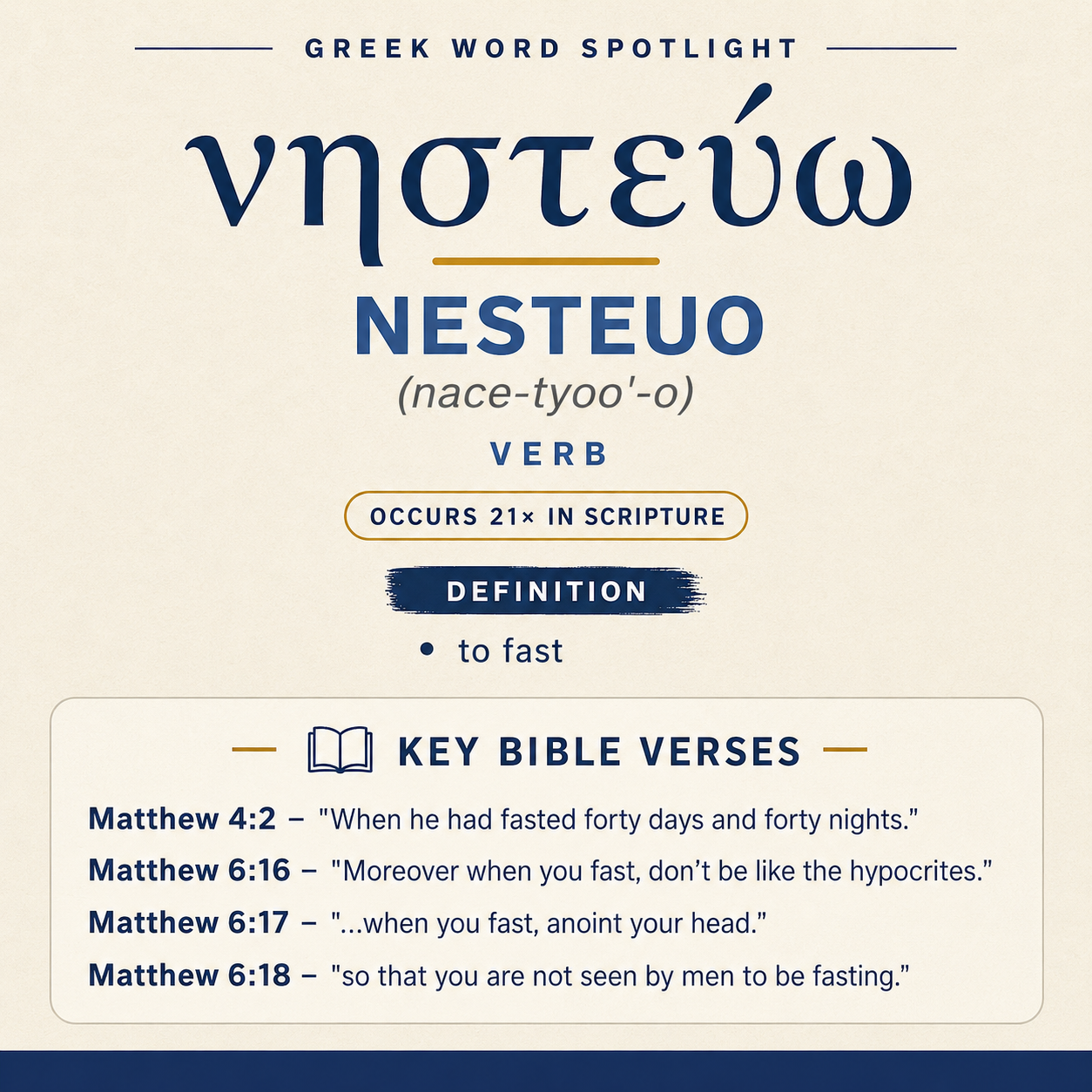
νηστεύω (Nesteuo) means “to fast” and appears 21 times in Scripture, including in Matthew 4:2 and Matthew 6:16–18.
Core Meaning
νηστεύω means “to fast.” In Matthew 4:2 it describes fasting for forty days and forty nights.
Learn More →Jesus’ Teaching
In Matthew 6:16–18, Jesus addresses how to fast without seeking to be seen by others. He instructs fasting with ordinary outward appearance.
Learn More →Questions About Fasting
In Matthew 9:14–15 and Mark 2:18–19, people ask why Jesus’ disciples do not fast like others. Jesus replies with the bridegroom illustration.
Learn More →νηστεύω means “to fast,” describing abstaining from food in settings of testing, devotion, or communal religious practice. In the passages where it appears, it is set alongside hunger, outward appearance, prayer, and the timing of joy or mourning.
Occurrences
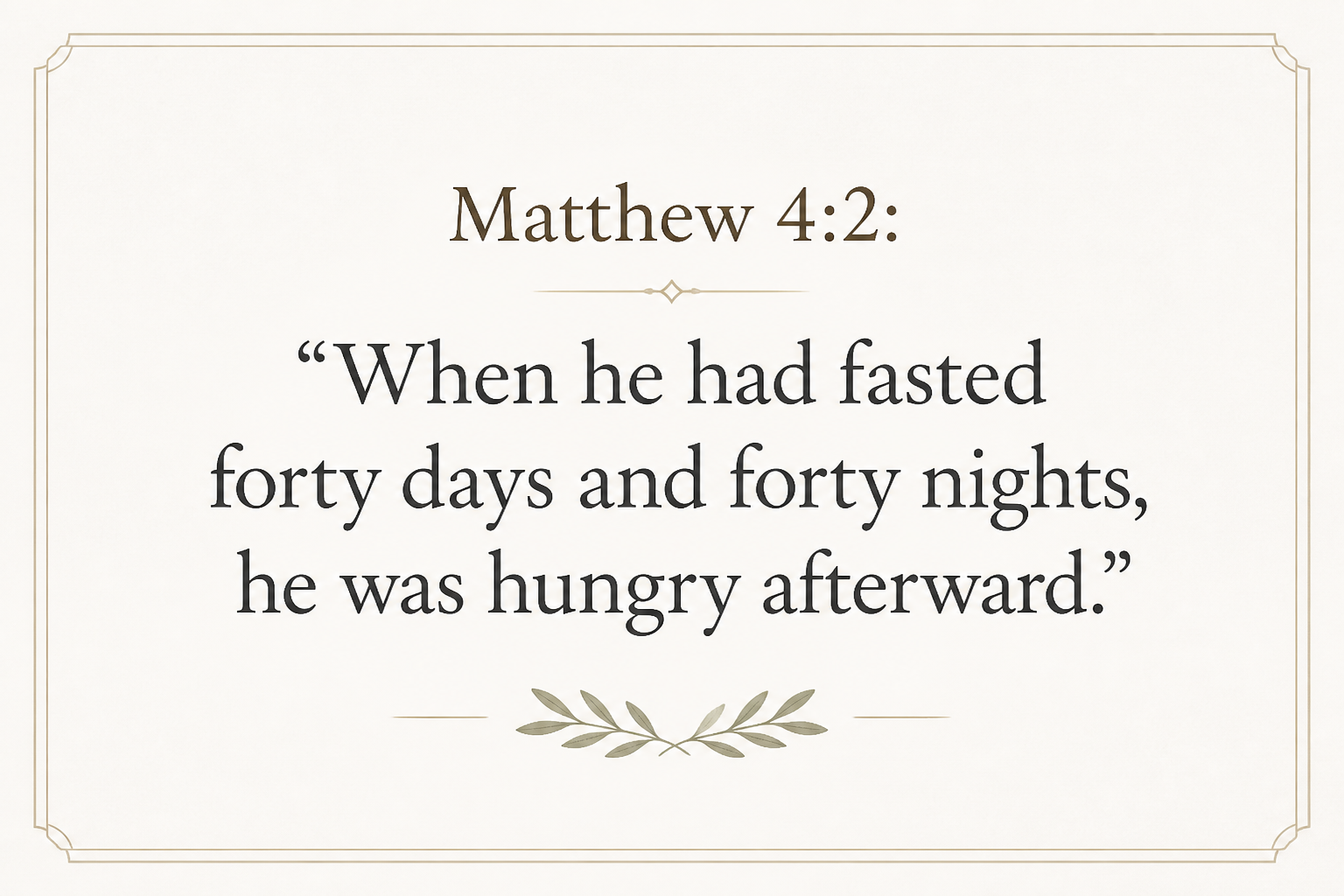
Matthew 4:2: “When he had fasted forty days and forty nights, he was hungry afterward.”
Here νηστεύω is linked directly to physical consequence: after the period of fasting, hunger follows. The duration (“forty days and forty nights”) frames the fasting as sustained and demanding, and the statement “he was hungry afterward” keeps the action concrete and bodily.
Matthew 6:16: “Moreover when you fast, don’t be like the hypocrites, with sad faces. For they disfigure their faces, that they may be seen by men to be fasting. Most certainly I tell you, they have received their reward.”
In this saying, νηστεύω is treated as a recognizable religious act that can be performed with an audience in mind. The fasting itself is not denied; instead, the scene critiques a manner of fasting marked by “sad faces” and “disfigure[d]” appearance, aimed at being “seen by men.” The verb thus sits at the center of a contrast between the act and the motive for displaying it.
Matthew 6:17: “But you, when you fast, anoint your head, and wash your face;”
Here νηστεύω is assumed as a practice (“when you fast”) and is paired with ordinary grooming: anointing the head and washing the face. The instruction positions fasting as something that need not advertise itself through neglect or visible gloom.
Matthew 6:18: “so that you are not seen by men to be fasting, but by your Father who is in secret, and your Father, who sees in secret, will reward you.”
This continuation focuses on visibility. Fasting can be “seen by men” or carried out “in secret” before “your Father who is in secret.” νηστεύω is therefore framed as an action whose value, in this teaching, is connected to hiddenness rather than public recognition, and the promised “reward” is tied to the Father’s seeing.
Matthew 9:14: “Then John’s disciples came to him, saying, “Why do we and the Pharisees fast often, but your disciples don’t fast?””
In this question, νηστεύω is presented as an established pattern among identifiable groups: “we and the Pharisees fast often.” The frequency (“often”) and the comparison (“but your disciples don’t”) make fasting a marker of religious routine and group identity, something expected enough to provoke inquiry when absent.
Matthew 9:15: “Jesus said to them, “Can the friends of the bridegroom mourn, as long as the bridegroom is with them? But the days will come when the bridegroom will be taken away from them, and then they will fast.”
Here νηστεύω is placed in a time-based analogy. The presence of the bridegroom corresponds to a time when “friends… mourn” is unfitting; the removal of the bridegroom introduces a future period when fasting becomes appropriate: “then they will fast.” The verb is tied to a shift in circumstance, from presence to absence, and from celebration-like imagery to a posture closer to mourning.
Mark 2:18: “John’s disciples and the Pharisees were fasting, and they came and asked him, “Why do John’s disciples and the disciples of the Pharisees fast, but your disciples don’t fast?””
This narrative depiction shows fasting in progress: certain groups “were fasting.” The question again treats νηστεύω as a normal devotional behavior for those groups, and the contrast with Jesus’ disciples repeats the theme that fasting can be socially noticeable—observable enough to ground a challenge.
Mark 2:19: “Jesus said to them, “Can the groomsmen fast while the bridegroom is with them? As long as they have the bridegroom with them, they can’t fast.”
In Mark’s form of the saying, νηστεύω is contrasted with the social reality of being with the bridegroom. “They can’t fast” is not a statement about ability in general but about suitability “as long as they have the bridegroom.” The verb marks a practice regarded as incompatible with the present occasion.
Mark 2:20: “But the days will come when the bridegroom will be taken away from them, and then they will fast in that day.”
This line repeats the future orientation: a change (“will be taken away”) leads to fasting. The added phrase “in that day” gives the fasting a defined time of onset, emphasizing that νηστεύω is responsive to an event and its aftermath.
Luke 5:33: “They said to him, “Why do John’s disciples often fast and pray, likewise also the disciples of the Pharisees, but yours eat and drink?””
Luke pairs νηστεύω with another devotional practice: “fast and pray.” The contrast is sharpened by the description of Jesus’ disciples as those who “eat and drink.” Fasting is thus depicted not merely as abstention but as part of a recognizable lifestyle of piety, set opposite ordinary table practice in this dispute.
Luke 5:34: “He said to them, “Can you make the friends of the bridegroom fast while the bridegroom is with them?”
Here the focus falls on imposing fasting: “Can you make… fast…?” νηστεύω is something that might be demanded or expected, yet Jesus frames such expectation as unsuitable during the bridegroom’s presence. The verb functions as a test case for what kind of behavior fits the moment.
Luke 5:35: “But the days will come when the bridegroom will be taken away from them. Then they will fast in those days.”
Luke concludes the triad by locating fasting explicitly in the period after the bridegroom is removed: “in those days.” νηστεύω becomes a future practice tied to the community’s experience of absence, not a perpetual requirement applied without regard to time.

Sense and Usage
Across these passages, νηστεύω consistently names the concrete act of fasting, yet its narrative and instructional settings show several dimensions of how the act functions. First, fasting is bodily and measurable. Matthew 4:2 connects it to a specified duration and to hunger, anchoring the verb in physical experience rather than treating it as a merely inward posture.
Second, fasting is socially legible. In Matthew 6:16–18, the act can be made visible through facial expression and deliberate “disfigure[ment],” and it can also be concealed through ordinary grooming so that one is “not seen by men.” Mark 2:18 assumes that observers can tell that certain groups “were fasting,” and in the question scenes (Matthew 9:14; Mark 2:18; Luke 5:33) the presence or absence of fasting becomes a basis for evaluating a group’s religious seriousness.
Third, fasting is treated as a practice with an intended direction of attention and reward. Matthew 6:18 frames fasting as conducted before “your Father who is in secret,” shifting the axis away from human spectatorship. In this presentation, the verb can name the same outward behavior, but its significance is reshaped by whether it is performed for human notice or oriented toward the Father who “sees in secret.”
Fourth, fasting is timed. The bridegroom sayings (Matthew 9:15; Mark 2:19–20; Luke 5:34–35) repeatedly connect νηστεύω to the movement from presence to absence: “the days will come… then they will fast.” The verb is not treated as an always-on marker of devotion, but as an action that belongs to particular “days,” defined by a communal circumstance. Within the imagery of bridegroom and friends/groomsmen, fasting is set alongside mourning language (“mourn”) and set against a period when fasting “can’t” fit because the bridegroom is present.
Finally, Luke 5:33 shows fasting appearing in a paired rhythm with prayer (“fast and pray”), suggesting that νηστεύω can be part of a broader devotional pattern. Yet even there, the dispute is not about whether fasting exists as a pious practice, but about why Jesus’ disciples are characterized by “eat and drink” in the present moment.
Imagery and Contrast
These scenes give fasting a set of vivid contrasts: hunger after long abstention (Matthew 4:2), altered or unaltered appearance (Matthew 6:16–18), and tables where some “eat and drink” while others “fast and pray” (Luke 5:33). Over that practical imagery stands a repeated wedding picture in which the suitability of fasting turns on whether the bridegroom is present or “taken away” (Matthew 9:15; Mark 2:19–20; Luke 5:34–35). In this cluster, νηστεύω becomes a way of naming a communal response that fits certain days and not others.
Sources: Lexical data from Strong’s Exhaustive Concordance and the Translators Brief Lexicon of Extended Strongs for Greek (STEPBible, CC BY). Occurrence data from the Translators Amalgamated Greek New Testament (STEPBible, CC BY). Scripture quotations from the World English Bible (public domain).