
Exploring the Meaning of Nesos in Greek
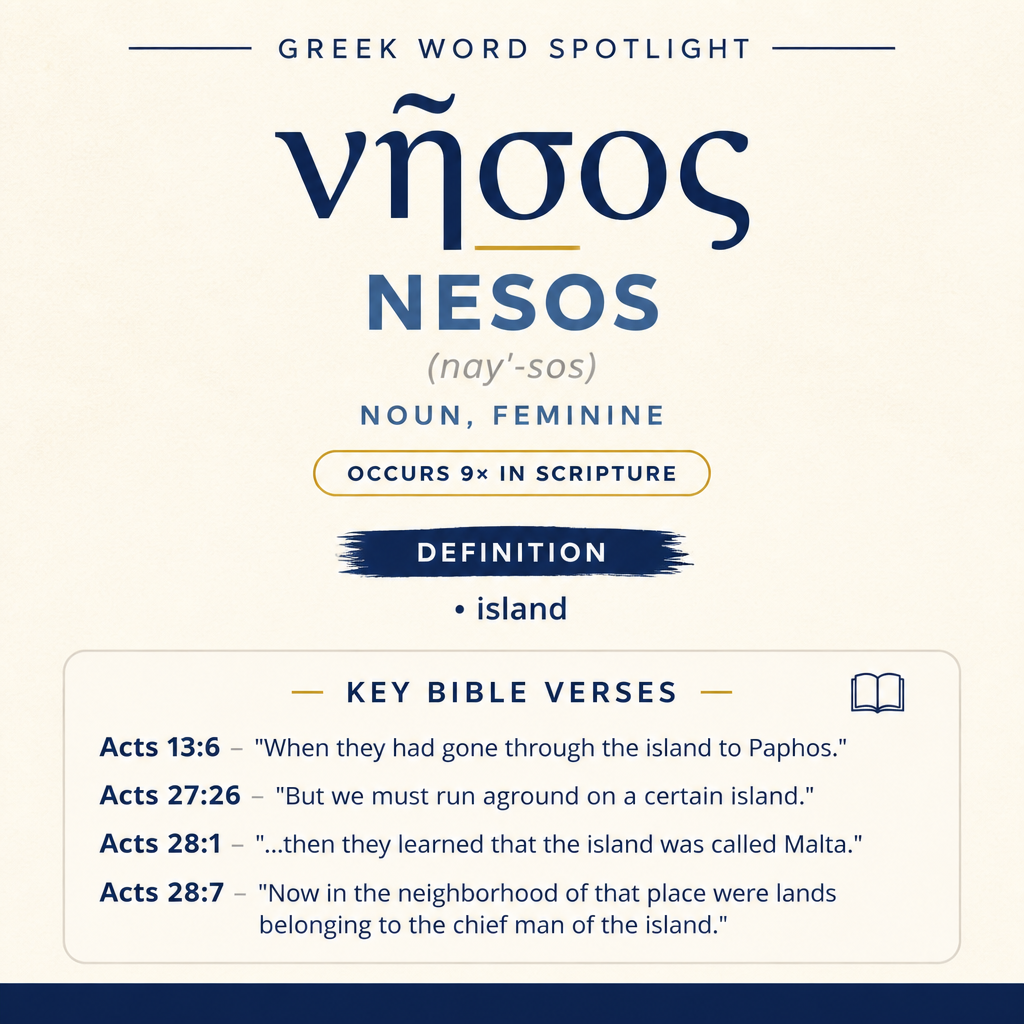
νῆσος means “island” and appears nine times in Scripture, notably in Acts (13, 27–28) and Revelation (1, 6).
Acts Context
In Acts it describes travel and events on islands, including Malta (Acts 28:1).
Learn More →Revelation Usage
In Revelation it appears in John’s exile on an island (Revelation 1:9) and in a cosmic scene where islands are moved (Revelation 6:14).
Learn More →νῆσος names an “island,” a bounded piece of land set off by surrounding waters. In the passages where it appears, it anchors travel routes and shipwreck narrative in Acts and contributes to the cosmic geography of Revelation.
Occurrences
Acts 13:6 — “When they had gone through the island to Paphos, they found a certain sorcerer, a false prophet, a Jew, whose name was Bar Jesus,”
Here νῆσος frames the mission’s movement as traversal of an island’s interior: they go “through the island” with a destination “to Paphos.” The word supplies the setting’s physical limits and cohesion—an island as a single traversable space—so that the encounter with “a certain sorcerer” is located within a defined landmass rather than an open-ended region.
Acts 27:26 — “But we must run aground on a certain island.”
In the midst of sea travel, νῆσος functions as a concrete point of contact with land. The phrasing “a certain island” highlights specificity without naming it; the island is the necessary endpoint of “run aground,” the place where uncontrolled sea movement meets a fixed boundary.
Acts 28:1 — “When we had escaped, then they learned that the island was called Malta.”
νῆσος marks the landfall that follows escape, and the narrative moves from survival to identification: the island “was called Malta.” The island is not merely scenery; it becomes a known location with a name, turning an anonymous “certain island” into a recognized place that can host the next events.
Acts 28:7 — “Now in the neighborhood of that place were lands belonging to the chief man of the island, named Publius, who received us, and courteously entertained us for three days.”
Here νῆσος defines a sphere of local authority: Publius is “the chief man of the island.” The word connects geography to social structure—leadership and landholdings are described in relation to the island as the relevant territory. “Lands” in the “neighborhood” are understood as part of the island’s organized space, where hospitality can be extended to shipwrecked strangers.
Acts 28:9 — “Then when this was done, the rest also who had diseases in the island came and were cured.”
νῆσος gathers a dispersed population into a single community of need: “the rest also who had diseases in the island.” The island’s boundedness makes “the rest” meaningful—those across the island, not only near Publius, are drawn into the same place of healing. The word gives scale to the response: the cures become an island-wide event.
Acts 28:11 — “After three months, we set sail in a ship of Alexandria which had wintered in the island, whose sign was “The Twin Brothers.””
In this sailing notice, νῆσος anchors a time of delay and refuge: the ship “had wintered in the island.” The island is the sheltering location where a vessel can remain through a season, and from which travel resumes. The word thus connects the narrative’s timing (“After three months”) with a concrete geographical haven.
Revelation 1:9 — “I John, your brother and partner with you in the oppression, Kingdom, and perseverance in Christ Jesus, was on the isle that is called Patmos because of God’s Word and the testimony of Jesus Christ.”
νῆσος provides the setting for the speaker’s location—“on the isle that is called Patmos”—and the clause that follows explains why he is there “because of God’s Word and the testimony of Jesus Christ.” The island functions as a defined, named place of separation from broader society, yet it is also the place from which testimony continues. The concreteness of “isle” and the naming of Patmos ground the book’s voice in a particular geography.
Revelation 6:14 — “The sky was removed like a scroll when it is rolled up. Every mountain and island were moved out of their places.”
Here νῆσος appears in a pair—“Every mountain and island”—as part of a scene of massive displacement. Islands, normally fixed landmarks, are pictured as moved “out of their places,” contributing to the passage’s sense that the created order’s stable features are being rearranged. The word adds breadth: not only prominent landforms like mountains but also islands are affected.
Revelation 16:20 — “Every island fled away, and the mountains were not found.”
νῆσος again stands alongside mountains, but the imagery intensifies: “Every island fled away.” The verb choice portrays islands as if they could retreat, heightening the portrayal of upheaval. The island, a familiar sign of enduring geography amid the sea, becomes something that cannot be located—its very presence in the world’s map is undone in the scene.

Sense and Usage
Across these passages, νῆσος keeps its straightforward geographical force: an island is a piece of land surrounded by water, identifiable as a distinct place. Acts uses the term in travel narrative where an island is experienced as a traversable region (“gone through the island”), a projected point of landfall (“run aground on a certain island”), and a named locale that supports ongoing action (“the island was called Malta”). The word helps the reader feel the shift from sea to land: the sea voyage’s uncertainty resolves into the stability of an island, which can be crossed, inhabited, governed, and used as a place to wait out a season.
Within Acts 28, νῆσος becomes a framework for community. It defines the scope of Publius’s role (“chief man of the island”) and the extent of the sick who come for help (“who had diseases in the island”). This is not merely a scenic label; it is the boundary that makes the social world coherent—lands, leadership, and population are all described with the island as their shared setting. Even the logistic note about a ship that “had wintered in the island” depends on the island’s function as a safe and stable place in contrast with the dangers that made running aground necessary in the first place.
Revelation uses νῆσος in two distinct but related ways. First, it provides a concrete location for the speaker (“on the isle that is called Patmos”), emphasizing that the testimony is voiced from an identifiable, bounded place. Second, it participates in scenes where the world’s landmarks are destabilized (“Every mountain and island were moved out of their places”; “Every island fled away”). In these visions, an island represents a fixed point in the natural order—land that stands over against the sea—so its movement or disappearance is a powerful marker of comprehensive disruption. The pairing with “mountains” underscores that what people commonly regard as most immovable is, in the vision, subject to being displaced or lost from sight.
Taken together, these uses show νῆσος operating at two scales: local and cosmic. Locally, islands are places one can cross, name, administer, inhabit, and depart from; cosmically, islands are part of the world’s stable geography whose removal signals that ordinary spatial expectations no longer hold. The word’s ordinary concreteness is precisely what gives weight to Revelation’s imagery: when even an island “fled away,” the reader is meant to feel the extent of the upheaval in terms of the most recognizable features of land and sea.
Imagery
νῆσος carries strong spatial imagery in these texts because islands are naturally bounded and easily visualized. Acts invites the reader to picture movement across an island toward a city, then later the relief of reaching an island after peril at sea, followed by the rhythms of island life—landholdings, leadership, illness, hospitality, and seasonal travel. Revelation draws on that same concreteness: a named island can be a place of isolation and testimony, and “every island” can also be swept into a scene where the world’s familiar map no longer stays put.
Sources: Lexical data from Strong’s Exhaustive Concordance and the Translators Brief Lexicon of Extended Strongs for Greek (STEPBible, CC BY). Occurrence data from the Translators Amalgamated Greek New Testament (STEPBible, CC BY). Scripture quotations from the World English Bible (public domain).





