Exploring the Meaning of Nesion in Greek
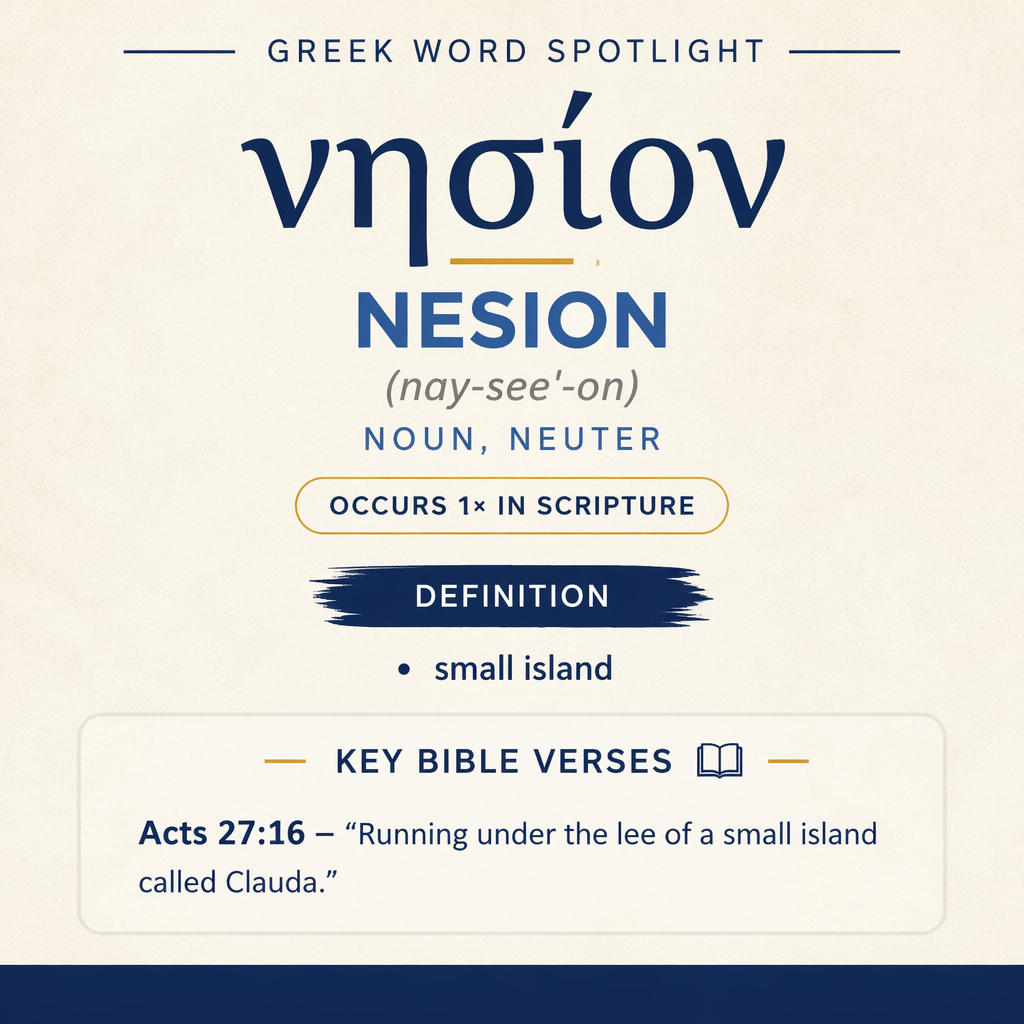
νησίον means “small island” and appears once in Scripture at Acts 27:16.
Context in Acts
In Acts 27:16, it refers to a small island called Clauda, under whose lee the crew secured the boat with difficulty.
Learn More →νησίον means “small island” and appears once in the New Testament, in the narrative of Paul’s storm-driven sea voyage. In its single context it names a specific geographic feature that provides momentary shelter and a crucial opportunity for action.
Root and Related Words
νησίον (Nesion) is derived from νῆσος (nesos), “island” (Strong’s G3520).

Occurrences
“Running under the lee of a small island called Clauda, we were able, with difficulty, to secure the boat.” (Acts 27:16)
Here νησίον identifies Clauda as a “small island” and frames it as a providentially useful feature in the sailors’ struggle. The sentence is packed with movement and constraint: “Running under the lee” describes a deliberate change of course to take advantage of shelter on the downwind side of land, and the small island is what makes that shelter possible in the first place. By calling Clauda a “small island,” the wording sets expectation about what it can and cannot offer: it is substantial enough to break the wind and sea to some degree (“under the lee”), yet it is not portrayed as a large destination with harbor facilities or extended refuge. Its role is tactical—an immediate, temporary respite amid ongoing danger.
The phrase “we were able, with difficulty, to secure the boat” ties the geographic detail directly to an urgent seamanship task. The “small island” is not scenery; it is the enabling circumstance for a hard-won bit of control. The narrative logic moves from location to capability: because the vessel is now under the island’s lee, “we were able” to do something that had been precarious or impossible in open water. Thus νησίον functions as a concrete pivot point in the episode: the crew’s encounter with Clauda marks a brief window in which action can be taken, though still “with difficulty,” underscoring that the sea remains threatening even in partial shelter.
Sense and Usage
In Acts 27:16, the sense “small island” is tied to scale and immediate navigational utility. The diminutive idea conveyed by “small” is not merely descriptive; it shapes how the reader imagines the ship’s relationship to the land. A small island presents a narrow piece of geography—enough to have a “lee,” enough to alter conditions locally, but not enough to resolve the voyage’s larger crisis. The term therefore supports the pacing of the storm narrative: the crew gains a limited advantage (shelter sufficient to work) rather than a full solution (shelter sufficient to end the peril).
The usage also shows how a “small island” can carry both specificity and function. Clauda is named, and the word places it in a category (“small island”) that is meaningful to sailors. The line does not linger on the island’s features; it concentrates on what the island does in the moment—create a lee that makes a difficult operation barely achievable. In this way, νησίον contributes a realistic maritime detail: in storm conditions, even modest landforms matter because they can reduce exposure and provide just enough relief for necessary work to be done.
The immediate collocation with “under the lee” reinforces that the word’s force is practical. The island is defined by the protection it can offer relative to wind and waves, and by the crew’s choice to “run” along a course that takes advantage of it. The text’s emphasis on effort (“with difficulty”) keeps the word from being romanticized; this is a hard, constrained shelter, not a calm anchorage. The “small island” is a momentary buffer between the crew and the full force of the storm, allowing them to “secure the boat” and continue the struggle.
Imagery
The lone occurrence paints a vivid maritime image: a ship slipping into the partial calm “under the lee” of a “small island,” with sailors straining at a critical task. The smallness of the island heightens the contrast between fragile human effort and the surrounding danger—an outcrop of land offering just enough cover for a difficult, necessary act before the voyage presses on.
Sources: Lexical data from Strong’s Exhaustive Concordance and the Translators Brief Lexicon of Extended Strongs for Greek (STEPBible, CC BY). Occurrence data from the Translators Amalgamated Greek New Testament (STEPBible, CC BY). Scripture quotations from the World English Bible (public domain).