
Exploring the Meaning of Neotes in Greek
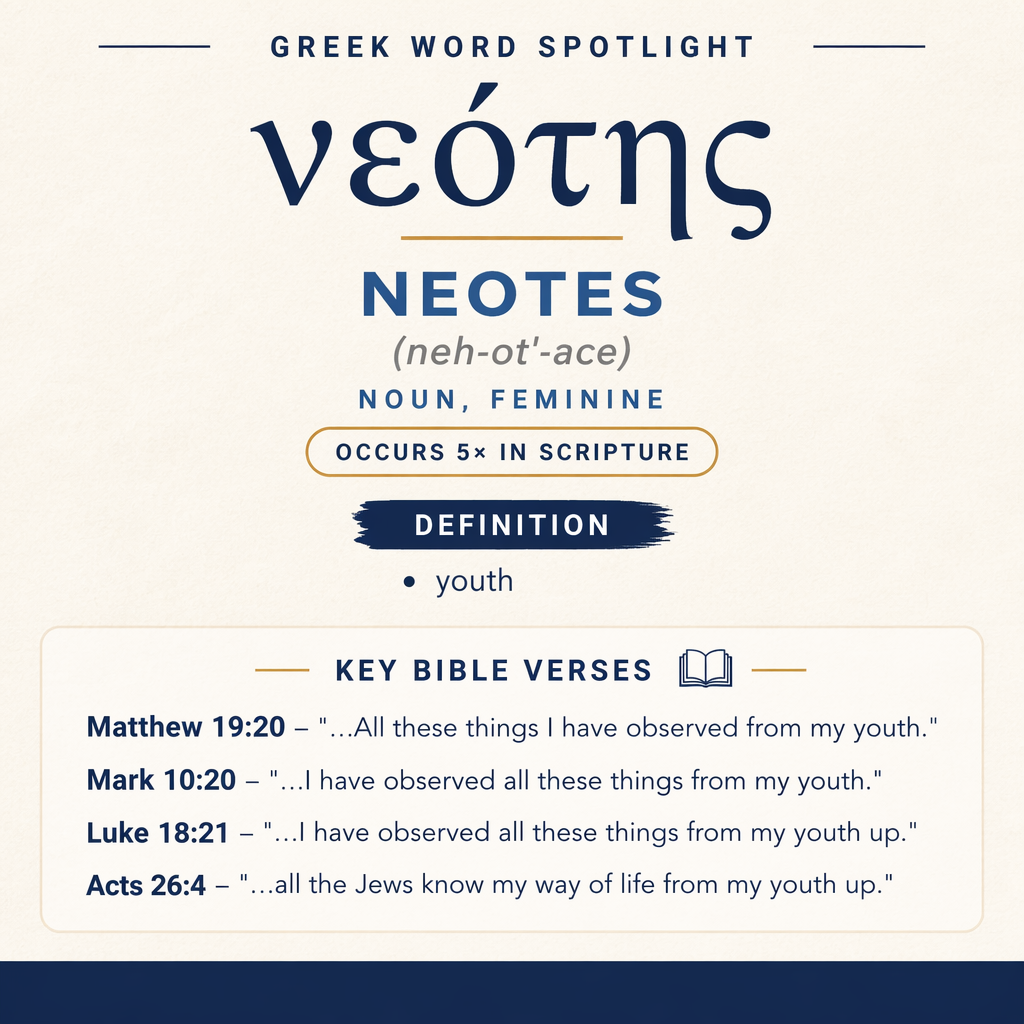
νεότης (Neotes) means “youth” and appears five times in Scripture: Matthew 19:20; Mark 10:20; Luke 18:21; Acts 26:4; 1 Timothy 4:12.
Core Meaning
νεότης means “youth.” It refers to one’s younger years or season of youth.
Learn More →Gospel Usage
In Matthew 19:20, Mark 10:20, and Luke 18:21, it appears in the phrase “from my youth,” describing lifelong observance from early life.
Learn More →Later References
In Acts 26:4 it describes a way of life “from my youth up.” In 1 Timothy 4:12 it is addressed directly: “Let no man despise your youth.”
Learn More →νεότης denotes “youth,” the season of life spoken of as one’s earlier years. It appears in Gospel accounts of a man describing his lifelong obedience and in two later settings where “youth” frames a public life and a public ministry.
Root and Related Words
νεότης derives from neos (νέος), “new” (Strong’s G3501).

Occurrences
Matthew 19:20: “The young man said to him, “All these things I have observed from my youth. What do I still lack?””
Here “from my youth” functions as a time-span marker for the young man’s claim. He points back to earlier years as the starting point of a pattern—“I have observed”—and places the weight of his question (“What do I still lack?”) on the idea that his obedience has been steady across the whole stretch of life he can meaningfully recount. νεότης anchors his self-description in continuity: what he is saying is not merely that he currently keeps these things, but that his practice has roots in the years identified as “youth.”
Mark 10:20: “He said to him, “Teacher, I have observed all these things from my youth.””
In Mark’s parallel scene, the wording is concise and emphatic. The address “Teacher” sets a respectful tone, and the phrase “from my youth” supplies the temporal depth behind the statement “I have observed all these things.” νεότης here gives the claim a long horizon: obedience is presented as beginning in earlier life and extending to the present moment of the conversation. The word serves to support the credibility and seriousness of the speaker’s assertion by rooting it in a remembered stage of life.
Luke 18:21: “He said, “I have observed all these things from my youth up.””
Luke adds the expression “up,” which pushes the sense toward an unbroken line from that early stage forward. In this reply, “I have observed all these things” is framed not as an occasional achievement but as a continuing biography. νεότης supplies the beginning point of that biography. The result is a claim about a life formed early: his present stance is portrayed as the outgrowth of commitments traced back to “youth,” and the phrase supports the completeness implied by “all these things.”
Acts 26:4: ““Indeed, all the Jews know my way of life from my youth up, which was from the beginning among my own nation and at Jerusalem;”
In Acts, “from my youth up” occurs within a defense in which the speaker appeals to public knowledge: “all the Jews know my way of life.” νεότης again provides the early-life starting point, but now the emphasis is not primarily on keeping commands; it is on an observable “way of life.” The phrase ties the speaker’s conduct to communal memory—something known “from the beginning”—and locates that remembered life “among my own nation and at Jerusalem.” Youth here is not merely private recollection; it becomes part of a public record, a foundation for credibility because it is presented as long-standing and widely attested.
1 Timothy 4:12: “Let no man despise your youth; but be an example to those who believe, in word, in your way of life, in love, in spirit, in faith, and in purity.”
In 1 Timothy, νεότης is not used to look backward in time but to name a present condition that might attract contempt: “Let no man despise your youth.” The instruction does not treat youth as disqualifying; instead it places beside it a set of visible qualities: being “an example to those who believe, in word, in your way of life, in love, in spirit, in faith, and in purity.” In this setting, “youth” is the social label others may use to diminish someone, yet the passage counters that social reflex by calling for exemplary conduct that can be observed and measured in speech and behavior. νεότης therefore functions as the potential point of weakness in public perception, set against the strength of consistent example.
Sense and Usage
Across these passages, νεότης operates in two main ways. First, it serves as the remembered beginning of a life-pattern. In the Gospel sayings, it marks the early stage from which obedience is claimed to have extended: “I have observed … from my youth” (Matthew 19:20; Mark 10:20) and “from my youth up” (Luke 18:21). The word’s contribution is temporal and biographical: it brings into the conversation the formative years and presents the speaker’s current moral self-understanding as having been established earlier.
Second, νεότης can describe a present status that affects how a person is received by others. In 1 Timothy 4:12, it is something that may be “despise[d],” meaning it is visible enough to shape community attitudes and expectations. The verse responds by insisting that the antidote is not to hide youth but to outshine prejudice through observable example in multiple domains—speech (“in word”), conduct (“in your way of life”), and inner qualities expressed outwardly (“love,” “spirit,” “faith,” “purity”). Youth, in this usage, is not primarily the past but a current frame through which leadership or instruction might be evaluated.
Acts 26:4 links these two threads by treating youth as both early time and public witness. The speaker’s “way of life” has been known “from my youth up,” and that knowledge is located “among my own nation and at Jerusalem.” Youth becomes the start of a long, community-visible story. Taken together, the occurrences show νεότης as a word that ties personal claims to a timeline: it can support assertions of long-standing practice, and it can also name a stage of life that others may use to judge a person’s standing—either by discounting them (1 Timothy 4:12) or by recognizing the long continuity of their life and conduct (Acts 26:4).
Imagery
The passages attach νεότης to the idea of a life observed over time. A young man speaks of his earlier years as the start of his obedience (Matthew 19:20; Mark 10:20; Luke 18:21), and a public figure appeals to a biography known from early days in a specific community (Acts 26:4). The word also carries the social image of someone regarded as young and therefore at risk of being dismissed, while being called to visible, exemplary integrity (1 Timothy 4:12).
Sources: Lexical data from Strong’s Exhaustive Concordance and the Translators Brief Lexicon of Extended Strongs for Greek (STEPBible, CC BY). Occurrence data from the Translators Amalgamated Greek New Testament (STEPBible, CC BY). Scripture quotations from the World English Bible (public domain).




