
Exploring the Meaning of Nazarenos in Greek
Ναζαρηνός (Nazarenos) means “Nazareth” and appears six times in Scripture in Mark (1:24; 10:47; 14:67; 16:6) and Luke (4:34; 24:19).
Meaning
Ναζαρηνός is defined as “Nazareth.” It is used as a descriptor connected with Jesus in the cited passages.
Learn More →Gospel Occurrences
This word occurs six times, all in Mark and Luke. The references are Mark 1:24; 10:47; 14:67; 16:6 and Luke 4:34; 24:19.
Learn More →Context of Use
In Mark 1:24 and Luke 4:34 it appears in a direct address to Jesus. In Mark 16:6 it identifies “Jesus, the Nazarene” as crucified and risen.
Learn More →Ναζαρηνός identifies Jesus by association with Nazareth. In the Gospels it appears in direct address, public report, accusation, angelic announcement, and retrospective summary, each time anchoring Jesus’ identity in a way the speakers assume is widely recognizable.
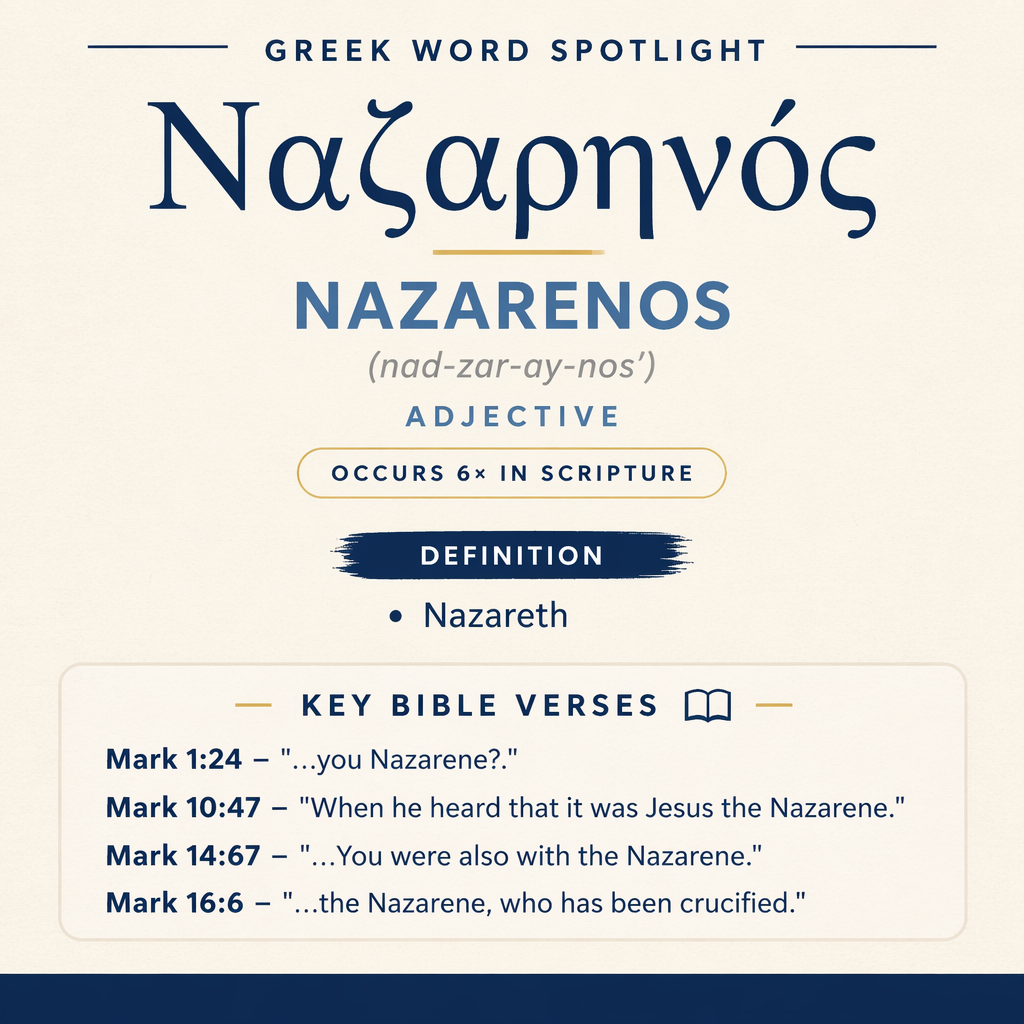
Occurrences
Mark 1:24: saying, “Ha! What do we have to do with you, Jesus, you Nazarene? Have you come to destroy us? I know you who you are: the Holy One of God!”
Here Ναζαρηνός functions as a form of address attached to Jesus’ name (“Jesus, you Nazarene”). The speaker frames the encounter as an unwanted confrontation (“What do we have to do with you…?”) and then adds two claims: fear of destruction and knowledge of Jesus’ identity. In this tense exchange, the Nazareth-designation is part of the way Jesus is identified at the outset, before the speaker intensifies the address with “the Holy One of God.”

Mark 10:47: When he heard that it was Jesus the Nazarene, he began to cry out, and say, “Jesus, you son of David, have mercy on me!”
In this scene the term is used in a report about Jesus (“it was Jesus the Nazarene”), and that identification triggers an immediate response. The man’s cry shifts from the Nazareth-based label to another title in direct appeal (“son of David”), but the narrative’s identification of Jesus as “the Nazarene” supplies the concrete recognition that sparks the plea for mercy.
Mark 14:67: and seeing Peter warming himself, she looked at him, and said, “You were also with the Nazarene, Jesus!”
Here Ναζαρηνός is used by a bystander to associate Peter with Jesus: “You were also with the Nazarene, Jesus!” The word supports an allegation of connection—Peter’s presence by the fire becomes the occasion for identifying him as belonging to Jesus’ circle. In this setting, the Nazareth-designation serves as a recognizable tag that enables public accusation in a pressured moment.
Mark 16:6: He said to them, “Don’t be amazed. You seek Jesus, the Nazarene, who has been crucified. He has risen. He is not here. Behold, the place where they laid him!
In the angelic announcement, Ναζαρηνός appears in a carefully built identification: “Jesus, the Nazarene, who has been crucified.” The designation from Nazareth is linked with the most recent public event named in the verse (“has been crucified”), and then contrasted with the new reality declared (“He has risen. He is not here”). The term helps pinpoint which Jesus is meant—the one known under this Nazareth-associated identity—so that the proclamation of resurrection is directed to the right referent.
Luke 4:34: saying, “Ah! what have we to do with you, Jesus of Nazareth? Have you come to destroy us? I know who you are: the Holy One of God!”
This occurrence parallels the confrontational address of Mark 1:24, but expresses the Nazareth association as “Jesus of Nazareth.” In the speaker’s mouth, the Nazareth-based identification again introduces a challenge (“what have we to do with you…?”) and fear (“Have you come to destroy us?”), culminating in a claim of recognition (“I know who you are”). The phrase “of Nazareth” supplies a locative-style identification that sets the address in concrete, earthly terms even as the speaker also names Jesus “the Holy One of God.”
Luke 24:19: He said to them, “What things?” They said to him, “The things concerning Jesus, the Nazarene, who was a prophet mighty in deed and word before God and all the people;
Here Ναζαρηνός appears in reflective narration, summarizing “the things concerning Jesus, the Nazarene.” The speakers pair the Nazareth identifier with an evaluative description of Jesus’ public ministry: “a prophet mighty in deed and word before God and all the people.” In this retelling, the term functions as a stable label by which Jesus can be referenced succinctly while the speakers articulate what kind of figure he was understood to be in the community’s experience.

Sense and Usage
Across these passages, Ναζαρηνός operates as a geographic identifier—an adjective marking Jesus’ association with Nazareth—and it is repeatedly treated as sufficient to single him out. The word appears both in vocative-like address (“Jesus, you Nazarene”) and as an identifying epithet within narrative speech (“Jesus the Nazarene”), showing its flexibility: it can be spoken directly to Jesus or spoken about him to others. Luke 4:34 places the same identifying function in a genitive-style phrase (“Jesus of Nazareth”), which achieves the same end: distinguishing Jesus by his connection to Nazareth.
The term’s force is not that it explains who Jesus is by itself, but that it anchors the name “Jesus” to a recognized identity in the social world of the story. In Mark 10:47, the label is enough for a listener to pivot from hearing to shouting; it is the recognition-point that makes an appeal possible. In Mark 14:67, it is the recognizable tag that enables suspicion and social pressure: being “with the Nazarene” is the accusation. In Mark 16:6, it works alongside the clause “who has been crucified” to ensure that the women’s search and the announcement’s message converge on the same person; “Jesus, the Nazarene” is the one whose death they would already know, and thus the one whose absence from the tomb matters.
Two occurrences (Mark 1:24; Luke 4:34) place the Nazareth identifier in a confrontational cry that also confesses knowledge of Jesus’ holiness (“the Holy One of God”). The juxtaposition is striking within the quoted speech: the speaker addresses Jesus with an earthly, place-linked designation and in the same breath articulates a transcendent claim about who he is. The Nazareth term does not replace the higher confession; it precedes it, as the initial naming that sets the encounter’s focus on a specific, known individual—“Jesus”—identified in the ordinary manner of a hometown association.
In Luke 24:19, the label is used after the events have unfolded, as part of a summary that highlights Jesus’ deeds and words “before God and all the people.” Here “Jesus, the Nazarene” functions like a headline for the life being recounted; it allows the speakers to compress a larger story into a single referent before they describe his recognized stature. Within the six occurrences, this is the broadest narrative use: not an address in the heat of conflict or need, but a retrospective framing of “the things concerning” him.
Imagery
In these scenes, Ναζαρηνός carries the imagery of public recognizability. Whether spoken by an alarmed voice (“Have you come to destroy us?”), a desperate petitioner (“have mercy on me!”), an accuser (“You were also with…”), a messenger at the empty tomb (“who has been crucified. He has risen”), or reflective disciples (“mighty in deed and word”), the label ties Jesus to a named place, presenting him as someone who can be identified, sought, feared, appealed to, and discussed as a known figure within the shared world of the speakers.
Sources: Lexical data from Strong’s Exhaustive Concordance and the Translators Brief Lexicon of Extended Strongs for Greek (STEPBible, CC BY). Occurrence data from the Translators Amalgamated Greek New Testament (STEPBible, CC BY). Scripture quotations from the World English Bible (public domain).





