
Exploring the Meaning of Murioi in Greek
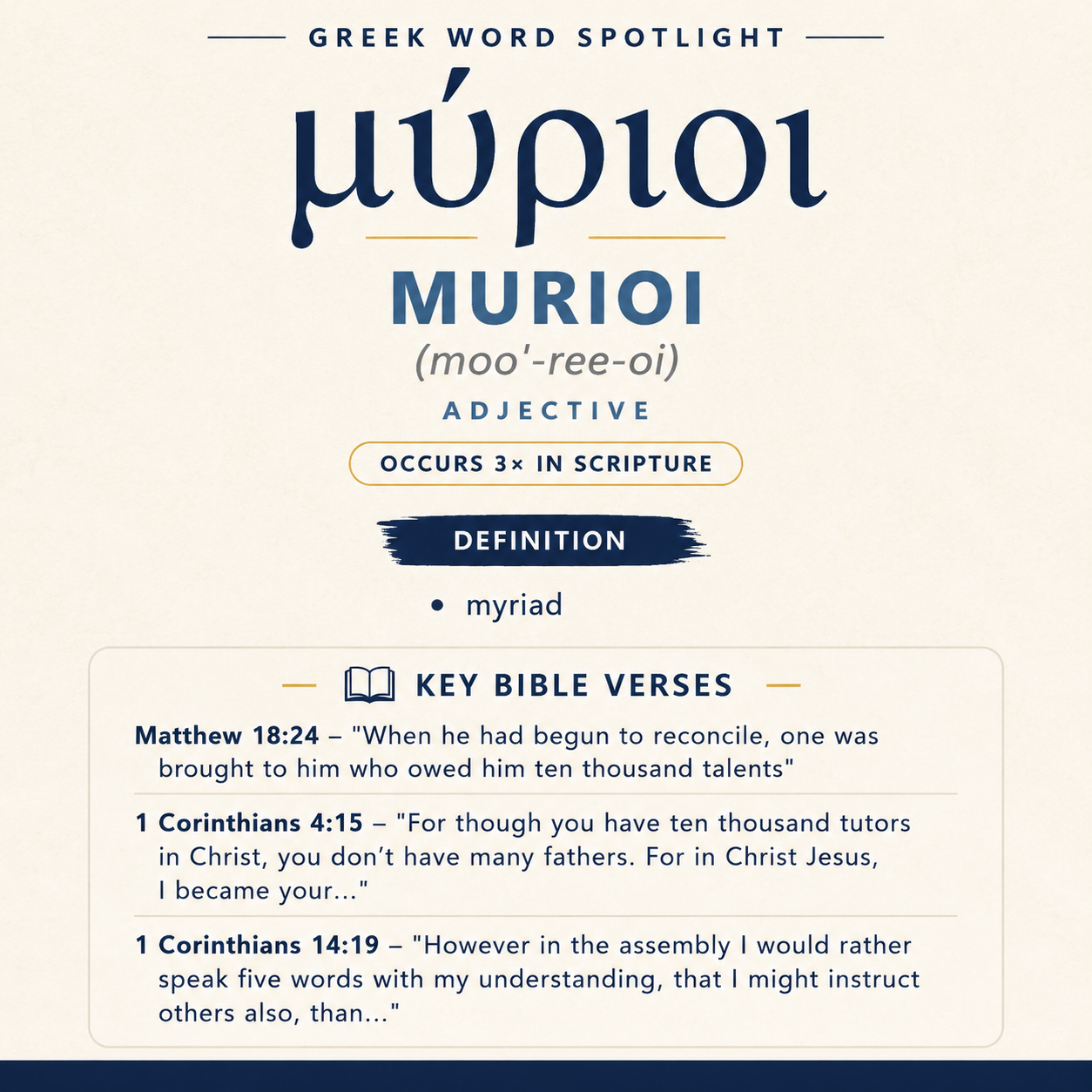
μύριοι means “myriad” and appears in Matthew 18:24; 1 Corinthians 4:15; and 1 Corinthians 14:19.
Scripture Locations
This word occurs 3 times in Scripture: Matthew 18:24; 1 Corinthians 4:15; and 1 Corinthians 14:19.
Learn More →Context Glimpses
In Matthew 18:24 and 1 Corinthians 4:15 it appears in contexts translated “ten thousand.” In 1 Corinthians 14:19 it contrasts many words with five understood words.
Learn More →μύριοι means “myriad” and appears in three New Testament passages where “ten thousand” functions as a deliberately large number. In each setting, it intensifies a contrast—between an unpayable debt and any realistic repayment, between countless instructors and the rarity of fatherhood, and between abundant speech and intelligible speech.
Occurrences
“When he had begun to reconcile, one was brought to him who owed him ten thousand talents.” (Matthew 18:24)
Here μύριοι sets the scale of the obligation as “ten thousand talents,” and the surrounding action frames it as a matter under accounting: the master “had begun to reconcile,” and a debtor is “brought to him.” Within that scene, “ten thousand” is not mere arithmetic; it supplies the narrative pressure of an overwhelming total placed into the spotlight of reconciliation. The verse does not describe any partial payment, negotiation, or accounting detail; it simply places an immense number alongside a weighty unit (“talents”) and lets the disproportion speak. The effect is to make the debt feel vast in a context where accounts are being settled and where amounts matter.
“For though you have ten thousand tutors in Christ, you don’t have many fathers. For in Christ Jesus, I became your father through the Good News.” (1 Corinthians 4:15)
In this pastoral argument, μύριοι heightens the first side of a comparison: “ten thousand tutors in Christ” versus “not… many fathers.” The large number functions rhetorically; it paints tutors as potentially abundant to the point of being innumerable for practical purposes, even “in Christ.” Against that abundance, the following clause narrows the field sharply—“you don’t have many fathers”—and then the speaker claims a particular relationship: “I became your father through the Good News.” Within the verse itself, “ten thousand” does not elevate tutors as superior; instead it helps set up the contrast in kinds of relationship. The multitude of tutors underscores that instruction can be plentiful, but fatherhood—defined here by personal origin (“I became your father”) and the means (“through the Good News”)—is presented as comparatively rare.
“However in the assembly I would rather speak five words with my understanding, that I might instruct others also, than ten thousand words in another language.” (1 Corinthians 14:19)
In this congregational setting, μύριοι again supplies the larger side of a stark numerical contrast. The speaker pits “five words with my understanding” against “ten thousand words in another language,” grounding the preference in a stated purpose: “that I might instruct others also.” The number “ten thousand” functions as an extreme—speech can be abundant, even overflowing, yet still be less desirable if it is “in another language” and does not serve instruction within “the assembly.” By choosing such a large count of words, the verse pushes the comparison beyond mere preference between two ways of speaking; it emphasizes that sheer quantity, even at the level of a “myriad,” is outweighed by intelligibility and edification as defined in the sentence itself.

Sense and Usage
Across these three occurrences, μύριοι (“myriad”) operates as a number-word that marks an upper extreme—“ten thousand”—and its force is consistently rhetorical. In Matthew 18:24, the “ten thousand” belongs to the world of debt and settlement (“reconcile… owed him”), so the word amplifies the felt impossibility of clearing an account. In 1 Corinthians 4:15, it belongs to the social-spiritual world of roles (“tutors… fathers”), so the word amplifies abundance in one category in order to sharpen the scarcity and significance of another. In 1 Corinthians 14:19, it belongs to the realm of speech (“words”), so the word amplifies quantity in order to show that quantity alone is not the measure of what benefits the gathered community.
In each case, “myriad” carries the idea of an almost unmanageably large amount, but it is not used the same way each time. It can describe an immense sum (“ten thousand talents”), an immense crowd of potential guides (“ten thousand tutors”), or an immense heap of utterances (“ten thousand words”). The common thread is that μύριοι gives scale in order to establish proportion: the magnitude of a debt relative to reconciliation, the magnitude of instruction relative to fatherhood, and the magnitude of speech relative to understanding. Because the verses themselves place μύριοι within explicit comparisons—either implied by the situation (a master reconciling accounts with a debtor who owes a massive amount) or stated plainly (“though… ten thousand… you don’t have many”; “rather… five… than… ten thousand”)—the word functions as a tool of contrast more than as an interest in precise counting.
The use of “ten thousand” in the two Corinthian texts also shows μύριοι working in hyperbolic-sounding totals without requiring the reader to imagine an actual headcount or literal word tally. The sentence logic does not depend on the exact number; it depends on the stark disparity that the number creates. A “myriad” makes the first term feel effectively boundless, which makes the second term—“many fathers” or “five words with my understanding”—stand out as surprisingly small, yet presented as weightier for the stated goal (relationship and origin in 4:15; instruction in the assembly in 14:19).
Though μύριοι appears with different nouns (talents, tutors, words), the contexts guide how the largeness should be felt. With “talents,” the largeness bears financial weight and judicial seriousness in a moment of reckoning. With “tutors,” the largeness suggests a surplus of voices capable of teaching, which makes the claim of fatherhood more pointed and personal. With “words,” the largeness suggests torrents of speech, which makes the preference for a handful of understandable words both striking and practical, especially given the explicit aim “that I might instruct others also.”
Imagery
The imagery connected to μύριοι in these passages is the imagery of scale: an account sheet dominated by a staggering figure (Matthew 18:24), a community surrounded by innumerable instructors yet needing paternal care (1 Corinthians 4:15), and an assembly where oceans of language can be poured out but a few comprehensible words do more good (1 Corinthians 14:19). In each scene, “myriad” makes the reader feel the weight of “more than enough,” so the text can then expose what truly matters when quantity is no longer persuasive.
Sources: Lexical data from Strong’s Exhaustive Concordance and the Translators Brief Lexicon of Extended Strongs for Greek (STEPBible, CC BY). Occurrence data from the Translators Amalgamated Greek New Testament (STEPBible, CC BY). Scripture quotations from the World English Bible (public domain).





