
Exploring the Meaning of Mura in Greek
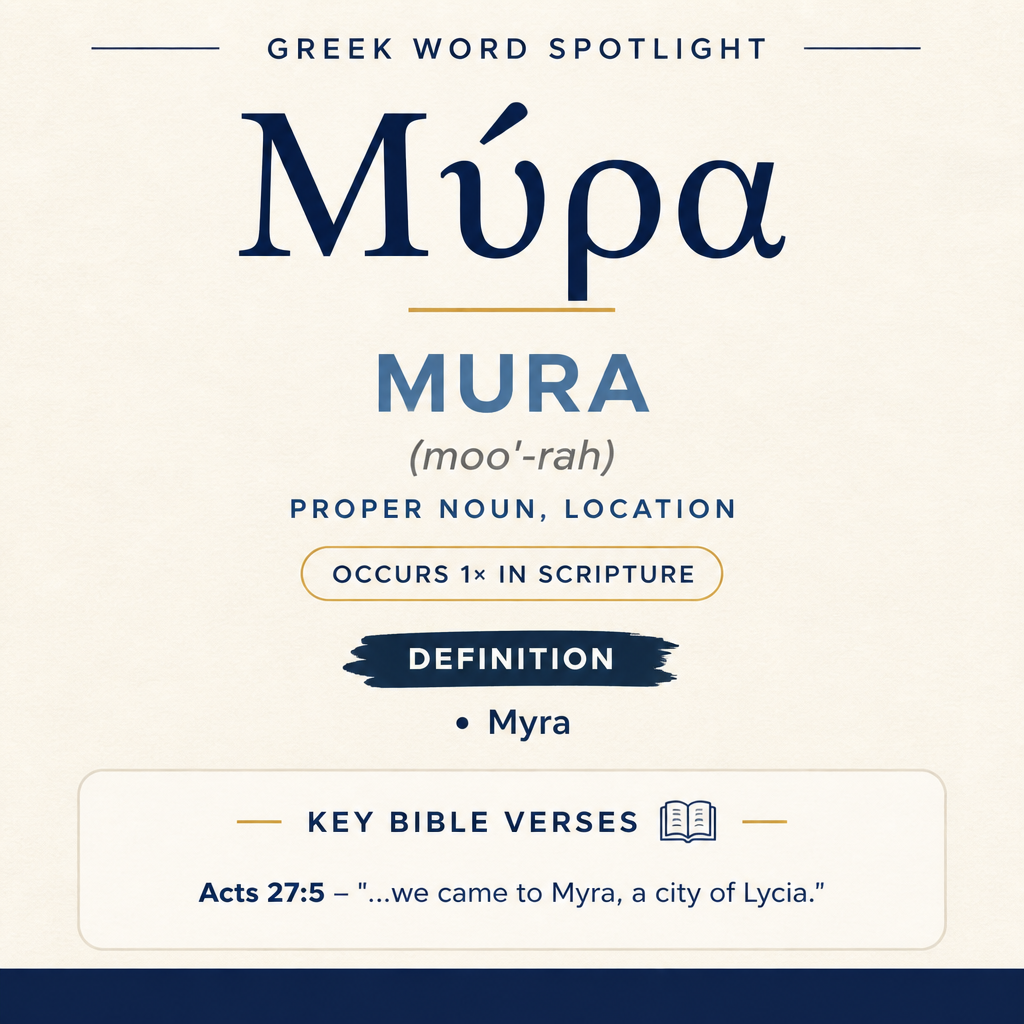
Μύρα (Mura) means “Myra” and appears in Acts 27:5, naming a city of Lycia.
Μύρα means “Myra” and appears in the narrative of Paul’s sea voyage in Acts. In that setting it functions as a named place along a sailing route that moves step by step across the northeastern Mediterranean.
Occurrences
“When we had sailed across the sea which is off Cilicia and Pamphylia, we came to Myra, a city of Lycia.” (Acts 27:5)
Here Μύρα identifies the next point reached after a stretch of travel described in geographic terms: the ship sails “across the sea which is off Cilicia and Pamphylia,” then “we came to Myra.” The name anchors the itinerary in a concrete arrival, marking a transition from movement over open water to a specific city. The verse also apposes the place-name with an explanatory locator—“a city of Lycia”—so that “Myra” is not merely a dot on a route but a definable urban destination situated within a larger regional description. In the flow of the sentence, “we came to Myra” is the main clause outcome of the sailing across the coastal sea, and the identification of Myra as a city supplies the kind of detail that fits a travel log: sailing, approach, and landfall.

Sense and Usage
As “Myra,” Μύρα operates as a fixed toponym: it does not describe a quality, activity, or object, but designates a place that can be reached, entered, and named in relation to surrounding areas. Acts 27:5 frames it as a waypoint that is legible through geography (“off Cilicia and Pamphylia”) and political or regional association (“of Lycia”). This gives the name a practical narrative role: it establishes location with enough specificity to keep the reader oriented as the voyage advances. The emphasis falls on movement and arrival—sailing across a defined stretch of sea, then coming to a particular city—so the sense of the word is carried by its function in travel narration: it is the place arrived at after the stated course.
The verse’s phrasing also places Μύρα within a chain of spatial references, and that chain is what gives the name its force. “Cilicia,” “Pamphylia,” “Myra,” and “Lycia” are coordinated so that the reader learns where the travelers are in relation to coastlines and regions without any need for extended explanation. In that respect, “Myra” is not introduced for its own sake; it is introduced because an actual voyage must be told in actual stages. The act of naming the city serves the narrative’s realism and sequence: a ship does not merely sail; it sails somewhere and reaches somewhere, and Μύρα is the “somewhere” that concludes the described leg of travel.
Because the verse identifies Myra as “a city,” the name carries an implied contrast with the sea just mentioned: the travelers cross a maritime space and arrive at an urban place on land. This land/sea shift is important to the way Acts 27:5 reads, even though it is expressed with plain travel language. “We came to Myra” signals that the ship’s passage has reached a point of contact with settled infrastructure—something stable enough to be called a city and to be located within Lycia. Thus Μύρα functions not only as a coordinate but as a narrative hinge: the end of one segment of sailing and the beginning of whatever occurs next at that port city.
Imagery
The imagery attached to Μύρα in Acts 27:5 is the understated imagery of a voyage record: coastline, open water, and a port city reached after sailing. The name itself evokes arrival—after the sea “off Cilicia and Pamphylia,” the travelers “came to Myra”—so the word bears the picture of a ship completing a leg of its journey and making landfall at a known city within a known region.
Sources: Lexical data from Strong’s Exhaustive Concordance and the Translators Brief Lexicon of Extended Strongs for Greek (STEPBible, CC BY). Occurrence data from the Translators Amalgamated Greek New Testament (STEPBible, CC BY). Scripture quotations from the World English Bible (public domain).





