
Exploring the Meaning of Morphoo in Greek
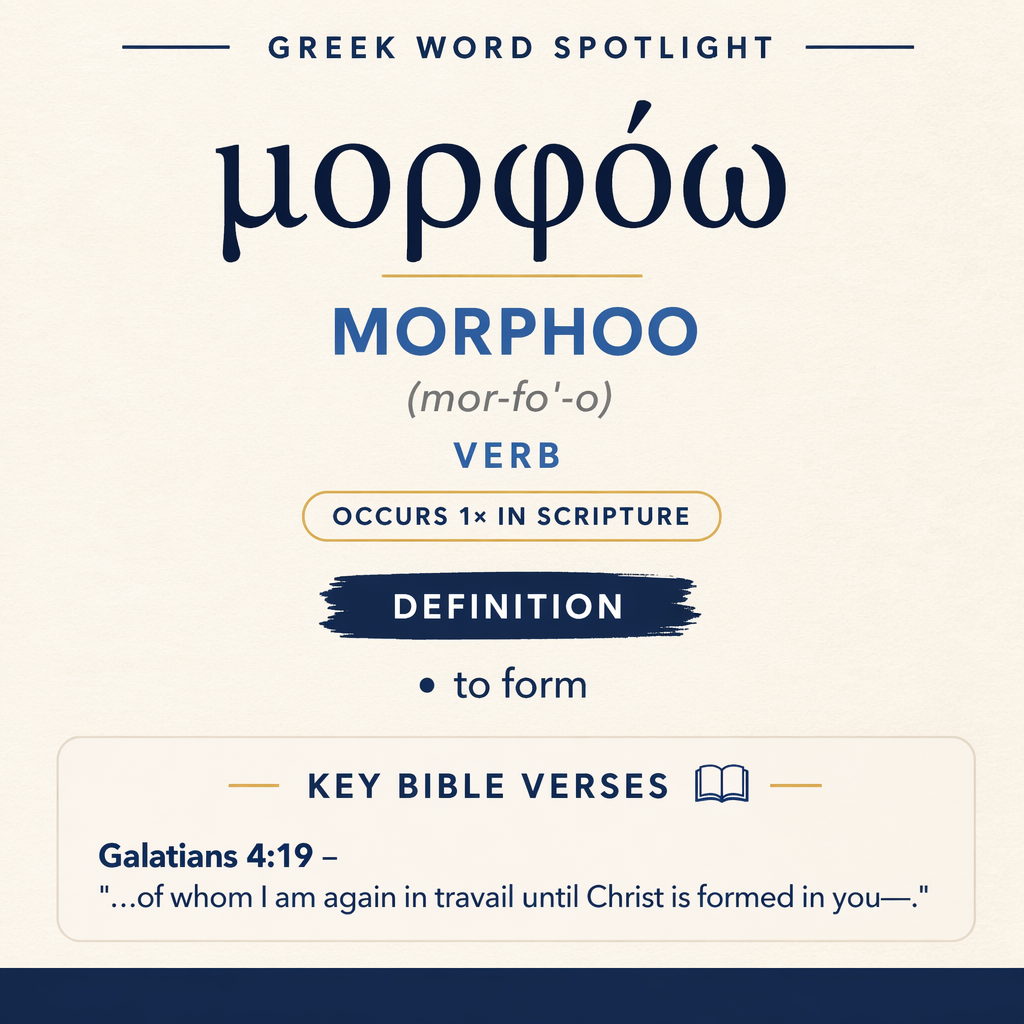
μορφόω means “to form” and appears once in Scripture, in Galatians 4:19.
Biblical Occurrence
This word occurs 1 time in Scripture. Its single occurrence is in Galatians 4:19.
Learn More →Verse Context
In Galatians 4:19, Paul speaks of “travail until Christ is formed in you.”
Learn More →μορφόω means “to form” and appears in a single New Testament passage, where Paul describes his pastoral labor with the image of an inward shaping that has Christ as its goal. The term’s force is carried by the one clause in which it occurs: a process that is ongoing and not yet complete.
Root and Related Words
μορφόω is related to the noun morphē (μορφή), “form” (Strong’s G3444). The verb expresses action connected with that noun: the bringing about of “form” in a person or situation.

Occurrences
“My little children, of whom I am again in travail until Christ is formed in you—” (Galatians 4:19)
Here μορφόω stands in an “until” clause that sets an endpoint for Paul’s present struggle: “until Christ is formed in you—”. The surrounding language supplies the scene and emotional temperature. Paul addresses the Galatians as “My little children,” a relational appeal that frames the action not as detached instruction but as family-like concern. The phrase “I am again in travail” uses childbirth imagery to portray intense, costly effort; within that image, μορφόω marks what that effort aims at—an internal forming that reaches its intended shape only when “Christ” is the one formed “in you.”

The verb also contributes a clear sense of process. Paul is “again in travail,” implying a renewed labor rather than a single moment. The “until” that introduces the verb places the forming as a goal not yet reached at the moment of speaking. In this sentence, then, μορφόω does not function as a label for something already possessed; it names a work underway, something awaited as the completion of Paul’s present pains on their behalf.
Finally, the prepositional phrase “in you” locates the forming as an inward reality. Paul does not describe Christ as merely represented among them or spoken of to them in this clause, but as formed within them. The verb’s contribution is to portray an interior shaping that corresponds to Paul’s deep personal investment and anguish, like labor pains aimed at bringing something to completion.
Sense and Usage
With the straightforward definition “to form,” μορφόω in Galatians 4:19 conveys formation as a directed process toward a definite outcome. The sentence sets up a contrast between Paul’s present state (“again in travail”) and the hoped-for completion (“until Christ is formed in you—”). In that frame, “to form” is not a mere external arrangement; it describes something that comes to take shape within a person. The subject matter of the forming is explicit—“Christ”—and the location is explicit—“in you.” The clause therefore presents formation as inward, personal, and teleological: the forming has an end point, and the end point is the completed reality of Christ’s being formed in the community addressed.
The imagery of travail fills out the kind of forming involved. Travail is both painful and purposeful; it is oriented toward bringing forth what is not yet fully present. By pairing “again in travail” with “until … is formed,” the verse links the verb to the slow, strenuous character of growth toward a finished shape. The forming is portrayed as something that can be awaited, worked toward, and longed for—rather than assumed as immediate or automatic. Paul’s language places the emphasis on the intensity of his concern and the seriousness of the outcome, while the verb provides the central picture of what that concern seeks: formation reaching completion.
Because the verse uses the passive expression “is formed,” the forming is presented as something happening to the Galatians rather than something they are described as doing to themselves in this clause. Paul’s own role is pictured through “travail,” not through directly “forming” them by force of will; instead, he labors “until” the forming takes place. The result is a sentence where the verb captures the goal toward which pastoral labor strains: an inward formation whose content is Christ.
Imagery
Galatians 4:19 wraps μορφόω in the concrete metaphor of childbirth. In that picture, “to form” evokes the gradual taking of shape that precedes a finished arrival. Paul’s “travail” gives emotional weight to the forming: it is not trivial adjustment but the kind of deep change he can describe only through the pains of labor, and it remains incomplete until the stated outcome—“Christ is formed in you—”.
Sources: Lexical data from Strong’s Exhaustive Concordance and the Translators Brief Lexicon of Extended Strongs for Greek (STEPBible, CC BY). Occurrence data from the Translators Amalgamated Greek New Testament (STEPBible, CC BY). Scripture quotations from the World English Bible (public domain).





