Exploring the Meaning of Misthapodotes in Greek
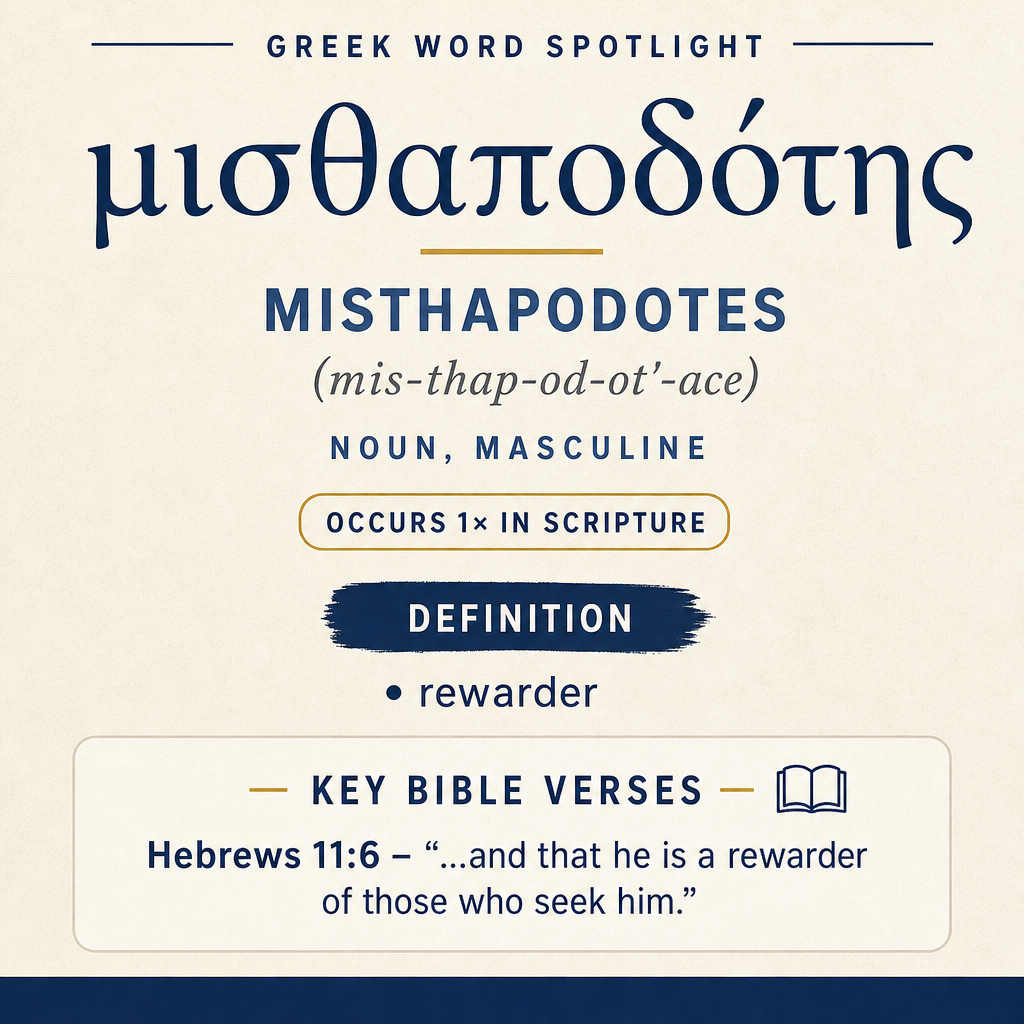
μισθαποδότης means “rewarder” and appears once in Scripture, in Hebrews 11:6.
Scripture Occurrence
This word occurs 1 time in Scripture. Its occurrence is in Hebrews 11:6.
Learn More →Verse Context
In Hebrews 11:6, it appears in a statement about faith and coming to God. The verse includes, “must believe that he exists, and that”.
Learn More →Misthapodotes means “rewarder” and appears once in the New Testament, in Hebrews 11:6. In that setting it functions as a stated object of belief about God, paired with the conviction that God exists.
Root and Related Words
Misthapodotes is connected with two verbal ideas reflected in related words: misthoo (μισθόω), “to hire” (Strong’s G3409), and apodidomi (ἀποδίδωμι), “to pay” (Strong’s G591). Together these related terms frame the noun’s conceptual field in terms of giving what is due, in a manner that can be spoken of as payment.

Occurrences
“Without faith it is impossible to be well pleasing to him, for he who comes to God must believe that he exists, and that he is a rewarder of those who seek him.” (Hebrews 11:6)
Here misthapodotes is part of a twofold content of faith: the one who “comes to God must believe that he exists, and that he is a rewarder of those who seek him.” The word therefore identifies a divine quality that is not merely assumed but explicitly believed. In the logic of the sentence, this conviction supports why faith is necessary for being “well pleasing to him”: approaching God in a way that pleases him is inseparable from trusting both his reality (“that he exists”) and his disposition toward seekers (“that he is a rewarder of those who seek him”).

The phrase “of those who seek him” narrows the focus of the term in this verse. Misthapodotes is not used in isolation, as though describing reward in general; it is tethered to a particular posture toward God—seeking. The rewarder language thus functions relationally: it speaks of God in connection with the people who draw near and persist in pursuit of him. In context, this relationship is cast as a reasoned conclusion: “for he who comes to God must believe…” The term stands within an argument about what must be believed if one is truly coming to God, rather than as a poetic flourish.
Because Hebrews 11:6 begins with the claim that “Without faith it is impossible to be well pleasing to him,” misthapodotes also serves a rhetorical purpose. It describes God in a way that makes faith intelligible and purposeful: seeking is not presented as futile or indifferent; it is directed toward one who is characterized as a rewarder. The verse does not spell out the form or timing of that reward; the force lies in the asserted identity of God with respect to seekers.
Sense and Usage
The single attestation of misthapodotes in Hebrews 11:6 shows the noun operating as a compact title-like description of God. Within the sentence, it functions in parallel with the confession “that he exists,” giving a second pillar to the belief that defines genuine approach to God. The word therefore carries the weight of a settled conviction: faith includes not only acknowledgment of God’s being but trust in his response to those who seek him.
In this verse, “rewarder” is not portrayed as an occasional act but as a stable aspect of who God is: “that he is a rewarder.” The grammar presents it as a predicate assertion about God himself. This makes the term more than a description of an event; it is a description of divine character as it is relevant to the act of seeking. The connection between coming, believing, and seeking creates a coherent pattern: approach (“comes to God”) entails conviction (“must believe”), and that conviction includes the expectation that seeking is met by God as rewarder (“of those who seek him”).
The related verbal ideas (to hire; to pay) help illuminate how the word’s “rewarder” sense can be heard in a concrete, transactional register without changing its stated definition. Hebrews 11:6 places the term in the sphere of what God gives in response to seekers: the verse frames divine rewarding as something dependable enough to be an object of belief. At the same time, the verse keeps the emphasis on faith and seeking rather than on quantifying reward, so the word serves the argument by anchoring hope in God’s reliable disposition toward those who pursue him.
Imagery
Hebrews 11:6 pairs misthapodotes with the act of “coming to God,” evoking the image of an approach toward a personal giver rather than an impersonal force. The title “rewarder” lends the approach a moral and relational expectation: the seeker comes believing not only that God is real, but that he responds to seeking with the giving that fits his identity as rewarder.
Sources: Lexical data from Strong’s Exhaustive Concordance and the Translators Brief Lexicon of Extended Strongs for Greek (STEPBible, CC BY). Occurrence data from the Translators Amalgamated Greek New Testament (STEPBible, CC BY). Scripture quotations from the World English Bible (public domain).