Exploring the Meaning of Metretes in Greek
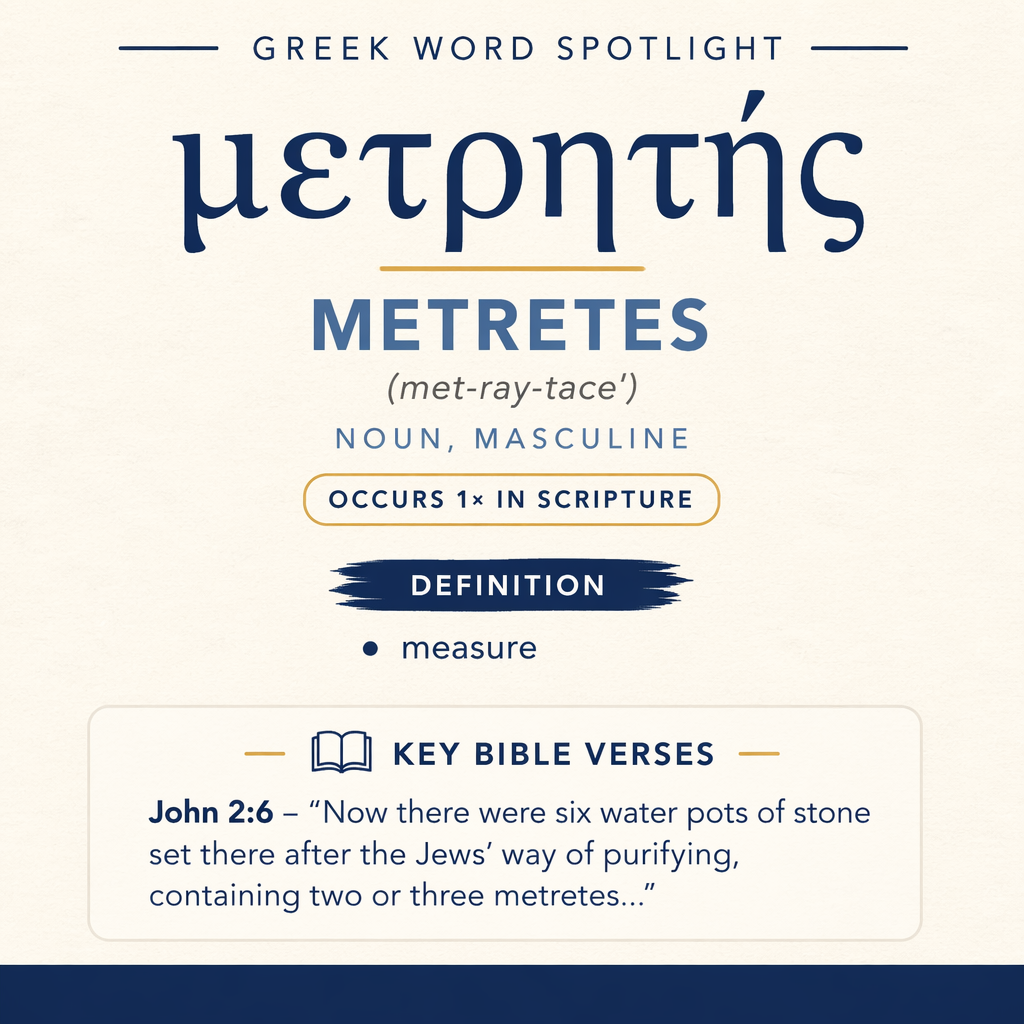
μετρητής (Metretes) means “measure” and appears once in Scripture, in John 2:6.
Context in John
John 2:6 describes six stone water pots for Jewish purification. Each contained two or three metretes.
Learn More →μετρητής names a “measure” and appears in the description of the stone water jars at the wedding in Cana. In that scene it specifies the capacity of each vessel as part of the narrative’s careful, concrete detail.
Root and Related Words
μετρητής is related to the verb metreo (μετρέω), “to measure” (Strong’s G3354). The relationship ties the noun to the action of measuring, so that the object named is understood in terms of a fixed, countable quantity rather than an undefined amount.

Occurrences
“Now there were six water pots of stone set there after the Jews’ way of purifying, containing two or three metretes apiece.” (John 2:6)
Here μετρητής functions as a unit of capacity within a tightly sketched setting. The verse lays out a sequence of descriptive elements—number (“six”), material (“of stone”), placement (“set there”), customary purpose (“after the Jews’ way of purifying”), and finally the amount each one held (“two or three metretes apiece”). Within that stack of details, the “metretes” phrase does not merely tell the reader that there was water; it frames the water as measured volume, jar by jar. The jars are not described as partly filled or vaguely large; the narrative assigns each vessel a stated range, “two or three,” and then anchors that range with a standard measure. That makes capacity part of the scene’s realism: these are substantial, purposeful containers associated with purification practice, and their contents are presented as a quantifiable supply rather than a small, incidental amount.
The plural “metretes” (in the English rendering) works with “apiece” to distribute the measure across the set: the reader is invited to picture six separate vessels, each with its own measured capacity. The phrase “containing two or three” also shows that the word is used in ordinary counting: a person can speak of a vessel as holding a certain number of this measure, and the narration can report it with the same ease it reports “six” pots. In this verse, then, μετρητής contributes precision—capacity specified in a way that fits naturally alongside other factual descriptors (stone, number, customary use) and helps the scene feel located in the concrete world of objects and quantities.
Sense and Usage
With the sense “measure,” μετρητής in John 2:6 names a definite, countable quantity used to describe how much a container holds. The context shows several features of how the term is used. First, it is a unit that can be multiplied: each jar contains “two or three” of them, so the word supports numerical modifiers and can be treated as a discrete amount. Second, it is suitable for stating capacity rather than what is presently poured: the verse describes the jars as “containing” this amount, which portrays a built-in volume associated with the vessels as they stand “set there.” Third, the term’s function is descriptive rather than evaluative. Nothing in the wording suggests that the measure itself carries praise or blame; it is a straightforward way of communicating how much the vessels could hold in the setting described.
The verse also shows the rhetorical effect of measured language in narrative. By specifying capacity, the account slows down momentarily to quantify the scene. Numbers and measures work together: “six” sets the count of the jars; “two or three” sets the capacity of each; the measure-word then stabilizes what “two or three” refers to. Without a measure, “two or three” would require some implied object (“two or three what?”). With μετρητής, the quantity becomes intelligible as volume. This interplay demonstrates how a measure-term can make narration more exact without changing the story’s focus: it gives the reader a clear mental model of the physical setting and the scale of what is available.
Finally, because the jars are linked to “the Jews’ way of purifying,” the measured capacity sits within a context of practical, repeated use. Purification, as depicted here, involves water kept ready in substantial containers, and μετρητής provides the vocabulary for stating that readiness in terms of how much water those containers could hold. The word thus serves the scene’s concrete realism: purification is pictured not as an abstraction but as something supported by stone vessels and measured quantities of water.
Imagery
John 2:6 places μετρητής amid objects that can be seen and counted: stone jars, set in place, each with a stated capacity. The word’s imagery is the imagery of measured volume—water held within solid containers—so that the setting is drawn with the kind of specificity that lets the reader picture not only what was present, but how much could be present in each vessel.
Sources: Lexical data from Strong’s Exhaustive Concordance and the Translators Brief Lexicon of Extended Strongs for Greek (STEPBible, CC BY). Occurrence data from the Translators Amalgamated Greek New Testament (STEPBible, CC BY). Scripture quotations from the World English Bible (public domain).