
Exploring the Meaning of Metoche in Greek
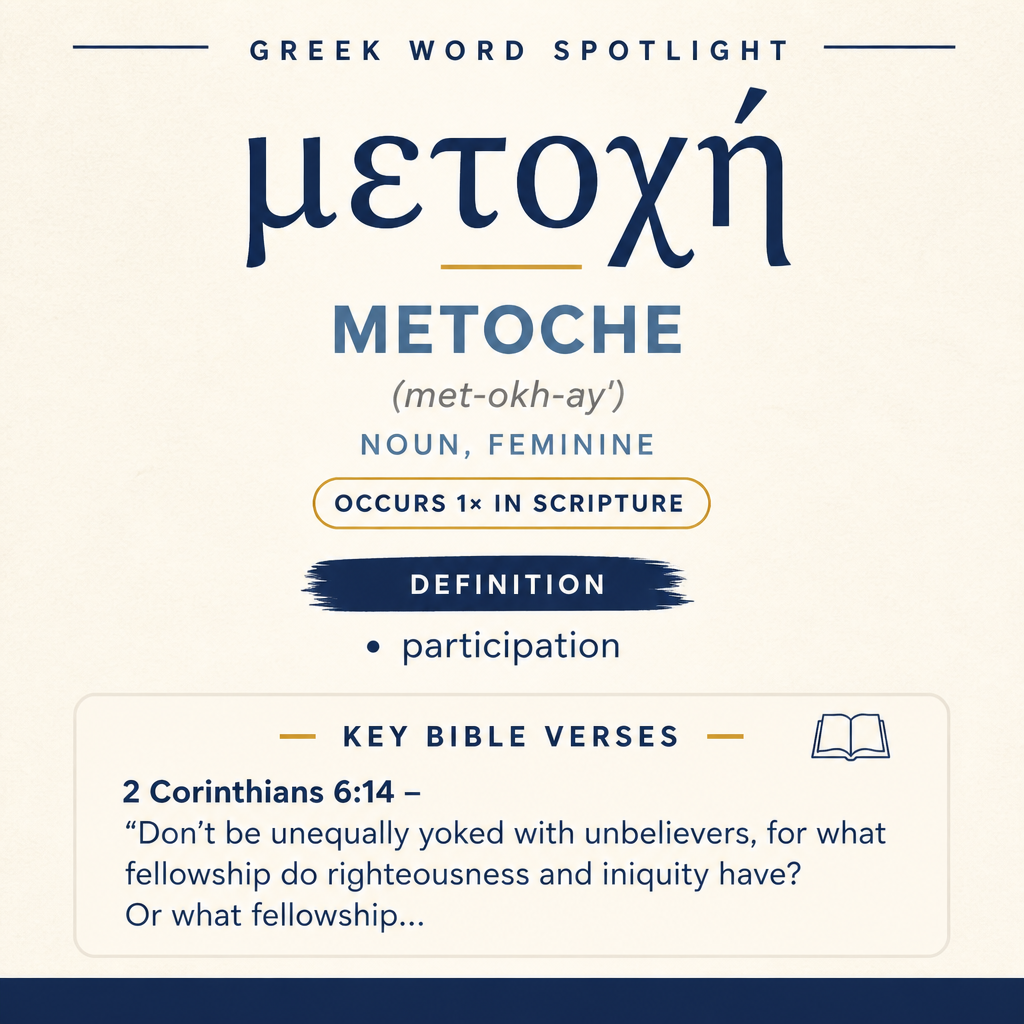
μετοχή means “participation” and appears once in Scripture, in 2 Corinthians 6:14.
Context in Verse
In 2 Corinthians 6:14 it appears in a rhetorical question contrasting righteousness and iniquity.
Learn More →μετοχή expresses “participation” and is attested in the New Testament in 2 Corinthians 6:14. In that setting it functions as a measuring word: it asks what kind of shared involvement can exist between two opposed realities.
Root and Related Words
μετοχή is related to the verb metecho (μετέχω), “to share” (Strong’s G3348). The noun names the state or reality that corresponds to the action of sharing: an actual share-in-common, an involvement held together by more than proximity.

Occurrences
“Don’t be unequally yoked with unbelievers, for what fellowship do righteousness and iniquity have? Or what fellowship does light have with darkness?” (2 Corinthians 6:14)
In 2 Corinthians 6:14, μετοχή is placed into a chain of probing questions. The verse is framed by the warning, “Don’t be unequally yoked with unbelievers,” and then immediately presses the issue by asking what “fellowship” can exist between paired opposites: “righteousness and iniquity,” and “light” and “darkness.” Within this rhetoric, μετοχή serves as a test for whether two parties actually have a joint share.
The opening image of being “unequally yoked” provides the concrete backdrop for the abstract noun. A yoke binds two animals together so they move as a unit; an unequal yoke makes the shared work lopsided and conflicted. Against that picture, μετοχή sharpens the question from mere association to true shared participation: it is not asking whether the two sides can be present in the same space, but whether there can be a real share held in common—something that can be carried together.
The verse then supplies two pairings that define the boundaries of such participation. “Righteousness” is set against “iniquity,” and “light” against “darkness.” The effect is to treat μετοχή as something that presupposes compatibility. Participation is not presented as neutral or automatic; it is evaluated by the character of the things participating. By choosing examples that are cast as opposites, the verse implies that participation is not simply a matter of contact, but of shared alignment and common direction.
The two questions are parallel: “for what fellowship do righteousness and iniquity have?” and “Or what fellowship does light have with darkness?” This repetition (without changing the logic) gives μετοχή a sense of breadth: it can be asked of moral categories (righteousness/iniquity) and of imagery-laden realities (light/darkness). In both cases the noun carries the idea of a genuine share that would make the two terms partners in some common undertaking. Within the verse’s argument, the implied answer is negative, and the force of the warning rests on that implied incompatibility.
Sense and Usage
As “participation,” μετοχή points to a relationship that goes beyond mere coexistence. Participation is the kind of connection in which there is a portion held together—an involvement in which two sides are bound to the same venture, share the same standing, or have a common stake. In 2 Corinthians 6:14 the word is not used to describe a momentary meeting or a passing interaction; it is used in a context of being “yoked,” a metaphor that suggests sustained linkage and coordinated movement. That metaphor helps define participation as something continuous enough to shape one’s course.
The verse’s two illustrative pairings also show that μετοχή is evaluated by the nature of what is being joined. The question is not framed as, “Can they meet?” but “what fellowship…have?”—that is, what real share could exist. The noun therefore naturally invites scrutiny of what is shared. If participation exists, something is held in common; if the elements are opposites (“righteousness and iniquity,” “light” and “darkness”), the shared portion is called into question. The word, as used here, functions like a diagnostic: it presses the reader to consider whether a proposed linkage truly contains a common share or only an outward pairing.
Because the term appears in a series of rhetorical questions, it also carries a deliberative tone. It does not merely label a relationship; it asks the audience to judge the plausibility of participation. The verse positions participation as the key issue behind the imperative not to be “unequally yoked”: the warning is grounded in the conviction that certain pairings do not possess a workable share-in-common. Thus μετοχή, though brief, anchors an argument about what kinds of partnerships are coherent, and it does so by appealing to universally understood contrasts—moral contrast (“righteousness” versus “iniquity”) and perceptual contrast (“light” versus “darkness”).
The progression from the yoke-image to the paired contrasts gives the noun a concrete resonance. Participation is not treated as a private, invisible idea; it is pictured as something that manifests in the direction and quality of a joined life. If two are yoked, their participation becomes visible in the way they walk and work; if light is paired with darkness, the question of participation becomes visible in what the union would produce. In this way the verse uses μετοχή to spotlight the practical reality that participation entails: a shared portion that shapes what the partnership is and where it goes.
Imagery
Although μετοχή names an abstract reality, its single New Testament setting surrounds it with strong imagery. The yoke evokes a shared labor that binds two together, while “light” and “darkness” evoke mutually opposing realms. In that context, participation is pictured not as a thin connection but as a bond substantial enough to pull two parties into one track—precisely the sort of bond the verse questions when the paired realities stand in opposition.
Sources: Lexical data from Strong’s Exhaustive Concordance and the Translators Brief Lexicon of Extended Strongs for Greek (STEPBible, CC BY). Occurrence data from the Translators Amalgamated Greek New Testament (STEPBible, CC BY). Scripture quotations from the World English Bible (public domain).




