
Exploring the Meaning of Metamorphoo in Greek
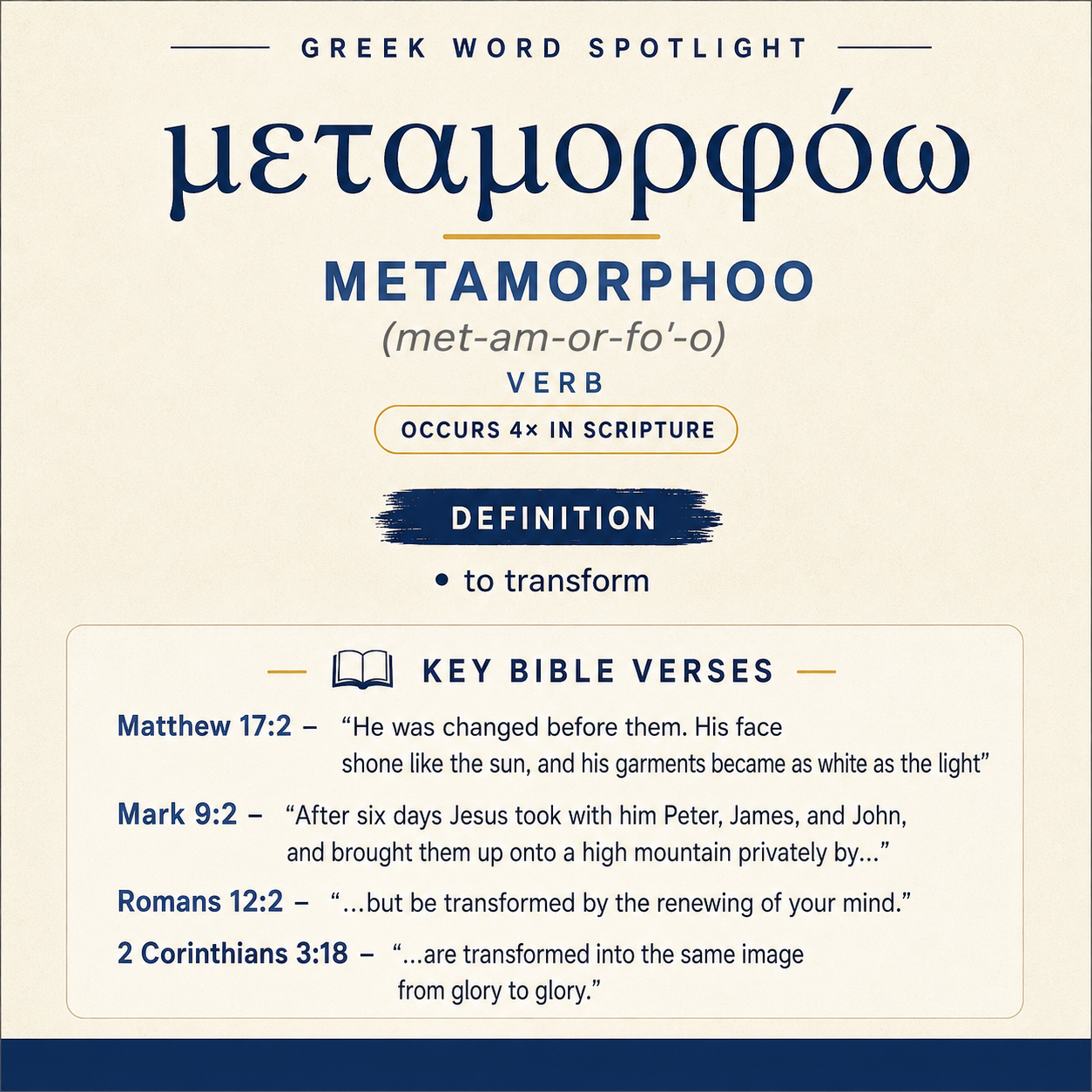
μεταμορφόω (Metamorphoo) means “to transform” and occurs four times in Scripture: Matthew 17:2, Mark 9:2, Romans 12:2, and 2 Corinthians 3:18.
Core Meaning
μεταμορφόω means “to transform.” In Matthew 17:2 it describes Jesus being changed before the disciples.
Learn More →Gospel Scenes
It appears in Matthew 17:2 and Mark 9:2 in the account of Jesus on a high mountain with Peter, James, and John. Matthew 17:2 describes His face shining and His garments becoming white.
Learn More →Apostolic Exhortation
Romans 12:2 commands believers to be transformed by the renewing of the mind. 2 Corinthians 3:18 speaks of being transformed into the same image from glory to glory.
Learn More →μεταμορφόω means “to transform,” a verb used for Jesus’ visible change on a mountain and for the inward change expected of believers. It appears in two Gospel narratives and in two Pauline exhortations that speak of a renewed mind and an unveiled vision of the Lord’s glory.
Root and Related Words
μεταμορφόω is connected with meta (μετά), “with/after” (Strong’s G3326), and morphoo (μορφόω), “to form” (Strong’s G3445). In combination these elements frame the verb around the idea of a formed state that undergoes change in relation to something else.

Occurrences
“He was changed before them. His face shone like the sun, and his garments became as white as the light.” (Matthew 17:2)
Here the verb marks a change that occurs “before them,” that is, in the presence of witnesses. The verse immediately describes the effects of this change in concrete, visible terms: the face “shone like the sun,” and the garments “became as white as the light.” The transformation is therefore not treated as a private inward experience in this scene; it is presented as an observable alteration accompanied by brilliance and whiteness. The verb gathers these descriptions into a single event: Jesus is changed, and the radiance and the clothing’s whiteness are the way that change is perceived.
“After six days Jesus took with him Peter, James, and John, and brought them up onto a high mountain privately by themselves, and he was changed into another form in front of them.” (Mark 9:2)
Mark sets the transformation within deliberate movement and setting: “After six days” Jesus leads three disciples “up onto a high mountain privately by themselves.” The verb again occurs with an explicit audience—“in front of them”—and this time the change is described as being “into another form.” The wording draws attention not only to the fact of change but also to the notion of a different “form” as the outcome of the event. The disciples’ presence and the mountain setting frame the transformation as a moment of disclosure: what they see is Jesus “changed,” the change being characterized as a shift into “another form” rather than merely a change in appearance from a distance.
“Don’t be conformed to this world, but be transformed by the renewing of your mind, so that you may prove what is the good, well-pleasing, and perfect will of God.” (Romans 12:2)
In Romans the verb is used as a direct exhortation: “be transformed.” The contrast with “Don’t be conformed to this world” sets transformation against a competing patterning. The means or instrument is expressed in the clause “by the renewing of your mind,” locating the transformation in mental renewal rather than in outward brightness or a change of visible form. The purpose is then stated: “so that you may prove what is the good, well-pleasing, and perfect will of God.” In this verse, transformation is not an end in itself; it serves discernment and testing, enabling a lived recognition of God’s will described with three coordinated terms—“good,” “well-pleasing,” and “perfect.”
“But we all, with unveiled face seeing the glory of the Lord as in a mirror, are transformed into the same image from glory to glory, even as from the Lord, the Spirit.” (2 Corinthians 3:18)
This occurrence places transformation in the context of vision and reflection. The subjects are inclusive—“we all”—and they are characterized as having an “unveiled face,” an openness associated with “seeing the glory of the Lord as in a mirror.” The verb is in the passive (“are transformed”), and the result is specified: “into the same image.” The process is portrayed as progressive: “from glory to glory.” The source of the transformation is also given: “even as from the Lord, the Spirit.” The verse thus ties transformation to beholding—an ongoing seeing of the Lord’s glory—and to a corresponding change toward “the same image,” with the movement described as a transition between degrees of glory.
Sense and Usage
Across these four passages, “to transform” is applied to both a momentary, visible change and an ongoing, inwardly grounded change. In Matthew and Mark the verb is anchored in sight-language (“before them,” “in front of them”) and narrated with external effects: shining face, bright garments, and “another form.” The transformation there functions as an event that can be pointed to in time and place—on a mountain, in the presence of particular disciples—and its reality is communicated through sensory description.
In Romans and 2 Corinthians, the same verb moves into exhortation and communal experience. Romans frames transformation as the alternative to being “conformed to this world,” and it connects the change to “the renewing of your mind.” The verb therefore expresses a reshaping that touches thinking and evaluation, because it yields the ability “to prove” God’s will. 2 Corinthians similarly speaks of a change that happens to believers (“we all… are transformed”), but it locates the dynamic in beholding: seeing the Lord’s glory “as in a mirror” corresponds to being transformed “into the same image.” Where Romans stresses renewal and discernment, 2 Corinthians stresses unveiled seeing and likeness, yet both present transformation as something that works upon a person and produces a changed capacity or resemblance.
These uses also show that the verb can take different kinds of complements that clarify the direction of change. Mark’s “into another form” highlights a shift of form as such, whereas 2 Corinthians’ “into the same image” focuses on likeness as the outcome. Romans expresses agency or means (“by the renewing of your mind”), presenting transformation as mediated through a renewing process, and then points to a practical result in knowing and approving God’s will. Together, the passages show transformation as a change that is real and describable, whether by visible radiance, by renewed thinking, or by increasing likeness associated with the Lord’s glory.
Imagery
The verb’s imagery is especially vivid where transformation is paired with light and sight. Matthew describes a face shining “like the sun” and garments “as white as the light,” using the language of brightness to convey the intensity of the change. Mark places the transformation on a “high mountain” and speaks of “another form,” reinforcing the sense of a manifested reality set before observers. Paul draws on different but related visual language: in 2 Corinthians, an “unveiled face” and seeing “as in a mirror” accompany transformation “from glory to glory.” Even Romans, though focused on the mind, sets transformation within a contrast of patterns—conformed or transformed—so that the renewed mind becomes the arena in which God’s will can be recognized as “good, well-pleasing, and perfect.”
Sources: Lexical data from Strong’s Exhaustive Concordance and the Translators Brief Lexicon of Extended Strongs for Greek (STEPBible, CC BY). Occurrence data from the Translators Amalgamated Greek New Testament (STEPBible, CC BY). Scripture quotations from the World English Bible (public domain).





