
Exploring the Meaning of Metalepsis in Greek
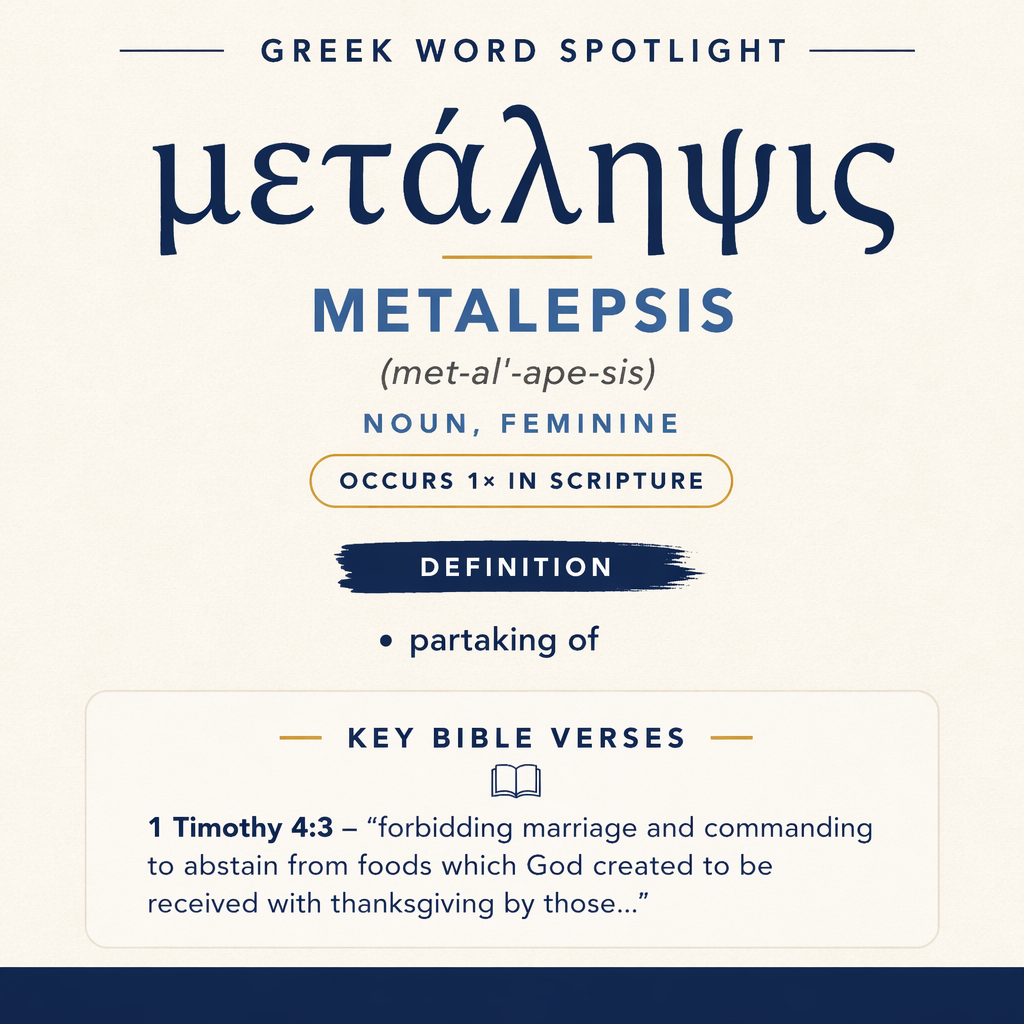
μετάληψις means “partaking of” and appears once in Scripture, in 1 Timothy 4:3.
Verse Context
In 1 Timothy 4:3, it relates to foods God created to be received with thanksgiving by believers.
Learn More →μετάληψις expresses “partaking of,” and it appears once, in Paul’s instruction about food in 1 Timothy 4:3. In that setting it helps frame eating as a received share in what God has made, taken up with gratitude and truth.
Root and Related Words
μετάληψις is derived from the verb metalambanō (μεταλαμβάνω), “to partake” (Strong’s G3335). The noun form presents the idea of participation as a thing or event—an act of taking a share—rather than merely describing the action as a verb would.

Occurrences
“forbidding marriage and commanding to abstain from foods which God created to be received with thanksgiving by those who believe and know the truth.” (1 Timothy 4:3)
In this sentence, the focus is on “foods” and how they are to be approached. The line contrasts a restrictive command—“commanding to abstain from foods”—with God’s creative purpose—foods “which God created to be received with thanksgiving.” μετάληψις (“partaking of”) belongs to the second side of that contrast: it anchors the positive, intended posture toward food as an active reception. The verse does not treat food as a neutral object but as something given by God for a particular kind of engagement: taking a share of it in a thankful manner.

The verse also specifies who receives these foods in the described way: “those who believe and know the truth.” Within the logic of the sentence, partaking is not presented as an isolated physical act; it is situated within a community marked by belief and knowledge of truth. The noun therefore carries an implied setting: the taking of food is done as a conscious, meaningful participation in what God has created, and it coheres with thanksgiving and with a truthful understanding of God’s gifts. In context, partaking is the opposite of abstaining under a command that forbids; it is reception under God’s creative intent.
Sense and Usage
The basic idea of “partaking of” in μετάληψις can be heard in the way the verse frames “foods” as created “to be received.” The sense is not simply that food exists, but that it is intended for human participation—someone takes a share in it. The wording “to be received with thanksgiving” further shapes the nuance: partaking is characterized by gratitude. That thanksgiving is not an additional action tacked on after eating; it describes the mode of reception. In this line, the noun’s contribution is to present eating as a kind of participation in a gift, rather than as mere consumption.
The immediate contrast with abstinence sharpens the value of the term. “Commanding to abstain from foods” depicts a prohibition as a controlling religious demand. Against that, the created purpose of foods is articulated: they are meant for reception, and not in a grudging or embarrassed way, but “with thanksgiving.” Thus, in this verse, “partaking of” is implicitly aligned with the goodness of creation as something to be shared in. The force of the statement is not to shift attention toward the mechanics of eating, but to locate the act within God’s creative provision and within the fitting response of gratitude.
The final qualifier—“by those who believe and know the truth”—sets partaking within a moral and cognitive frame. Participation in the created gift is linked to believing and to knowing truth; the noun therefore serves a discourse about discernment. The verse does not depict partaking as indiscriminate or thoughtless. Instead, it treats the reception of food as an action that corresponds to the reality of God as Creator and to a truthful grasp of that reality. In other words, partaking is placed within a life that can give thanks in a way consistent with what is true.
Because the term appears in a context about receiving food, its imagery is concrete: someone takes what has been made and receives it into ordinary life. Yet the verse also makes that concrete act a site of gratitude and confession of truth. “Partaking of” here carries both the simplicity of eating and the richer idea of sharing in what God gives, in a way that acknowledges the Giver. The noun’s sense remains “partaking of,” but the verse’s framing shows how that partaking is evaluated: abstaining under a prohibitive command is set over against thankful reception of God’s creation by believers who know the truth.
Imagery
The language of “foods which God created to be received with thanksgiving” gives μετάληψις an everyday image of a table where created food is accepted as a gift. The scene is not one of scarcity or suspicion, but of open-handed receiving—participation in what God has made—marked by gratitude and aligned with truth.
Sources: Lexical data from Strong’s Exhaustive Concordance and the Translators Brief Lexicon of Extended Strongs for Greek (STEPBible, CC BY). Occurrence data from the Translators Amalgamated Greek New Testament (STEPBible, CC BY). Scripture quotations from the World English Bible (public domain).





