Exploring the Meaning of Mesouranema in Greek
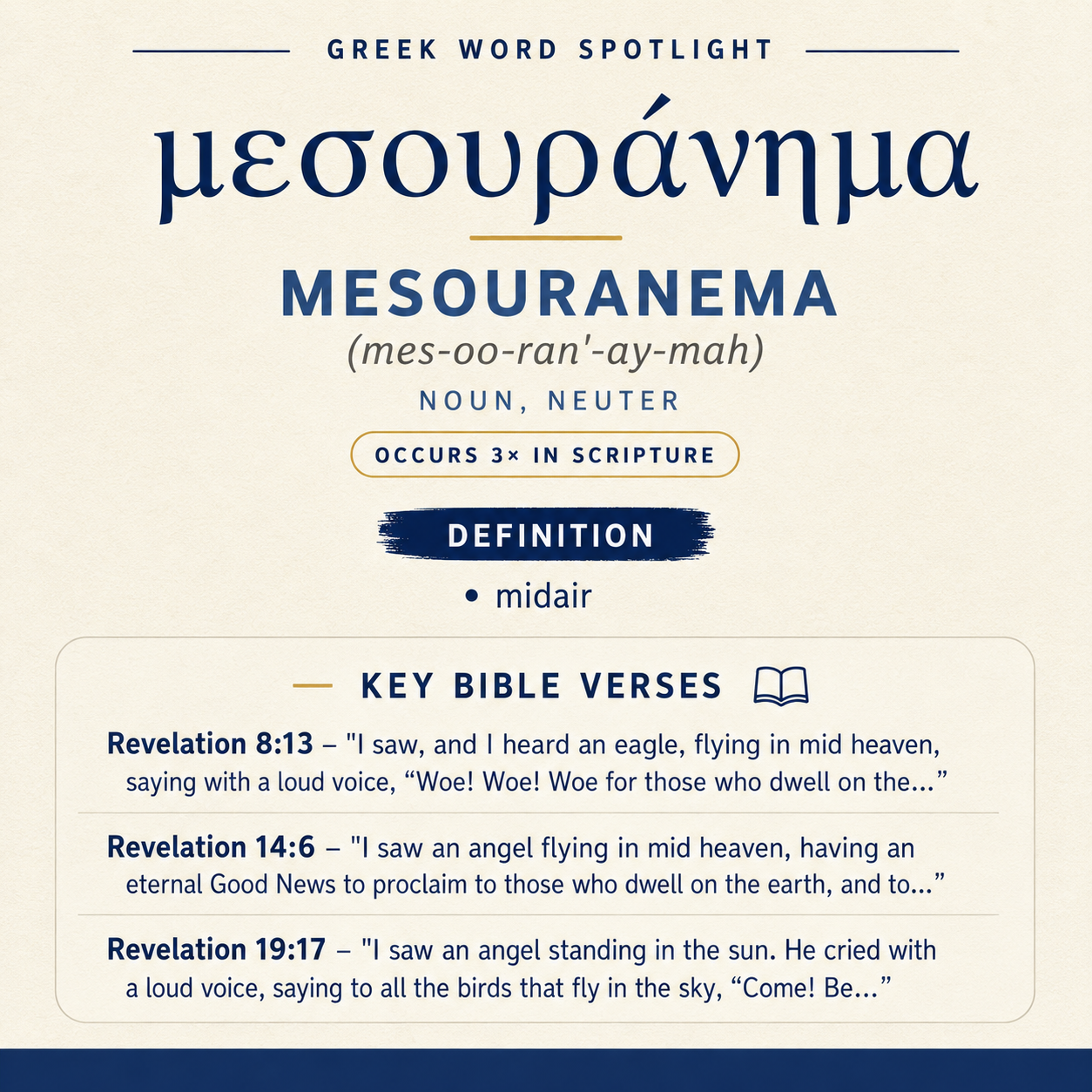
μεσουράνημα means “midair” and appears three times in Revelation (8:13; 14:6; 19:17).
Core Meaning
μεσουράνημα is defined as “midair.” It denotes the space described as “mid heaven” in Revelation’s scenes.
Learn More →Revelation Scenes
In Revelation 8:13 an eagle is heard flying in “mid heaven.” In Revelation 14:6 an angel flies in “mid heaven” proclaiming an eternal Good News.
Learn More →Angelic Proclamation
In Revelation 19:17 an angel cries with a loud voice to birds that fly in the sky. The setting includes the angel standing in the sun.
Learn More →μεσουράνημα denotes “midair,” and it appears in scenes in Revelation where a heralding voice is placed high above the earth. In these passages, the term marks a public, elevated location from which announcements are made to those below.
Root and Related Words
μεσουράνημα is connected with μέσος (mesos), “midst,” and οὐρανός (ouranos), “heaven.” The compound association naturally frames a location described in terms of being “in the midst” of “heaven,” giving the word a spatial force suitable for describing an aerial position.

Occurrences
Revelation 8:13: “I saw, and I heard an eagle, flying in mid heaven, saying with a loud voice, “Woe! Woe! Woe for those who dwell on the earth, because of the other voices of the trumpets of the three angels, who are yet to sound!””
Here μεσουράνημα places the eagle’s flight at a height that matches the scope of its cry. The eagle is not merely present in the scene; it is “flying in mid heaven” while issuing a threefold “Woe!” directed toward “those who dwell on the earth.” The wording ties the aerial location to audibility and reach: the warning is not private or local but projected outward as a loud announcement over the earthbound audience. The term therefore supports the narrative effect that the message is meant to be heard broadly, anticipating “the other voices of the trumpets of the three angels, who are yet to sound.”
Revelation 14:6: “I saw an angel flying in mid heaven, having an eternal Good News to proclaim to those who dwell on the earth, and to every nation, tribe, language, and people.”
In this occurrence, μεσουράνημα again situates a messenger in flight, but the content is proclamation rather than woe. The angel’s position “in mid heaven” corresponds to the stated breadth of the audience: “those who dwell on the earth” as well as “every nation, tribe, language, and people.” The word functions as a narrative staging detail that fits a message intended for the whole inhabited world. The angel is pictured not approaching a single city or building but occupying open sky, and the open-air setting reinforces the idea that the proclamation is directed outward to all groups named in the verse.

Revelation 19:17: “I saw an angel standing in the sun. He cried with a loud voice, saying to all the birds that fly in the sky, “Come! Be gathered together to the great supper of God,”
This verse describes an angel “standing in the sun,” and although μεσουράνημα is not expressed with the same “mid heaven” phrase in the English wording, the scene remains emphatically aerial. The call is aimed “to all the birds that fly in the sky,” and the messenger’s placement “in the sun” conveys an elevated vantage point for a summons meant for creatures already in flight. The word’s contribution in this context is consistent with the other occurrences: it belongs to the depiction of a high, open-air locale from which a loud cry goes out. The imagery keeps the summons above the earth, matching an audience defined not by geography on the ground but by movement through the sky.
Sense and Usage
Across these passages, “midair” operates as more than a simple coordinate on a map; it is a narrative location repeatedly used for messages that must carry widely. The speaking or proclaiming element is prominent each time: the eagle is “saying with a loud voice,” the angel has good news “to proclaim,” and the angel in the sun “cried with a loud voice.” In each case, the term anchors that vocal activity in an open, elevated place above the earth, so that the message is portrayed as public and far-reaching.
The word also helps define the relationship between messenger and audience. In Revelation 8:13 and 14:6, the recipients are named as “those who dwell on the earth,” explicitly contrasting their ground-based condition with the messenger’s midair position. The height creates a vertical staging: the messenger is above; the hearers are below. That vertical contrast supports the rhetorical force of the pronouncements—warning in one instance, worldwide proclamation in another—by giving the scene a clear directional flow from the sky down to earth’s inhabitants.
Even where the immediate addressees are airborne (“birds that fly in the sky” in Revelation 19:17), the midair setting remains fitting. The angel’s elevated station keeps the summons in the same sphere as the audience. The location is neither indoors nor on the ground; it is placed in the sky where flying creatures can be addressed collectively. In this way, “midair” serves as a consistent staging device for sweeping announcements: either to all earth-dwellers, or to all birds in flight.
Because the word is used with flying heralds and loud speech, it tends to carry connotations of exposure and visibility within the narrative world of Revelation. A message uttered in midair is not hidden; it belongs to the open realm above the earth. The term thus helps the reader imagine proclamation and warning as events carried out in the broadest possible public space—the sky over the world being addressed.
Imagery
Revelation’s use of μεσουράνημα gathers a consistent picture: a herald aloft, a loud voice, and an audience defined in universal terms (“those who dwell on the earth,” “every nation, tribe, language, and people,” “all the birds that fly in the sky”). The word contributes to that picture by fixing the action in the open air, a place suited to cries meant to travel and to be heard as part of the unfolding trumpet- and proclamation-scenes.
Sources: Lexical data from Strong’s Exhaustive Concordance and the Translators Brief Lexicon of Extended Strongs for Greek (STEPBible, CC BY). Occurrence data from the Translators Amalgamated Greek New Testament (STEPBible, CC BY). Scripture quotations from the World English Bible (public domain).