Exploring the Meaning of Mesopotamia in Greek
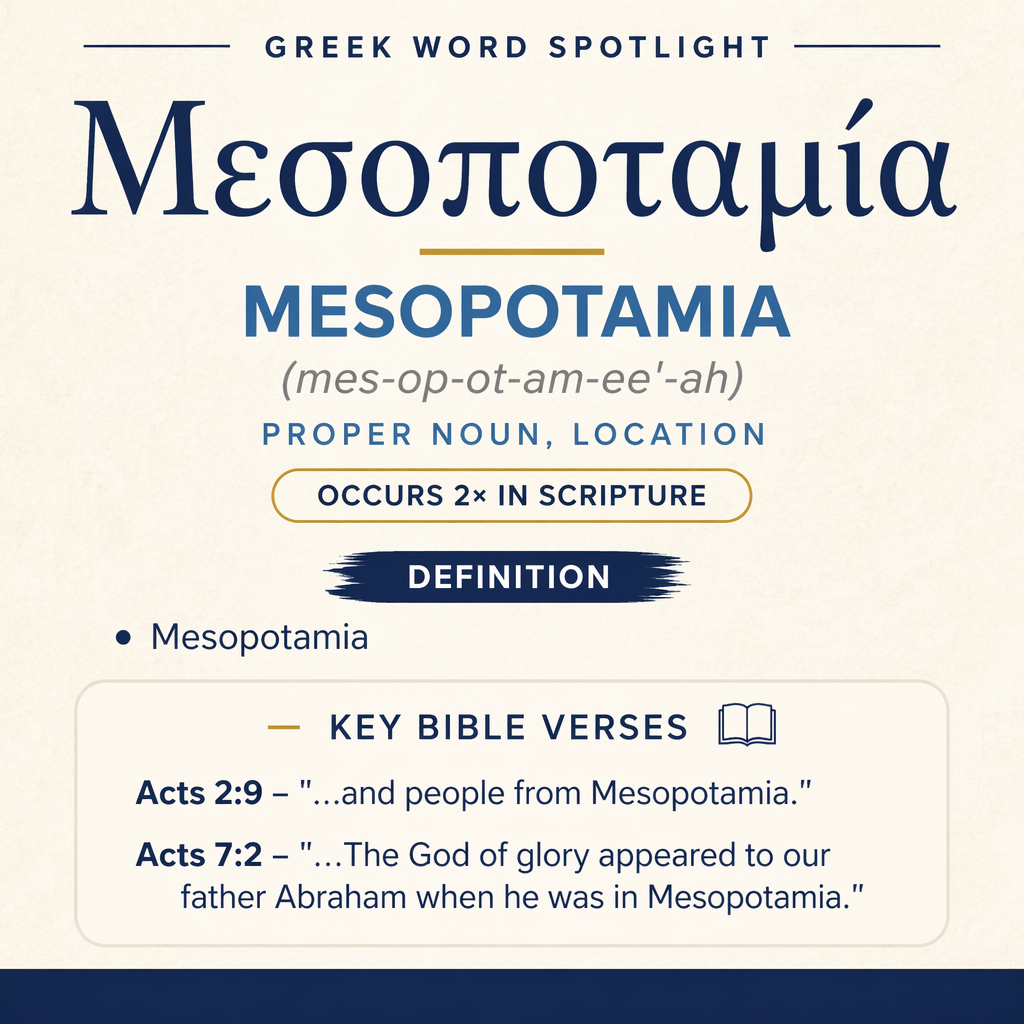
Μεσοποταμία means “Mesopotamia” and appears twice in Scripture, in Acts 2:9 and Acts 7:2.
Context in Acts
In Acts 2:9 it names people from Mesopotamia among other regions. In Acts 7:2 it locates Abraham in Mesopotamia before Haran.
Learn More →Μεσοποταμία refers to Mesopotamia, a named location. In the New Testament it appears in a list of places represented at Pentecost and in Stephen’s speech recounting a key moment in Abraham’s early life.
Root and Related Words
Mesopotamia is associated (per Strong’s) with the elements mesos (μέσος), “midst,” and potamos (ποταμός), “river.” These related terms frame the place-name as a geographically described region-name built from familiar Greek words.
Occurrences
“Parthians, Medes, Elamites, and people from Mesopotamia, Judea, Cappadocia, Pontus, Asia,” (Acts 2:9)
Here Mesopotamia functions as one item in a broad catalog of lands whose people are present in Jerusalem. The verse groups “people from Mesopotamia” alongside neighboring or well-known regional labels (“Parthians, Medes, Elamites”) and then continues with additional provinces and areas (“Judea, Cappadocia, Pontus, Asia”). Within the sentence, Mesopotamia marks a distinct point of origin: it is not merely a geographic term but a way of identifying a portion of the crowd by where they come from. The effect of the list is cumulative; Mesopotamia contributes to the breadth of the gathering by adding another recognizable homeland within the sweep of locations named.
“He said, “Brothers and fathers, listen. The God of glory appeared to our father Abraham when he was in Mesopotamia, before he lived in Haran,” (Acts 7:2)
In Stephen’s opening address, Mesopotamia anchors the setting for a decisive appearance of “the God of glory” to Abraham. The clause “when he was in Mesopotamia” places Abraham in that location at the time of the divine encounter, and the following phrase—“before he lived in Haran”—adds a temporal marker that distinguishes Mesopotamia from a later place of residence. Mesopotamia therefore carries narrative weight: it is the geographic point attached to the moment Stephen highlights, and it helps Stephen order events in Abraham’s life by place as well as by time. Within the rhetoric of the speech, the place-name is not decorative; it is the coordinate by which Stephen situates the patriarch and introduces the sequence that follows.
Sense and Usage
Across its two uses, Mesopotamia operates as a straightforward location name, but in two different kinds of discourse: a public listing and a historical recollection. In Acts 2:9 the term stands as a label of origin for a subset of “people,” functioning like a geographic identifier that helps the reader hear the diversity of the assembled crowd. Mesopotamia appears as one region among many, and its contribution is largely additive: it expands the sense of reach implied by the catalog of places.
In Acts 7:2, by contrast, Mesopotamia is embedded in a sentence that emphasizes timing (“when… before…”). The place-name is tied directly to an event (“appeared”) and to a person (“our father Abraham”), so it does more than indicate where someone comes from; it becomes the setting for an appearance of God and a hinge-point in a chronological account. The usage shows how a place-name can function both as a marker of origin in a multinational crowd and as a narrative locator in a speech that frames sacred history through movement and residence.
Taken together, these occurrences display Mesopotamia as a stable geographic reference that can carry either a social sense (“people from…”) or a biographical-historical sense (“when he was in…”). In both settings, the word’s force depends on its ability to name a real, recognizable location precisely enough to differentiate one group from another, or one stage of life from another, within a single sentence.
Imagery
The word evokes the concrete feel of a mapped world—named regions that people can come from (Acts 2:9) and named places where pivotal events are remembered as having occurred (Acts 7:2). In these passages, Mesopotamia carries the imagery of distance and placement: a homeland represented in a gathered crowd, and a locale set “before” another in a narrated life.
Sources: Lexical data from Strong’s Exhaustive Concordance and the Translators Brief Lexicon of Extended Strongs for Greek (STEPBible, CC BY). Occurrence data from the Translators Amalgamated Greek New Testament (STEPBible, CC BY). Scripture quotations from the World English Bible (public domain).