Exploring the Meaning of Mesonuktion in Greek
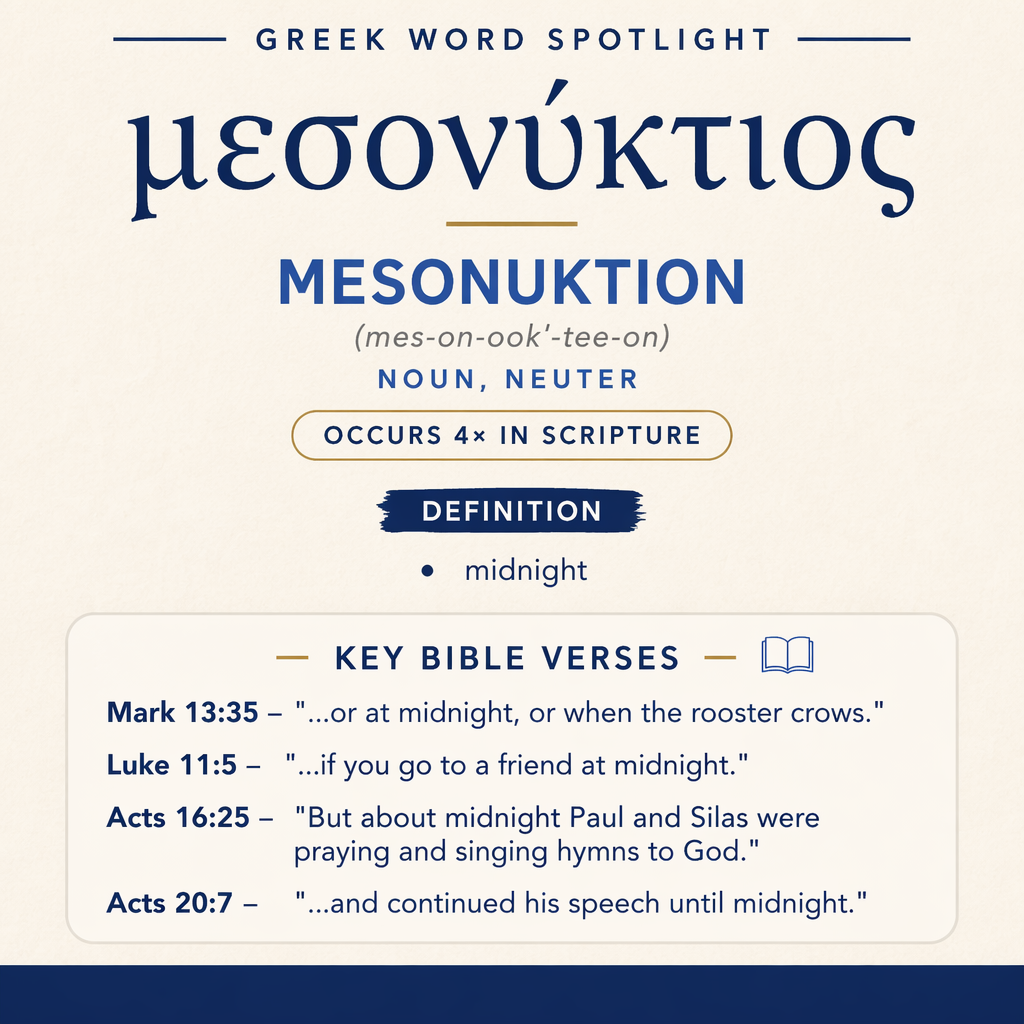
μεσονύκτιος means “midnight” and appears in Mark 13:35, Luke 11:5, Acts 16:25, and Acts 20:7.
Scripture Occurrences
It occurs 4 times in Scripture: Mark 13:35; Luke 11:5; Acts 16:25; Acts 20:7.
Learn More →Narrative Settings
It marks key moments such as a friend sought at midnight (Luke 11:5) and Paul and Silas praying and singing at midnight (Acts 16:25).
Learn More →μεσονύκτιος means “midnight,” the deep dividing point of the night. In the New Testament it appears in settings of watchfulness, a late-night request, prayer in confinement, and extended teaching to a gathered church.
Root and Related Words
μεσονύκτιος is formed from mesos (μέσος), “midst,” and nyx (νύξ), “night.” The compound naturally points to the middle portion of the night as a distinct time-marker within a larger sequence of hours.
Occurrences
“Watch therefore, for you don’t know when the lord of the house is coming, whether at evening, or at midnight, or when the rooster crows, or in the morning;” (Mark 13:35)
Here “midnight” functions as one item in a set of possible times for a master’s return. The verse divides the night-and-day cycle into recognizable watches: “evening,” “midnight,” “when the rooster crows,” and “in the morning.” In that list, μεσονύκτιος is the darkest, least predictable hour—an emblem of a time when people are normally least prepared—supporting the command to “Watch therefore.” The force of the warning depends on the fact that “midnight” is not a convenient or socially expected moment for arrival; it represents the kind of hour that exposes whether vigilance is real or only assumed.
“He said to them, “Which of you, if you go to a friend at midnight, and tell him, ‘Friend, lend me three loaves of bread,” (Luke 11:5)
In this question, “midnight” sharpens the social awkwardness and urgency of the scenario. The request is not made at a normal hour; it is made when a household would be closed up and at rest. By situating the approach “at midnight,” the verse frames the request (“lend me three loaves of bread”) as intrusive by time alone, even before any reason for the need is supplied. The word thereby heightens the pressure of the moment: the petitioner is willing to risk inconvenience and refusal because the need is immediate. “Midnight” becomes the narrative detail that makes the appeal feel costly and disruptive, and so it intensifies the stakes of the interaction between friends.
“But about midnight Paul and Silas were praying and singing hymns to God, and the prisoners were listening to them.” (Acts 16:25)
“About midnight” sets the time for an unexpected kind of activity: prayer and hymn-singing. The scene is framed as a time when darkness and confinement would normally mute hope; instead, the hour becomes the setting for audible worship. The mention that “the prisoners were listening” shows that the midnight prayers and hymns are not private thoughts but a public-sounding act within earshot. Μεσονύκτιος thus contributes more than a clock-reading: it places the worship at a boundary of the night when weariness would be natural, making the praying and singing stand out as deliberate and sustained. The word also marks the scene with a quiet intensity—few distractions, heightened attention—so that the listeners’ presence becomes plausible and pointed.
“On the first day of the week, when the disciples were gathered together to break bread, Paul talked with them, intending to depart on the next day, and continued his speech until midnight.” (Acts 20:7)
Here “until midnight” measures the duration of Paul’s speaking. The gathering is purposeful (“to break bread”), and Paul’s intent to “depart on the next day” explains why the time is stretched: the opportunity is limited, and the teaching continues as long as the night allows. By specifying “until midnight,” the verse conveys both the length of the meeting and the congregation’s endurance; the hour is late enough that it becomes a natural endpoint for a talk. Μεσονύκτιος functions as a narrative hinge between one day and the next: the disciples meet on “the first day of the week,” and the speech extends to the midnight threshold where the coming departure begins to loom closer. The word therefore underscores urgency and fullness of instruction within a single extended gathering.
Sense and Usage
Across these passages, “midnight” is consistently a concrete time reference, but it carries distinct narrative weight depending on context. In Mark 13:35 it is part of a series of time-points used to stress uncertainty; the hour serves as a test-case for vigilance because it is a moment when watchfulness is difficult. In Luke 11:5 it is the factor that makes the request startling: the petitioner’s boldness is measured in the willingness to disturb another person at the night’s midpoint. In Acts 16:25 it frames the atmosphere of worship as taking place when silence and despair might be expected, giving the praying and singing a striking contrast with the hour. In Acts 20:7 it becomes a measure of duration and urgency, showing how a community gathering can extend into the deepest part of the night when there is reason to press on.
Because μεσονύκτιος marks the middle of the night, it naturally highlights boundaries and transitions. It sits between earlier and later watches: in Mark’s sequence it is flanked by “evening” and “when the rooster crows,” and it anticipates “in the morning.” In Acts 20:7 it forms the terminus of a speech that began in a meeting already underway; the word marks how far the event has progressed. In Luke 11:5 it signals the extremity of the timing, shaping how the hearer imagines the closed door, sleeping household, and the difficulty of being approached. Even in Acts 16:25, where the phrase is “about midnight,” the approximation still centers the scene on the night’s midpoint, emphasizing that this is not early-night resilience but late-night perseverance.
In all four occurrences, “midnight” is not simply chronological information; it is a narrative tool that intensifies what people do in that hour. Watchfulness is demanded at midnight; a friend is approached at midnight; hymns are sung at midnight; teaching continues until midnight. The word therefore tends to spotlight actions that resist ordinary patterns of rest and closure, placing human choices and commitments under the pressure of a late, limiting time.
Imagery
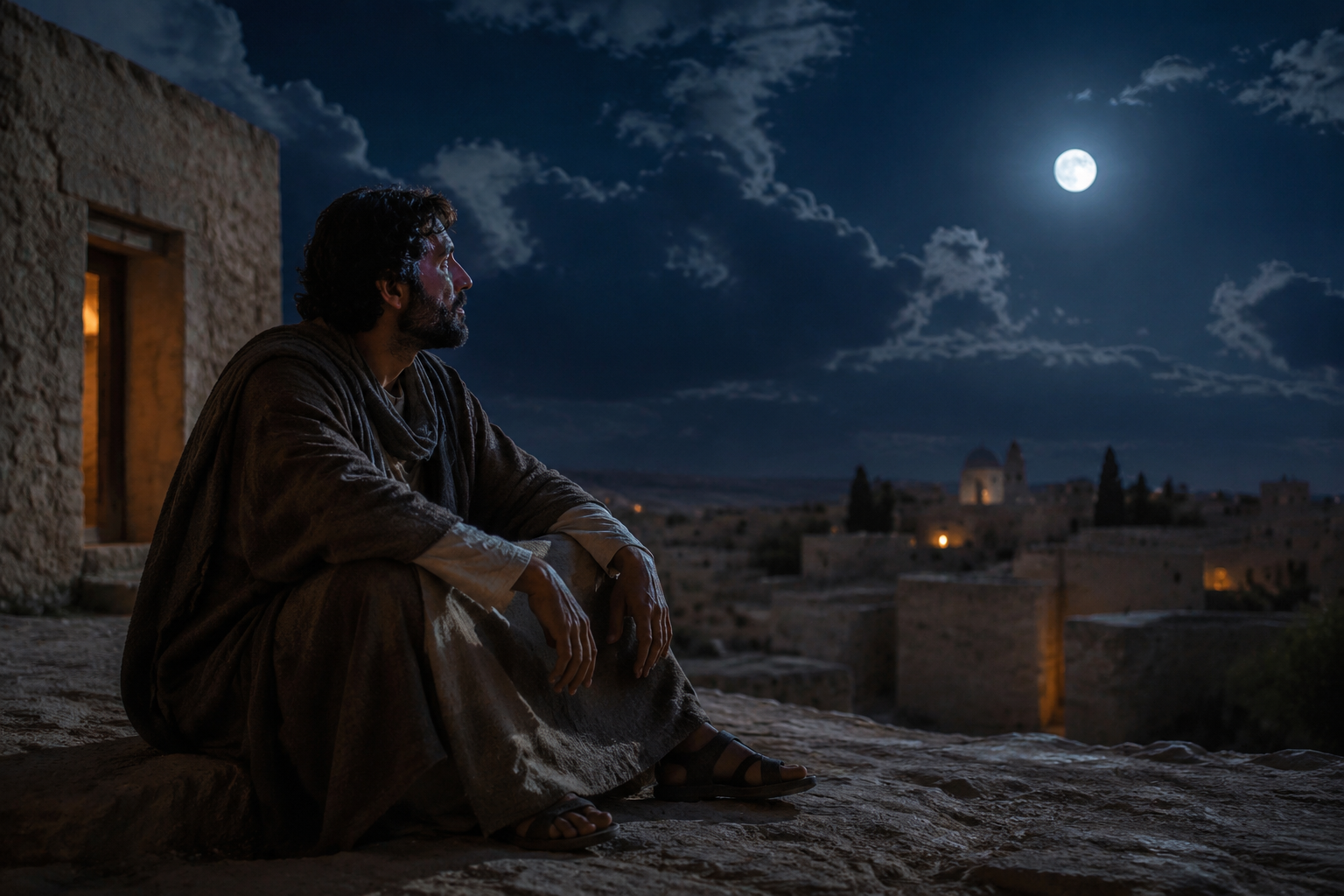
The imagery attached to “midnight” in these passages is the stillness and constraint of the night’s center: the hour when a household is shut, when a watchman is tested, when prisoners can listen in the dark, and when a gathered church measures the last stretch of an evening of instruction. In each scene, midnight is the backdrop that makes the action—watching, asking, praying, speaking—stand out with sharper edges.
Sources: Lexical data from Strong’s Exhaustive Concordance and the Translators Brief Lexicon of Extended Strongs for Greek (STEPBible, CC BY). Occurrence data from the Translators Amalgamated Greek New Testament (STEPBible, CC BY). Scripture quotations from the World English Bible (public domain).