Exploring the Meaning of Melas in Greek
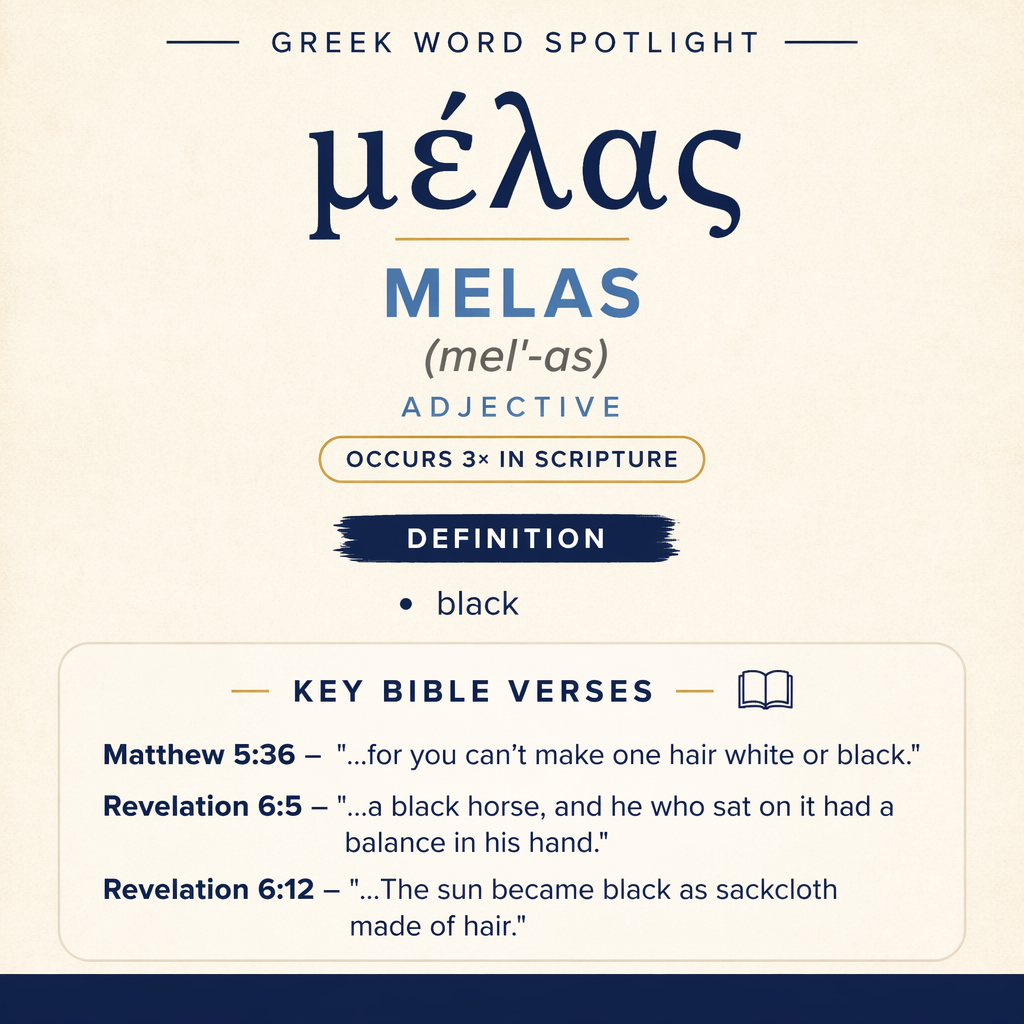
μέλας means “black” and appears in Matthew 5:36 and Revelation 6:5, 6:12.
Gospel Occurrence
In Matthew 5:36, it contrasts black with white hair. The verse notes human inability to change a hair’s color.
Learn More →Revelation Images
In Revelation 6:5, it describes a black horse. In Revelation 6:12, it describes the sun becoming black as sackcloth made of hair.
Learn More →μέλας expresses the color “black.” It appears in Matthew’s teaching about oaths and in two seal-visions in Revelation where blackness shapes what is seen in the scene.
Occurrences
“Neither shall you swear by your head, for you can’t make one hair white or black.” (Matthew 5:36)
Here μέλας names one end of a simple color contrast: “white or black.” The contrast is tied to human inability—“you can’t make one hair white or black”—and so the adjective functions as an everyday, observable marker of what lies outside a person’s control. In this sentence, blackness is not presented as a symbol to decode but as an ordinary, visible property of hair, paired with “white” to cover the range of what might be attempted. The point is driven by the plain fact that hair color is not something a person can command by an oath, even when swearing “by your head.”
“When he opened the third seal, I heard the third living creature saying, “Come and see!” And behold, a black horse, and he who sat on it had a balance in his hand.” (Revelation 6:5)
In the third seal, μέλας characterizes what John sees first: “behold, a black horse.” The color is part of the immediate visual profile of the horse and sets it apart as an object of attention within the vision. The horse’s blackness is narrated alongside two other concrete details in the same sentence: the rider (“he who sat on it”) and what the rider carries (“a balance in his hand”). The adjective thus contributes to the scene’s starkness and specificity; the vision is not merely of a horse, but of a horse defined by its black appearance, introduced with “behold” as a striking sight at the opening of the seal.
“I saw when he opened the sixth seal, and there was a great earthquake. The sun became black as sackcloth made of hair, and the whole moon became as blood.” (Revelation 6:12)
In the sixth seal, μέλας is applied not to an animal or a human feature but to the sun: “The sun became black.” The statement is embedded in a sequence of overwhelming events—“a great earthquake,” the sun’s change, and the moon’s change—so blackness here is part of a cosmic transformation. The verse itself supplies a comparison that fixes the kind of blackness envisioned: “black as sackcloth made of hair.” That simile makes the adjective vivid by linking it to a tangible, dark fabric, and it intensifies the sense that what should give light is now darkened. Within the line, the blackened sun stands in deliberate contrast to the moon described with a different color image (“as blood”), underscoring the breadth of altered appearance across the sky.

Sense and Usage
Across these passages, μέλας consistently functions as a straightforward color term, but it is used at different scales and with different rhetorical weight. In Matthew 5:36 the adjective belongs to daily life and to the natural limits of personal agency: hair can be observed as “white or black,” yet it cannot be willed into one shade or the other. The word’s force comes from its ordinariness—blackness as something anyone can recognize without specialized knowledge—supporting the argument that swearing “by your head” pretends to command what cannot be commanded.
In Revelation 6 the same color term is carried into visionary description. In 6:5 it marks the horse’s appearance with a single, sharp descriptor. Color is one of the quickest ways to distinguish figures in a vision; “a black horse” is immediately identifiable, and the adjective helps hold the scene together as a visual tableau alongside the rider and the “balance.” The effect is not merely to paint the scene but to present a coherent, memorable object of sight at a key narrative moment (“When he opened the third seal… And behold…”). The word is still a plain color term, yet in this setting it functions as part of the vision’s staging.
In 6:12 μέλας moves from describing an earthly creature to describing the sun itself, and the context gives the color a heightened intensity. The sun “became black,” a phrasing that presents blackness as an imposed condition within the unfolding seal events. The comparison “as sackcloth made of hair” anchors the description in a recognizable material darkness, so the reader is guided not toward an abstract idea of blackness but toward a particular, heavy kind of dark appearance. In this verse, μέλας contributes to a picture of the world’s lights altered, set among other sensory changes (“a great earthquake” and the moon’s changed look).
Seen together, the occurrences show μέλας used both in contrast (with “white” in Matthew) and in concentrated description (the horse and the sun in Revelation). The adjective readily attaches to different nouns—hair, horse, sun—without changing its basic value as a color word. What changes is the narrative environment: a teaching about what one cannot do, and visions where blackness helps define what is seen as seals are opened.
Imagery
The imagery associated with μέλας in these passages ranges from intimate to immense. Matthew places blackness at the scale of a single “hair,” a small, everyday detail used to expose the limits of human power. Revelation expands the same color into scenes meant to be beheld: first a horse whose black appearance is part of the vision’s immediate impact, then a sun that “became black as sackcloth made of hair” amid earthquake and a transformed moon. In these texts, blackness helps the reader see—whether the point concerns ordinary life under one’s head, or the terrifying clarity of what appears when the seals are opened.
Sources: Lexical data from Strong’s Exhaustive Concordance and the Translators Brief Lexicon of Extended Strongs for Greek (STEPBible, CC BY). Occurrence data from the Translators Amalgamated Greek New Testament (STEPBible, CC BY). Scripture quotations from the World English Bible (public domain).