Exploring the Meaning of Methodeia in Greek
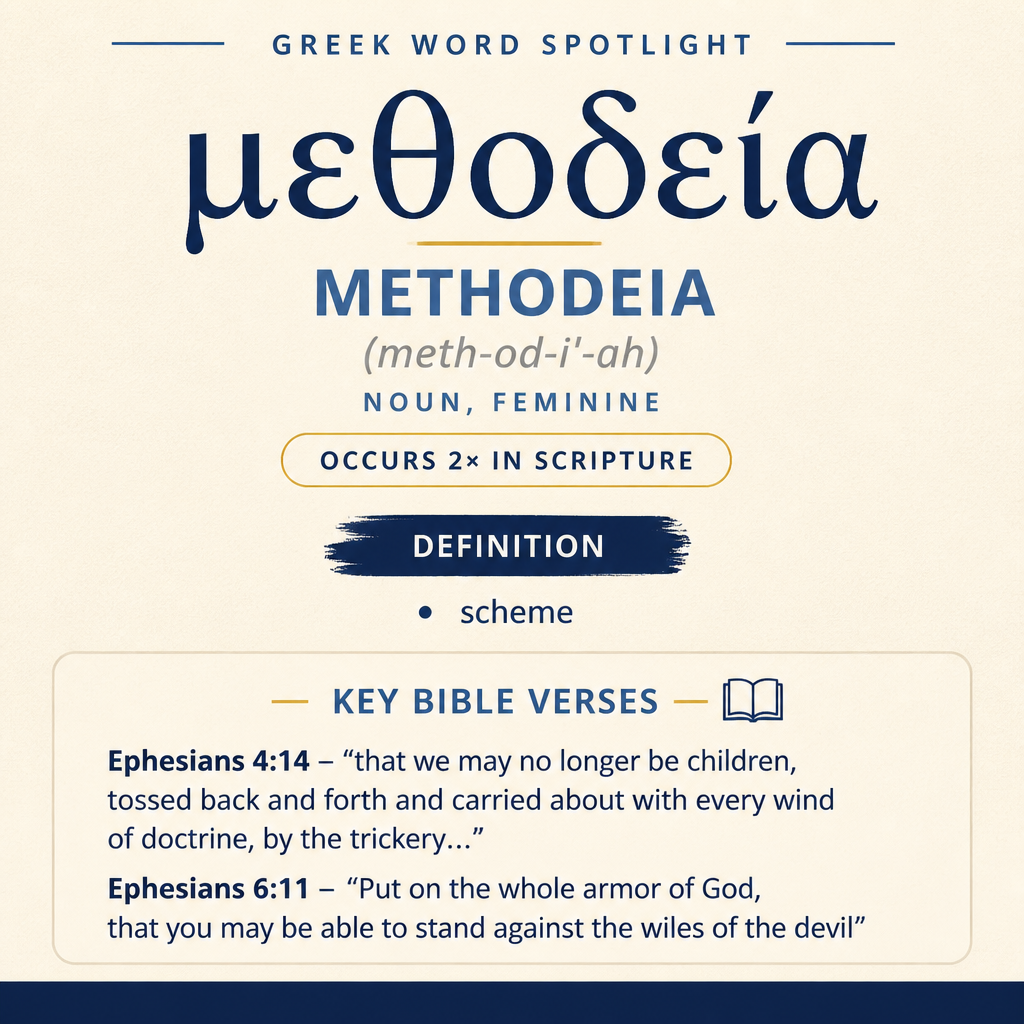
μεθοδεία means “scheme” and appears twice in Scripture, in Ephesians 4:14 and Ephesians 6:11.
Scripture Occurrences
This word occurs 2 times in Scripture. The references are Ephesians 4:14 and Ephesians 6:11.
Learn More →Context in Ephesians
In Ephesians 4:14 it appears in a warning about being carried about by every wind of doctrine. In Ephesians 6:11 it is used of the devil’s wiles.
Learn More →μεθοδεία means “scheme” and appears in Ephesians in two contexts of spiritual and doctrinal danger. In both, it names an organized threat that a believer must recognize and resist.
Root and Related Words
μεθοδεία (Methodeia) is associated with the preposition μετά (meta), “with/after” (Strong’s G3326), and the verb ὁδεύω (hodeuo), “to journey” (Strong’s G3593). Together these related elements suggest the idea of a course or way taken “with” something—language well suited to describing a plotted approach rather than a random impulse.
Occurrences
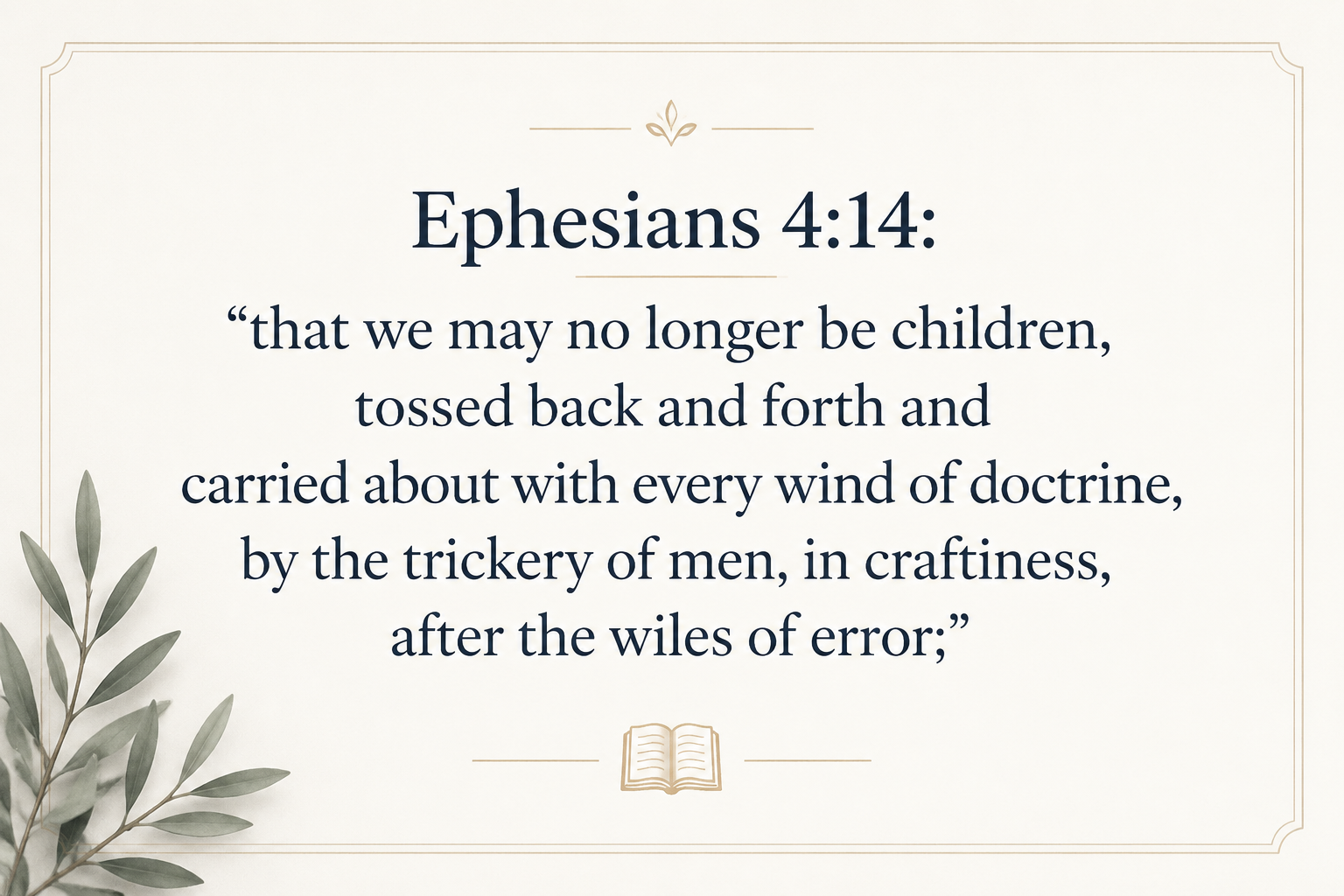
Ephesians 4:14: “that we may no longer be children, tossed back and forth and carried about with every wind of doctrine, by the trickery of men, in craftiness, after the wiles of error;”
Here μεθοδεία sits inside a tightly packed description of instability and manipulation. Paul contrasts maturity (“no longer be children”) with the vulnerability of being “tossed back and forth” and “carried about” by shifting teaching pictured as “every wind of doctrine.” In that setting, “scheme” belongs to the human side of the danger: “the trickery of men” and “craftiness” are not presented as mere mistakes or misunderstandings, but as purposeful activity that pushes people in a direction. The final phrase, “after the wiles of error,” frames error as having its own strategized patterns—error is not only a wrong conclusion but something that can work methodically through persuasive methods. Thus μεθοδεία names the patterned techniques that make doctrinal winds effective at moving immature hearers.
The verse’s imagery highlights how a scheme operates: it does not need force when it can rely on motion and momentum. A childlike state is pictured as lightness and lack of ballast; “trickery,” “craftiness,” and “wiles” become the hands that catch the wind and steer it. In this occurrence, μεθοδεία is bound up with persuasion and manipulation in speech and teaching, working through “doctrine” and through interpersonal influence (“men”).
Ephesians 6:11: “Put on the whole armor of God, that you may be able to stand against the wiles of the devil.”
In Ephesians 6:11, μεθοδεία moves from the realm of doctrinal turbulence to the posture of direct resistance. The command “Put on the whole armor of God” places the believer in a battlefield stance, and the purpose is explicitly stated: “that you may be able to stand.” Against what? “Against the wiles of the devil.” Here “scheme” is not attached to human trickery, but to a personal adversary whose approaches require a defensive, prepared response. The word marks the devil’s activity as calculated and tactical, the kind of threat that calls for “the whole armor,” not a partial readiness.
The contribution of μεθοδεία in this line is to explain why armor is needed at all: what must be faced is not only raw hostility but stratagem. A scheme is something one can be caught in or outflanked by; therefore the goal is “to stand,” not to be driven back or knocked down. The verse’s emphasis on standing frames the “wiles” as attempts to unsettle, dislodge, or overcome by planned approaches rather than by a single obvious blow.
Sense and Usage
Across these two occurrences, “scheme” functions as a word for organized opposition—danger that comes with method. In Ephesians 4:14, it is embedded in language about movement and instability: people can be “tossed,” “carried about,” and redirected through teaching that shifts like wind. In that scene, the scheme is effective because it works with psychological and communal dynamics: “trickery,” “craftiness,” and “wiles of error” all portray a process that steers belief and, by implication, conduct. The threat is not presented as neutral information that happens to be wrong, but as something working toward a result through human agency.
In Ephesians 6:11, the same term is tied to preparedness and endurance. The “scheme” is something to be stood against, and that resistance is enabled by being fully outfitted—“the whole armor of God.” The word therefore belongs to a framework where discernment and readiness are necessary precisely because the opponent’s activity has form and strategy. The schemes are pluralized in English (“wiles”), which fits the idea of multiple lines of approach: not one simplistic temptation, but varied tactics that require a complete defense.
Taken together, these passages show how μεθοδεία can name the strategic dimension of spiritual and doctrinal conflict: error does not only exist as a mistaken proposition, and the devil does not only menace as an open enemy. Rather, both can work through methods—planned patterns that exploit weakness. The contrast between “children” in Ephesians 4:14 and “stand” in Ephesians 6:11 is especially revealing: immaturity is portrayed as being moved around, while readiness is portrayed as holding ground. In that contrast, “scheme” is what makes the difference between being acted upon and being able to resist.
The term’s two settings also clarify the kinds of arenas in which schemes operate. One arena is teaching (“doctrine”) and the social-spiritual environment that spreads it (“trickery of men,” “craftiness”). The other is conflict that requires armor and steadfast posture. The word is flexible enough to describe strategized pressure from human agents and strategized assault from the devil, yet consistent in what it highlights: purposeful, directed methods.
Imagery in Ephesians
The imagery surrounding μεθοδεία is vivid and concrete. In Ephesians 4:14, the scheme is pictured as the hidden hand behind winds that jolt and carry the unsteady, turning doctrinal change into a vehicle for manipulation: “tossed back and forth” and “carried about.” In Ephesians 6:11, the scheme is faced like an opponent’s tactics on a battlefield, answered not by panic but by readiness: “Put on the whole armor of God, that you may be able to stand.” Together these images frame a scheme as something that either moves a person off course or tries to push a person off balance, and they place the reader in two complementary postures: growing out of childlike instability and standing firm with full protection.
Sources: Lexical data from Strong’s Exhaustive Concordance and the Translators Brief Lexicon of Extended Strongs for Greek (STEPBible, CC BY). Occurrence data from the Translators Amalgamated Greek New Testament (STEPBible, CC BY). Scripture quotations from the World English Bible (public domain).