Exploring the Meaning of Mattatha in Greek
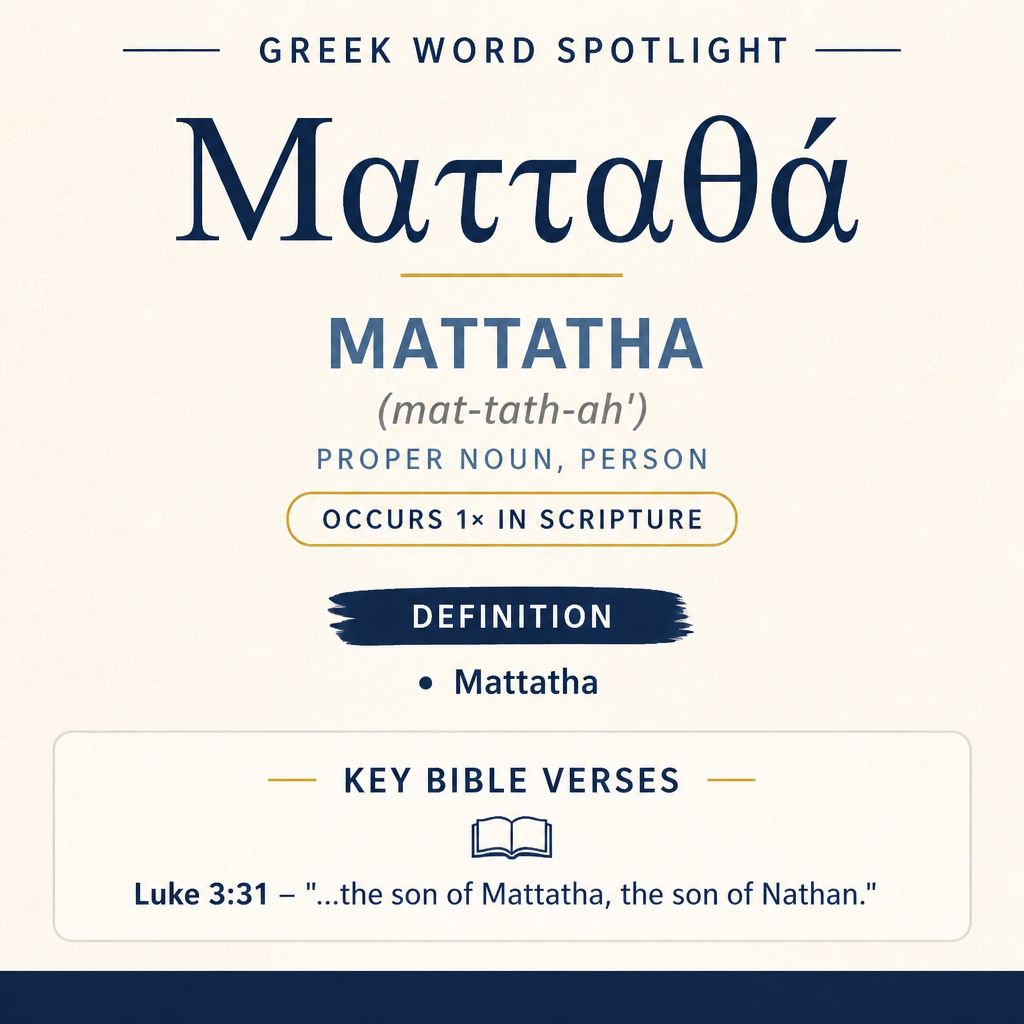
Ματταθά (Mattatha) means “Mattatha” and appears once in Scripture in Luke 3:31.
Genealogy Context
In Luke 3:31, Mattatha is named in a lineage: “the son of Mattatha, the son of Nathan, the son of David.”
Learn More →Mattatha is a personal name recorded in the genealogy of Jesus in Luke. It appears within a chain of “son of” relationships that situates individuals within a remembered family line.
Root and Related Words
Mattatha is related to the Greek proper name Mattathias (Ματταθίας), “Mattathias” (Strong’s G3161).

Occurrences
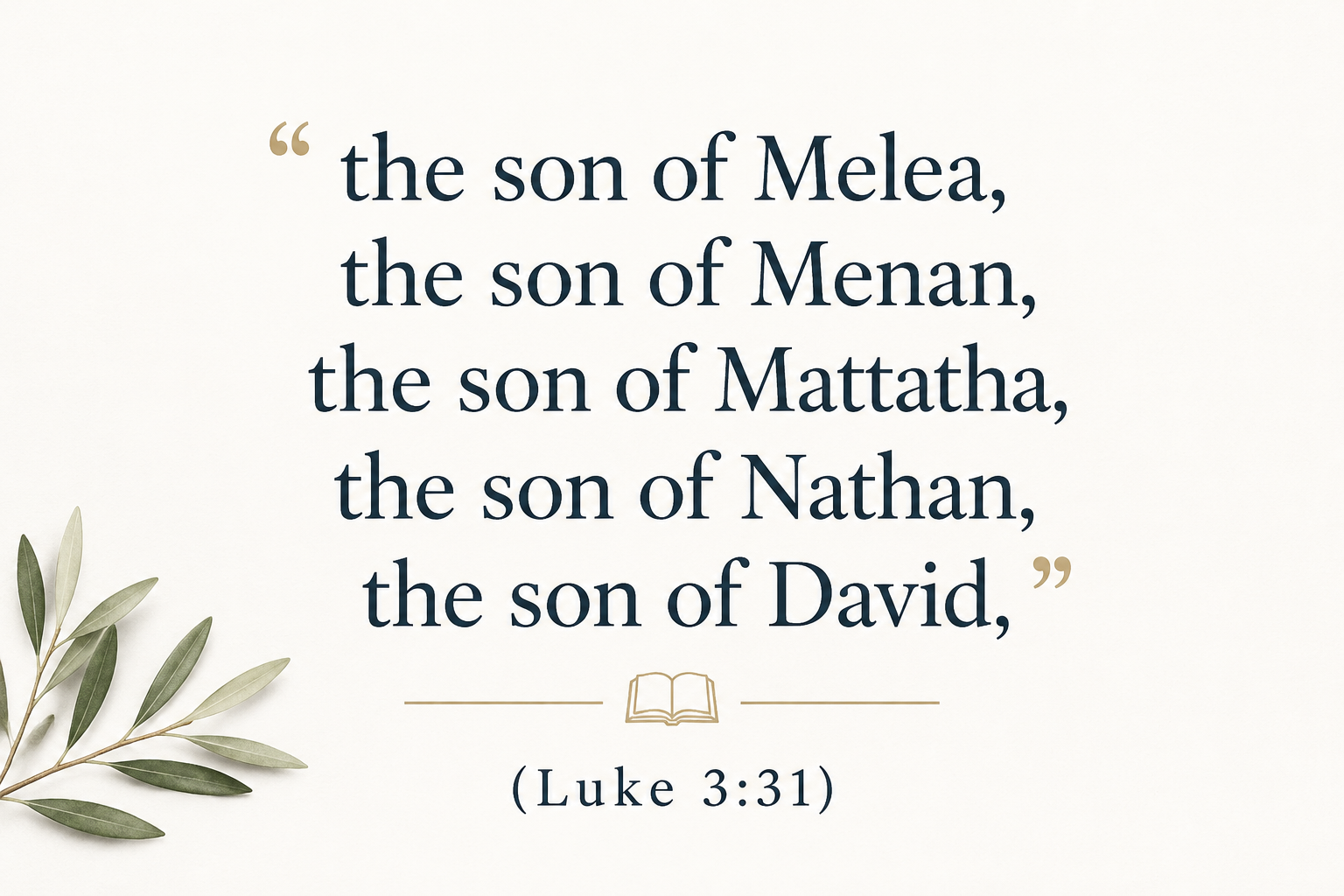
“the son of Melea, the son of Menan, the son of Mattatha, the son of Nathan, the son of David,” (Luke 3:31)
Here Mattatha functions as one link in a carefully ordered lineage. The repeated phrase “the son of” frames the name as an ancestral marker rather than as a character in a narrated episode: Mattatha is not introduced by actions, speech, or setting, but by placement within a succession of fathers and sons. In this single line, the genealogy moves from Melea to Menan to Mattatha, then onward to Nathan and David; Mattatha’s contribution is to anchor the transition between Menan and Nathan inside that sequence.
The verse’s structure also shows how the name works grammatically and rhetorically in genealogical discourse. It appears as the object of the repeated filial formula (“the son of …”), which gives each name its role: each person is defined in relation to the person immediately adjacent in the list. In that way, Mattatha is presented relationally—identified by the son who descends from him (“the son of Mattatha”) and, by implication within the chain, by his own placement between his predecessor (Menan) and his successor (Nathan). The result is a compact identity: Mattatha is “Mattatha” precisely as a remembered ancestor located at a specific point within a named line.
Because Luke 3:31 places Mattatha in immediate proximity to well-known names in Israel’s royal story (“… the son of David”), the name participates in the genealogy’s wider aim of tracing descent through recognizable ancestral points. Even though the verse gives no narrative detail about Mattatha personally, his inclusion matters for the continuity of the line as Luke presents it. In this list-form context, the presence of a single name is itself a form of testimony: it asserts that the lineage has a particular shape and that each step is to be read as part of an unbroken succession.
Sense and Usage
As a proper name, Mattatha is used straightforwardly as an identifier. The text does not treat it as a title or description, nor does it attach any explanatory phrase that would guide the reader toward a meaning beyond the name itself. Its function is referential: it points to a specific person positioned within a genealogy.
The way the name is embedded in Luke 3:31 highlights a common feature of genealogical naming: a person is presented as a node in a chain rather than as an independent subject. The repeated syntax (“the son of … the son of …”) reduces ambiguity by attaching each name to an immediate relational frame. Within that frame, Mattatha’s “sense” is not developed by context clues like occupation, place, or deeds; instead, it is developed by adjacency—who comes before and after. In this verse, the name’s usefulness lies in its capacity to keep the lineage precise: Menan is linked to Nathan through Mattatha, and Mattatha is the designated point of linkage.
Luke’s genealogical style also gives the name a particular kind of weight. A narrative scene can portray a figure through speech, conflict, or setting, but a genealogy portrays a figure through placement. Mattatha therefore carries the kind of significance genealogies assign: continuity, inheritance, and remembered connection. The verse does not invite speculation about the individual beyond his location in the line; it invites the reader to follow the line itself, name by name, and to recognize that each named person, including Mattatha, is treated as a real step within that descent.
In practical reading, Mattatha’s appearance shows how genealogies preserve lesser-known names alongside prominent ones. The verse moves toward “David,” a name with strong recognition, but it does so through intermediate names that do not receive further explanation here. Mattatha is one of those intermediate names, and his usage illustrates how the genealogy maintains its claims: not by skipping from one famous figure to another, but by stating intermediate links. The presence of Mattatha is thus part of the genealogy’s cumulative credibility as a list of successive relationships, presented in a consistent formula.
Imagery
The imagery surrounding Mattatha in Luke 3:31 is the imagery of a written lineage: a sequence of names bound together by repeated relational language. The verse evokes the picture of ancestry laid out step by step—each “son of” forming a verbal link—so that the reader can envision a line extending through time, with Mattatha occupying a single, fixed position within it.
Sources: Lexical data from Strong’s Exhaustive Concordance and the Translators Brief Lexicon of Extended Strongs for Greek (STEPBible, CC BY). Occurrence data from the Translators Amalgamated Greek New Testament (STEPBible, CC BY). Scripture quotations from the World English Bible (public domain).