Exploring the Meaning of Marmaros in Greek
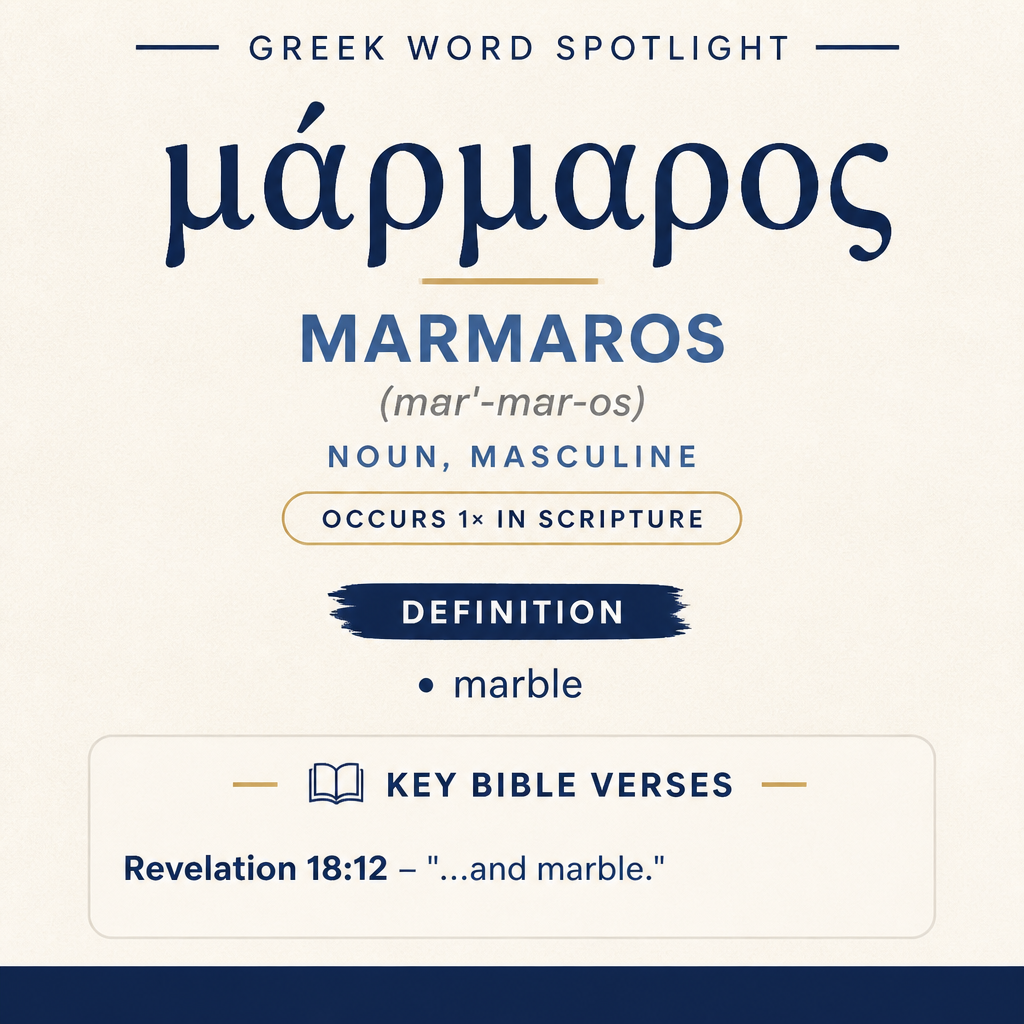
μάρμαρος means “marble” and appears once in Scripture, in Revelation 18:12.
μάρμαρος denotes “marble” and appears in the catalog of luxury goods associated with Babylon’s commerce. In its single New Testament occurrence, it functions as a concrete material that rounds out a list of costly merchandise.
Occurrences
“merchandise of gold, silver, precious stones, pearls, fine linen, purple, silk, scarlet, all expensive wood, every vessel of ivory, every vessel made of most precious wood, and of brass, and iron, and marble;” (Revelation 18:12)
Here μάρμαρος stands at the end of a long inventory introduced by “merchandise,” a word that frames the entire line as trade goods. The list moves through precious metals (“gold, silver”), gemstones and luxury adornments (“precious stones, pearls”), elite textiles and dyes (“fine linen, purple, silk, scarlet”), and then into costly materials used for crafted objects (“all expensive wood,” “every vessel of ivory,” “every vessel made of most precious wood”). Within this sequence, marble is grouped with durable materials for manufacture—“brass, and iron, and marble”—rather than with fabrics or gems. That placement lets the reader hear marble as a substance for making things (“vessel” language has just been repeated), and as an item of commerce that belongs alongside other high-status building or artisan materials.
The phrasing “and of brass, and iron, and marble” gives each material a separate beat. Even though iron might be common in other settings, in this particular list it is framed as part of “merchandise” associated with wealth, and marble is coordinated with it as one more commodity that contributes to the overall picture of costly supply chains. By ending this portion with marble, the text concludes the series of solid materials on a weighty, tangible note—something you can quarry, shape, transport, and display—matching the cumulative effect of a market that traffics in both beauty (pearls, silk) and permanence (wood, ivory, metals, marble).

Sense and Usage
Because μάρμαρος means “marble,” its sense is straightforwardly material: it names a specific kind of stone-valued commodity. In Revelation 18:12, marble participates in a carefully tiered portrayal of luxury. The catalog begins with items that are small, portable, and intrinsically valuable (gold and precious stones), then turns to textiles whose worth depends on quality and color, and finally arrives at raw and worked substances used to produce “vessels.” Marble belongs to this last category, where value is expressed through costly materials and craftsmanship rather than through rarity alone.
The immediate co-text gives several cues to how marble is being imagined. First, it appears as “merchandise,” not as a decorative detail in a single room or building. Marble is therefore pictured as an article in a trading economy: something bought and sold in quantity, part of a supply of refined materials. Second, its company—“brass, and iron”—highlights solidity, weight, and durability. The list is not simply naming “pretty things”; it is naming the full spectrum of luxury production, from adornment to furniture-like “vessels” and the substances that make them possible. Marble, in that setting, communicates expense through the kind of material that can be made into lasting, conspicuous objects.
Third, the syntax “every vessel of ivory, every vessel made of most precious wood” places emphasis on manufacture: vessels are defined by what they are made of. Marble is introduced immediately after these “vessel” lines, so that the reader naturally hears it in the same register of materials suitable for high-end workmanship. Even without repeating “vessel” again, the list’s momentum carries the association forward: marble is one more prestigious medium in which luxury can take physical form.
In this verse, μάρμαρος also helps the list feel comprehensive. Alongside perishable items (textiles) and objects whose value is tied to fine workmanship (ivory vessels), marble evokes a different kind of worth—stone that signals permanence and a public, architectural kind of splendor. The word’s contribution is thus not a shift in meaning but a shift in texture: it brings in the cold, hard, heavy feel of quarried stone as part of the luxury profile being portrayed.
Imagery
Revelation 18:12 piles up goods until the reader senses excess. Within that accumulation, marble adds the imagery of costly stone among the materials of wealth, a commodity fit to be transported, shaped, and displayed. In the cadence of “and of brass, and iron, and marble,” the term leaves the ear with the impression of tangible, durable riches—wealth that can be built into objects meant to last.
Sources: Lexical data from Strong’s Exhaustive Concordance and the Translators Brief Lexicon of Extended Strongs for Greek (STEPBible, CC BY). Occurrence data from the Translators Amalgamated Greek New Testament (STEPBible, CC BY). Scripture quotations from the World English Bible (public domain).