Exploring the Meaning of Makros in Greek
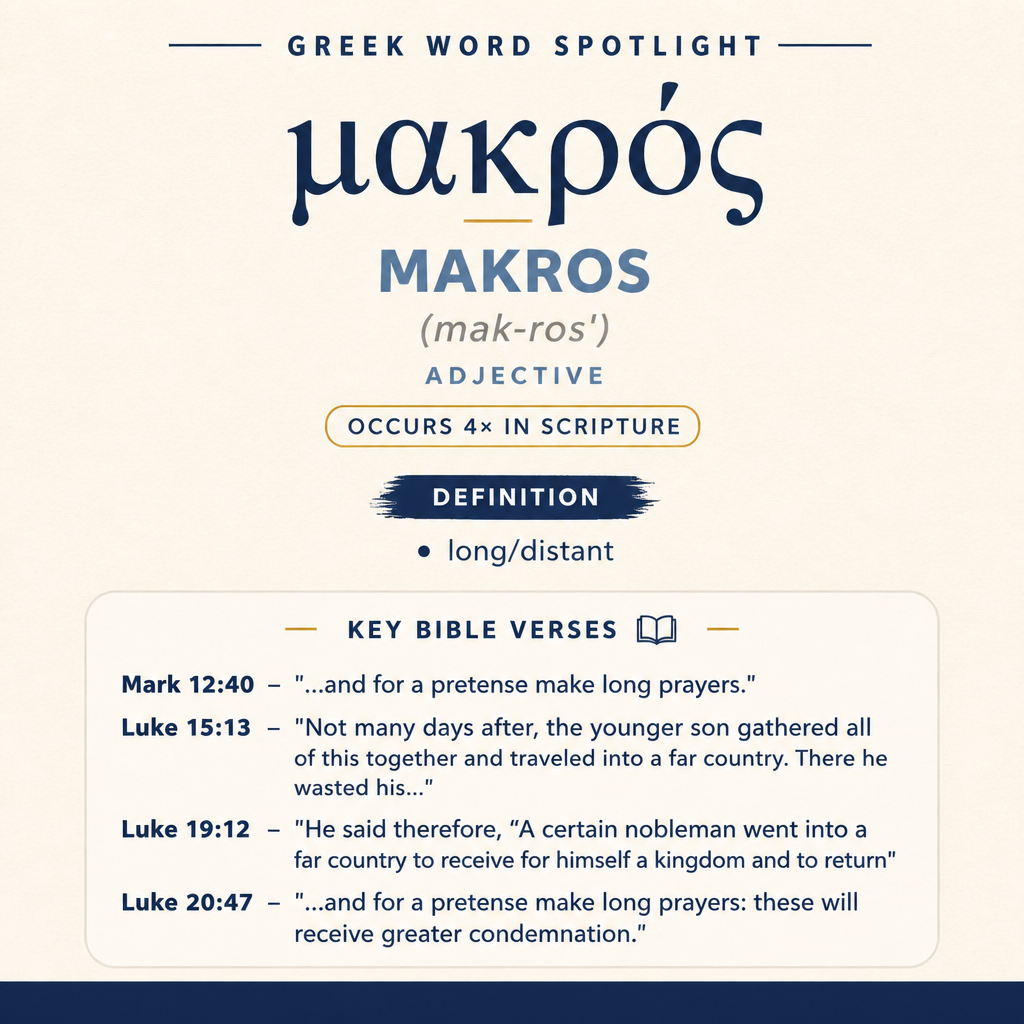
μακρός means “long/distant” and occurs four times in Scripture: Mark 12:40; Luke 15:13; Luke 19:12; Luke 20:47.
Core Meaning
μακρός carries the sense of “long” or “distant.” It describes length (prayers) and distance (a far country).
Learn More →Gospel Occurrences
This word appears in Mark 12:40 and Luke 20:47 in the phrase “long prayers.” It also appears in Luke 15:13 and Luke 19:12 for traveling into a “far country.”
Learn More →Context Snapshots
In Mark 12:40 and Luke 20:47, “long prayers” are linked with devouring widows’ houses and greater condemnation. In Luke 15:13 and Luke 19:12, it marks a journey into a far country.
Learn More →μακρός describes something as “long/distant,” and in the New Testament it appears in two main settings: public religious display (“long prayers”) and deliberate separation (“a far country”). The four attested uses cluster in Mark 12 and Luke 15, 19, and 20, each showing the adjective shaping how actions or movement are perceived.
Root and Related Words
μακρός is related to mekos (μῆκος), “length” (Strong’s G3372).

Occurrences
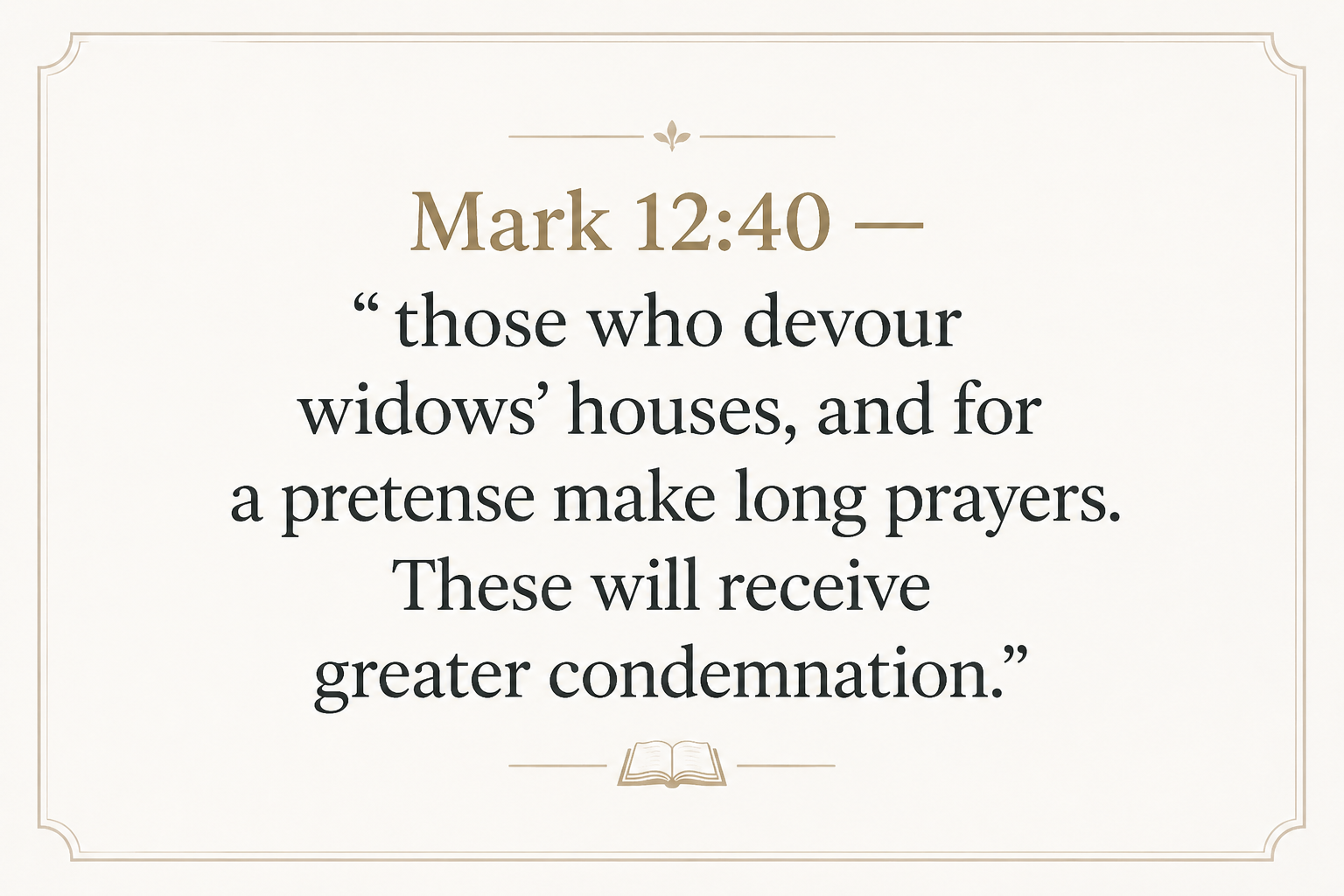
Mark 12:40 — “those who devour widows’ houses, and for a pretense make long prayers. These will receive greater condemnation.”
Here μακρός qualifies “prayers,” marking them as extended in duration. The surrounding description frames this length as part of a “pretense”: the prayers are not merely described as lengthy but are presented as a performed display alongside exploitation (“devour widows’ houses”). The adjective therefore contributes to the portrait of outward religiosity that can be stretched out for effect, and the moral weight of the scene falls on the contrast between the visible, prolonged act and the hidden wrongdoing it accompanies.
Luke 15:13 — “Not many days after, the younger son gathered all of this together and traveled into a far country. There he wasted his property with riotous living.”
In the parable, μακρός marks the country as “far,” emphasizing distance as a narrative tool. The younger son’s movement is not simply travel but a self-chosen removal from his previous setting, and the adjective helps the reader feel that separation. The “far country” becomes the stage for the next clause—“There he wasted his property”—so the distance functions as a context in which his squandered life unfolds. The adjective thus colors the setting with remoteness: what happens “there” is portrayed as occurring away from the place he left.
Luke 19:12 — “He said therefore, “A certain nobleman went into a far country to receive for himself a kingdom and to return.”
μακρός again characterizes the destination as “far,” but the plot purpose differs. The nobleman’s travel is connected to a defined aim (“to receive for himself a kingdom”) and an expected outcome (“and to return”). The adjective contributes the sense of separation and delay implied by traveling to a distant place: the nobleman is away long enough, and far enough, for events to be set in motion in his absence, yet the story holds together with the certainty that he will come back. Distance here is not aimless escape but part of an ordered sequence—going away, receiving, returning.
Luke 20:47 — “who devour widows’ houses, and for a pretense make long prayers: these will receive greater condemnation.”
This occurrence matches the Markan wording closely and uses μακρός in the same descriptive role: the prayers are “long,” and their length serves a “pretense.” The adjective intensifies the picture of public piety—extended prayer as something that can be seen, noticed, and perhaps admired—while the rest of the sentence exposes an exploitative reality. In this scene the length of the prayers is not praised; it is folded into an accusation. The concluding judgment (“greater condemnation”) indicates that the prolonged character of these prayers, when used as cover, becomes part of what is evaluated and condemned.
Sense and Usage
Across these passages, μακρός consistently works along two closely related lines that fit “long/distant.” In Mark 12:40 and Luke 20:47, it attaches to a practice (“prayers”) and characterizes it by extension: the action is drawn out, and that extended quality becomes socially legible. Because the prayers are linked with “pretense,” the adjective helps depict how an outwardly impressive religious activity can be prolonged to create an appearance. In both verses the “long” quality is not a neutral measurement but part of a larger moral portrait: the length functions rhetorically, contributing to the impression-making that stands alongside abuse.
In Luke 15:13 and Luke 19:12, μακρός modifies place (“country”) and points to spatial remoteness. Yet the narrative effect differs in each parable. In Luke 15, the “far country” highlights a break: the son gathers everything, leaves, and then “There” wastes what he has, with the distance helping to frame his dissipation as something done away from home. In Luke 19, the “far country” highlights interval and expectation: the nobleman departs to obtain something and intends to return, so the distance supports a storyline where absence is meaningful and return is part of the plan. In both, μακρός shapes how the reader imagines the setting—removed from the starting point, with actions occurring in the space created by that removal.
Read together, these uses show how μακρός can describe extension either in time-like experience (an act that goes on) or in space (a destination that is removed). The adjective’s contribution is often more than measurement: it helps set a scene. A “long” prayer becomes a visible performance within a charged moral evaluation, while a “far” country becomes the narrative room in which a character’s choices or a nobleman’s absence and return can be understood.
Imagery
The word’s imagery in these verses alternates between soundless duration and traveled distance. On one side are “long prayers” (Mark 12:40; Luke 20:47), pictured as extended speech offered “for a pretense,” with their length serving the impression they make. On the other side is the road to “a far country” (Luke 15:13; Luke 19:12), where remoteness frames either reckless waste or an ordered departure with an intended return.
Sources: Lexical data from Strong’s Exhaustive Concordance and the Translators Brief Lexicon of Extended Strongs for Greek (STEPBible, CC BY). Occurrence data from the Translators Amalgamated Greek New Testament (STEPBible, CC BY). Scripture quotations from the World English Bible (public domain).