Exploring the Meaning of Mainan in Greek
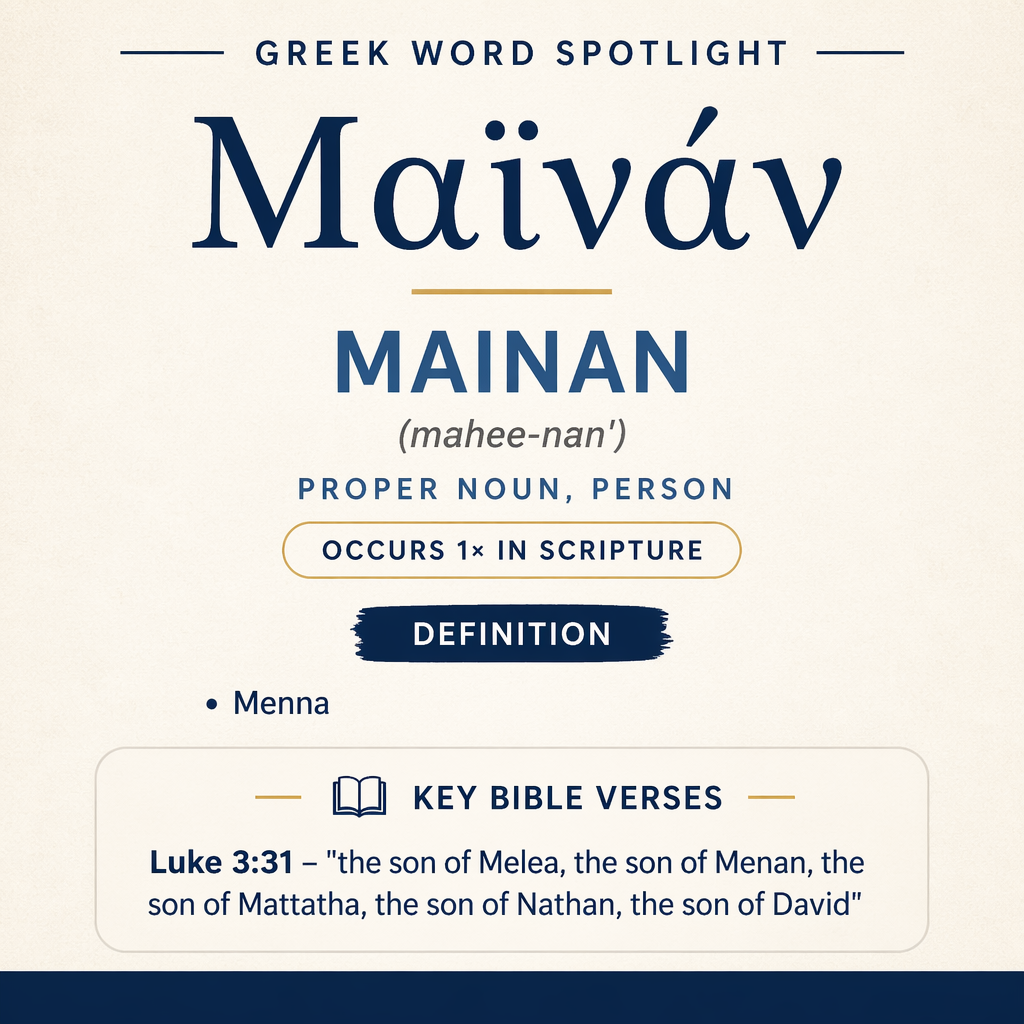
Μαϊνάν means “Menna” and appears once in Scripture in Luke 3:31 within Jesus’ genealogy.
Biblical Context
It occurs in Luke 3:31 in a genealogical line: “the son of Melea, the son of Menan, the son of Mattatha.”
Learn More →Mainan means “Menna” and appears within the genealogy in Luke’s Gospel. In that single line of descent, the name serves to locate one generation between Melea and Mattatha, contributing to the careful sequencing of ancestry that the verse is presenting.
Occurrences
“the son of Melea, the son of Menan, the son of Mattatha, the son of Nathan, the son of David,” (Luke 3:31)
In Luke 3:31, Mainan is presented as a personal name inside a repeated genealogical pattern: “the son of X, the son of Y.” The verse is not narrating actions or describing character; it is establishing relationships. Within that structure, the mention of “Menan” functions as one link in a chain: Melea is identified by his father, and Menan is likewise identified as the father of Mattatha. The name therefore contributes to the verse’s primary work of connecting individuals through parentage, where each name is both a destination (the person being named) and a bridge (the means by which the next person is attached).
The line continues on the same breath—“the son of Nathan, the son of David”—so the immediate effect of placing Mainan here is to position this generation within a larger, multi-generational descent that culminates, in this verse, at “David.” The text’s cadence builds continuity: the repeated phrasing creates a sense of ordered succession, and Mainan’s appearance maintains that rhythm. In genealogical discourse like this, omission would break the articulated sequence; inclusion preserves the integrity of the stated descent from one named ancestor to the next.

Sense and Usage
Mainan is used as the name “Menna,” and in this context it functions purely as an identifier within a family line. A personal name in a genealogy bears meaning not by describing the person’s qualities but by anchoring the stated relationships. Here the name’s contribution is structural: it marks a distinct generation and specifies how two adjacent names relate—Melea relates to Menan as “son” to “father,” and Mattatha relates to Menan in the same way.
The verse’s tightly packed list highlights a particular kind of precision. Each individual is not merely named but situated within a parent-child relationship, so Mainan’s role is to define the direction of descent across three successive points: Melea → Menan → Mattatha. In other words, the name is not standalone; it carries its genealogical “address,” fixed by the repeated descriptor “the son of.” This makes the name relational in function: it is the label for a person, but its purpose in the sentence is to hold together the links of ancestry being traced.
Because the verse continues beyond these three names to “Nathan” and “David,” Mainan also participates in the larger motion of the genealogy’s reach. Even though the text does not pause to narrate anything about Menan, placing him between Melea and Mattatha ensures that the stated descent arrives at the named endpoints through an explicit sequence rather than an implied jump. The usage is therefore conservative and documentary in tone: Mainan is included not to add color or story but to preserve a declared chain of descent in which every generation named matters to the form of the record.
The immediate neighborhood of the name also shapes how it is heard. In a list where names are presented without titles, locations, or descriptors, the sole semantic load the name bears in the verse is personal identification. The repeated formula levels all entries: Menan stands grammatically parallel to Melea, Mattatha, Nathan, and David. This parallelism makes the genealogy read as an uninterrupted lineage, and Mainan contributes by being one of the necessary points of articulation in that line.
Imagery
Luke 3:31 carries the imagery of a chain of descent expressed in a single, flowing sentence. Though the verse offers no visual description, the steady repetition—“the son of … the son of …”—evokes a sequence of links, each one connected to the next. Mainan, set between Melea and Mattatha, is one of those links, present to keep the line intact as it moves toward “Nathan” and “David.”
Sources: Lexical data from Strong’s Exhaustive Concordance and the Translators Brief Lexicon of Extended Strongs for Greek (STEPBible, CC BY). Occurrence data from the Translators Amalgamated Greek New Testament (STEPBible, CC BY). Scripture quotations from the World English Bible (public domain).