
Exploring the Meaning of Mathousala in Greek
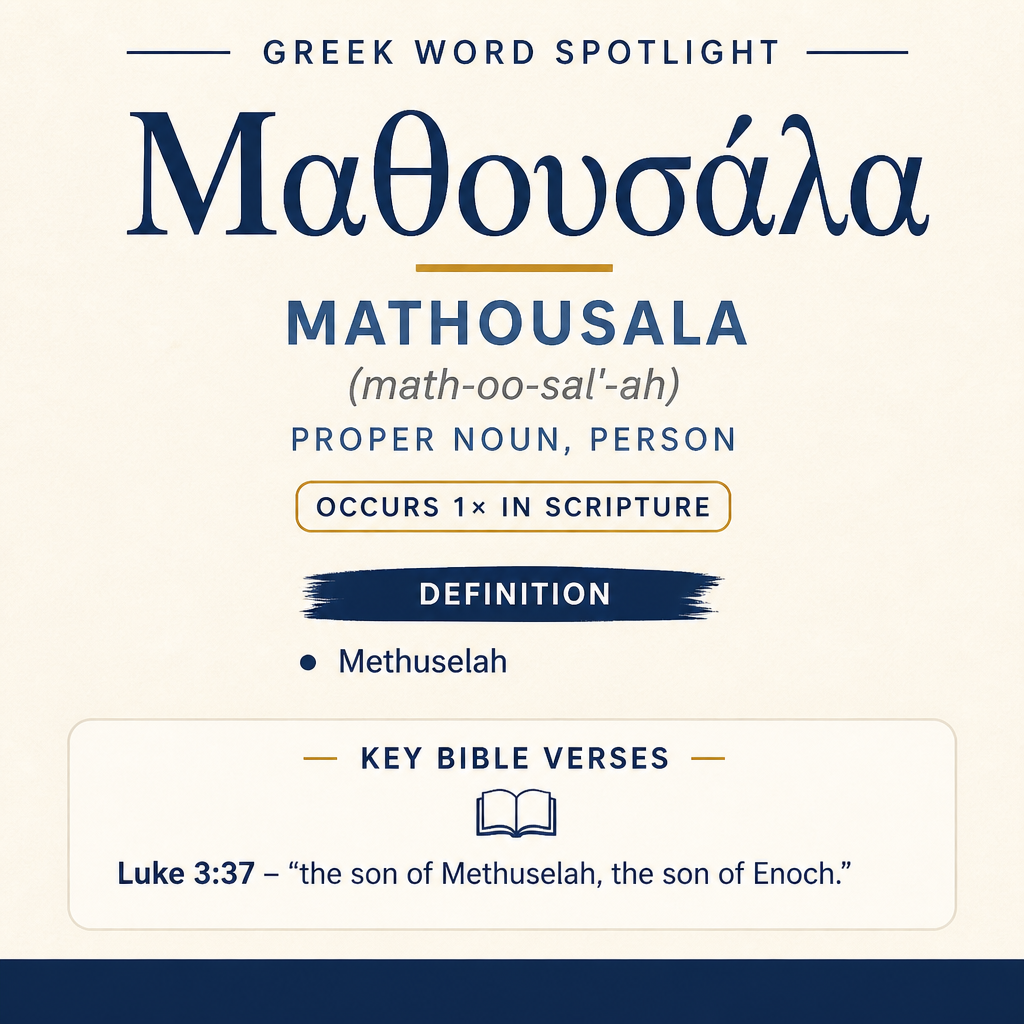
Μαθουσάλα means “Methuselah” and appears once in Scripture in Luke 3:37.
Scripture Occurrence
This name occurs 1 time in Scripture. Its single occurrence is in Luke 3:37.
Learn More →Genealogy Context
In Luke 3:37, Methuselah is named in a genealogy. He is listed as the son of Enoch.
Learn More →Μαθουσάλα refers to Methuselah. It appears in Luke’s genealogy of Jesus, where it functions as one link in a chain of descent.
Occurrences
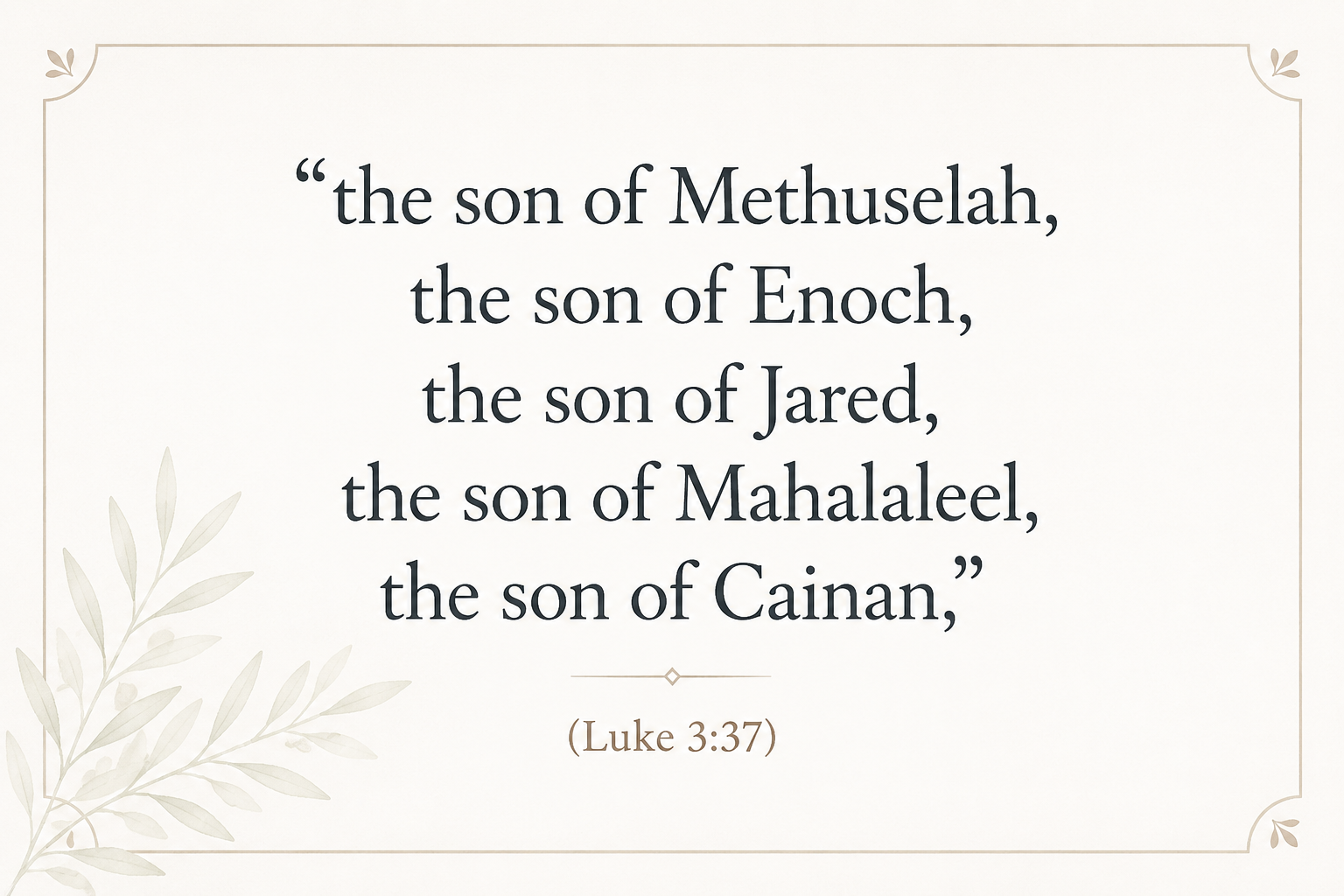
“the son of Methuselah, the son of Enoch, the son of Jared, the son of Mahalaleel, the son of Cainan,” (Luke 3:37)
Here Μαθουσάλα is used as a personal name within a tightly patterned sequence of ancestry. The repeated phrasing “the son of …, the son of …” sets each named figure in a direct familial relationship to the next, and Methuselah’s placement specifically marks him as the father of Enoch in this line (“the son of Methuselah, the son of Enoch”). The wording is not narrative but relational: the name’s contribution is to anchor the genealogy at a particular generational step, establishing continuity from one ancestor to another without additional biographical detail. Because the chain continues immediately onward (“… the son of Jared, the son of Mahalaleel, the son of Cainan”), Methuselah is presented as part of an ordered progression rather than as an isolated figure.
Sense and Usage
As the designation “Methuselah,” Μαθουσάλα functions in Luke 3:37 as a stable identifier inside a formal register of names. The genealogy’s style treats each name as a fixed point in a lineage, and the sense of the term is therefore carried by its role: it indicates a specific person who stands in a defined relationship to adjacent figures in the list. In this verse, the immediate relational framework determines how the name is understood. “The son of Methuselah” assigns Methuselah the role of parent in relation to Enoch, while simultaneously the next phrase (“the son of Enoch”) places Enoch as parent in relation to Jared; Methuselah’s identity in the verse is expressed through this two-directional positioning—one link back, one link forward.
The verse’s compressed form also shows how such a name operates without descriptive modifiers. There are no titles, locations, or epithets attached to Methuselah here. Instead, Luke’s genealogy relies on the recognizability and fixity of the personal name itself, using it to maintain the integrity of the chain. In this way Μαθουσάλα serves a documentary purpose: it supports the larger aim of tracing descent by listing successive fathers and sons. The significance of the name within the verse is therefore not thematic development but structural precision, ensuring that the line is stated unambiguously at this point in the sequence.
The surrounding names reinforce that function. By placing Methuselah among a string of ancestors (“Enoch,” “Jared,” “Mahalaleel,” “Cainan”), the verse frames him as one element in a long-established lineage rather than as a contemporary character. The repeated formula works almost like a verbal ledger: each entry is brief, standardized, and relational. Μαθουσάλα, as Methuselah, fits that pattern exactly—its usage is governed by the genealogy’s conventions, where meaning is conveyed through placement and relationship more than through description.
Genealogical Imagery
Luke 3:37 carries an understated but vivid image: a continuous line of descent stated step by step. Within that linear picture, the name Methuselah evokes the idea of generational linkage—one person situated between those who came before and those who came after. The verse’s rhythm (“the son of …, the son of …”) presents ancestry as a connected chain, and Μαθουσάλα stands as one articulated link in that chain, holding the sequence together at that point in the list.
Sources: Lexical data from Strong’s Exhaustive Concordance and the Translators Brief Lexicon of Extended Strongs for Greek (STEPBible, CC BY). Occurrence data from the Translators Amalgamated Greek New Testament (STEPBible, CC BY). Scripture quotations from the World English Bible (public domain).





