
Exploring the Meaning of Kukloo in Greek
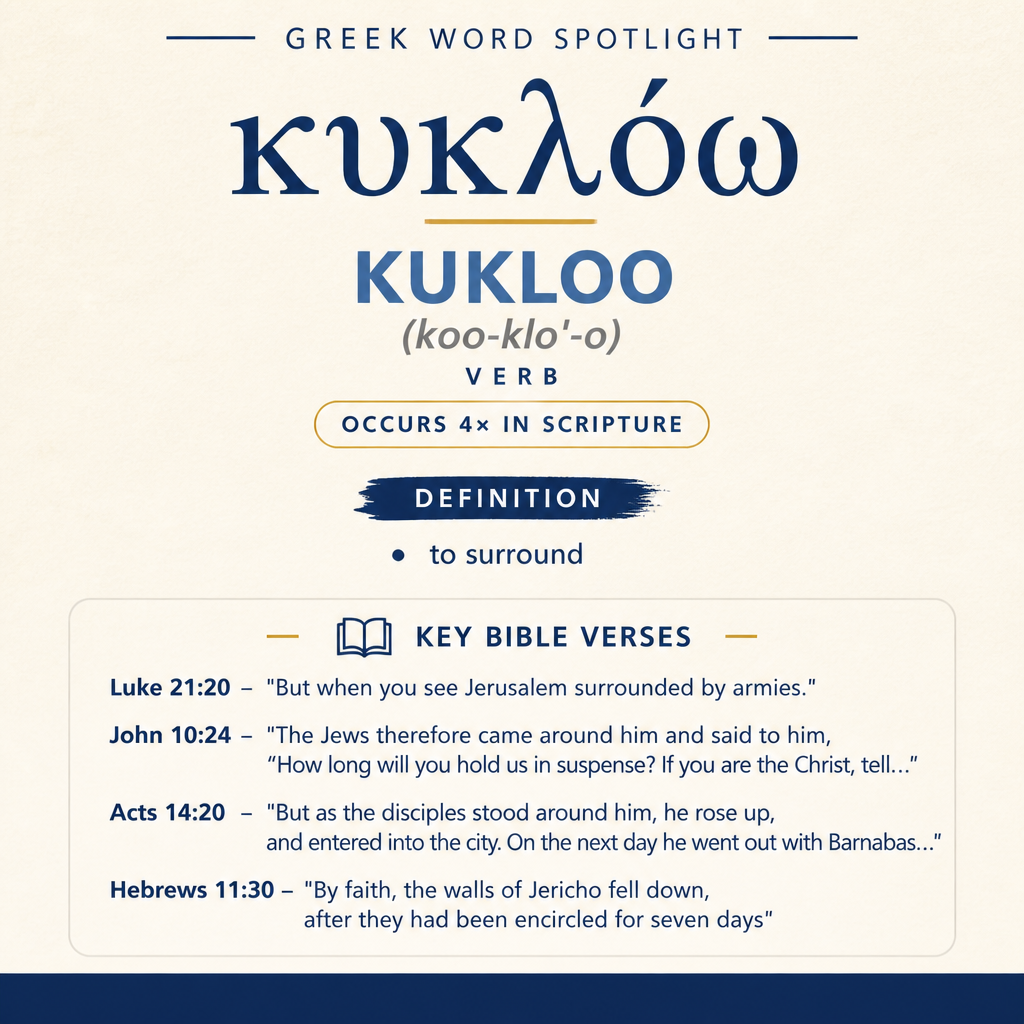
κυκλόω means “to surround” and occurs four times in Scripture: Luke 21:20, John 10:24, Acts 14:20, and Hebrews 11:30.
Core Meaning
κυκλόω means “to surround.” It can describe people or armies coming around something or someone.
Learn More →Narrative Scenes
It describes Jerusalem surrounded by armies (Luke 21:20) and Jews coming around Jesus to question Him (John 10:24). It also describes disciples standing around Paul (Acts 14:20).
Learn More →Encircling Jericho
Hebrews 11:30 uses it for the walls of Jericho falling after being encircled seven days.
Learn More →κυκλόω expresses the act of surrounding, pictured as something or someone being placed “around” a focal point. In the New Testament it appears in scenes of military encirclement, a tense confrontation, immediate care after violence, and the famous circling of Jericho’s walls.
Root and Related Words
The adverb κύκλῳ (kykloi), “surrounding” (Strong’s G2945), is related and reflects the same spatial idea of something being around something else.

Occurrences
“But when you see Jerusalem surrounded by armies, then know that its desolation is at hand.” (Luke 21:20)
Here κυκλόω places Jerusalem inside a tightening ring of hostile presence: the city is not merely threatened, but enclosed. The surrounding is presented as a visible sign—“when you see”—that enables recognition of what follows: “its desolation is at hand.” The verb contributes a concrete, observable configuration (armies around a city) that signals an imminent turning point. The force of the line lies in the change of situation implied by the surrounding: the city is positioned as the object, the armies as the encircling agents, and the result is a condition that can be “known” from what is seen.
The Jews therefore came around him and said to him, “How long will you hold us in suspense? If you are the Christ, tell us plainly.” (John 10:24)
In this setting, the surrounding is interpersonal rather than military: a group “came around him” and then speaks. κυκλόω contributes the sense of closing in physically—placing Jesus at the center of a cluster—so that their demand can be delivered face-to-face and with pressure. The spatial arrangement matches the rhetorical posture of the question: “How long will you hold us in suspense?” Their words push for a direct disclosure, and the act of surrounding supplies the scene’s tension: the group gathers around a single person, controlling access and proximity as they press for a plain answer.
“But as the disciples stood around him, he rose up, and entered into the city. On the next day he went out with Barnabas to Derbe.” (Acts 14:20)
κυκλόω here depicts the disciples’ posture around “him,” creating a circle of presence at a critical moment. The verb helps frame the action that follows: “he rose up, and entered into the city.” Their surrounding is not described in words of attack or interrogation but as standing near, and it functions as a visual marker of solidarity and attention at the point where recovery and movement occur. The surrounding also sets a boundary between the central figure and the larger, implied environment, while the narrative moves from the stillness of standing around to decisive motion—rising, entering the city, and then traveling the next day.
“By faith, the walls of Jericho fell down, after they had been encircled for seven days.” (Hebrews 11:30)
In Hebrews, the surrounding is extended and repeated: the walls “had been encircled for seven days.” κυκλόω contributes the imagery of a sustained action performed around a fixed object—the walls—until a climactic outcome: “the walls of Jericho fell down.” The verse ties the encircling to the larger theme introduced at the start (“By faith”), but the verb itself supplies the physical shape of the action: movement or placement around an enclosed perimeter. The temporal note “for seven days” underscores that the surrounding is not a momentary crowding but a persistent, completed course that precedes the fall.
Sense and Usage
Across these four passages, κυκλόω consistently marks a relationship of center and perimeter: a person or place becomes the focal point, and others arrange themselves around it. The resulting scene can carry very different tones depending on who does the surrounding and why. In Luke 21:20 the surrounding is strategic and foreboding; it turns the city into an enclosed object and becomes a sign of impending devastation. In John 10:24 the surrounding is confrontational; it constricts personal space and sets the stage for a demand that seeks to force clarity. In Acts 14:20 the surrounding is communal and attentive; the disciples’ stance around the central figure provides a visual frame for his recovery and immediate return to action. In Hebrews 11:30 the surrounding is disciplined and protracted; it is an action done around walls over days, presented as the condition preceding their collapse.
The verb therefore functions well for any situation where the decisive feature is not merely nearness but arrangement—being “around” as a configuration that affects what happens next. It can imply containment (a city ringed by armies), pressure (a group closing around one person to question him), care and watchfulness (disciples standing around someone who then rises), or methodical action around a boundary (walls encircled over time). In each case, the surrounding is not incidental stage-setting; it shapes the reader’s sense of what kind of moment it is: warning, confrontation, recovery, or culmination.
Imagery
The imagery carried by κυκλόω is strongly visual: it invites the reader to picture an inside and an outside, with a perimeter drawn by people or forces. Luke frames the image on the scale of a city—Jerusalem seen with armies around it—while John and Acts compress the image to a human center with others physically around him. Hebrews returns to architectural scale, focusing on “the walls of Jericho” and the repeated encircling that precedes their fall. Together these uses give the verb a concrete spatial weight: surrounding is an act that makes a situation visible, concentrates attention, and sets conditions for what follows.
Sources: Lexical data from Strong’s Exhaustive Concordance and the Translators Brief Lexicon of Extended Strongs for Greek (STEPBible, CC BY). Occurrence data from the Translators Amalgamated Greek New Testament (STEPBible, CC BY). Scripture quotations from the World English Bible (public domain).




