Exploring the Meaning of Kuklothen in Greek
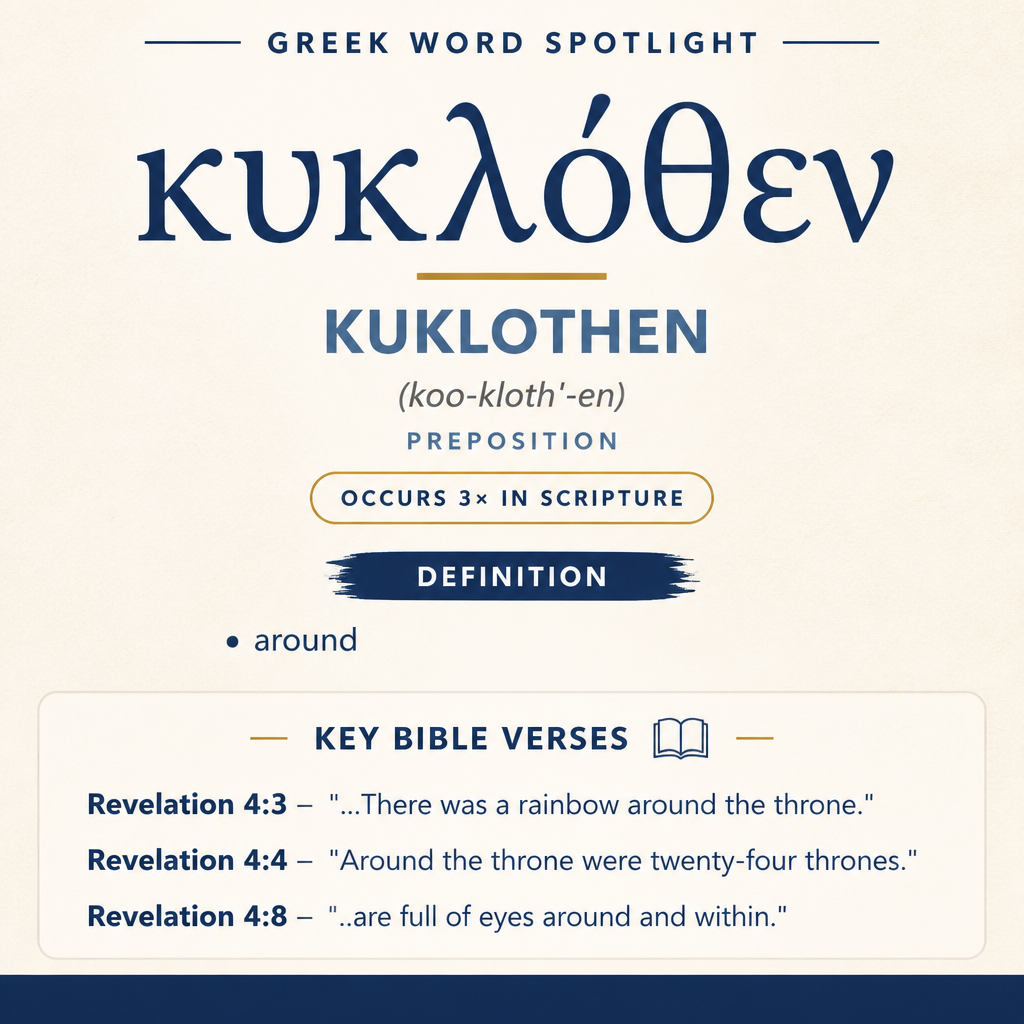
κυκλόθεν means “around” and appears three times in Scripture, all in Revelation 4:3–4 and 4:8.
Revelation Scenes
In Revelation 4, it describes what is around the throne: a rainbow (4:3) and twenty-four thrones (4:4).
Learn More →Creature Description
In Revelation 4:8, it describes the four living creatures as full of eyes around and within.
Learn More →κυκλόθεν expresses the spatial idea of something being “around.” In the New Testament it appears in Revelation 4 within John’s throne-room vision, describing what encircles the throne and what surrounds the living creatures.
Root and Related Words
κυκλόθεν is associated with the related form kykloi (κύκλῳ), “surrounding” (Strong’s G2945).

Occurrences
“that looked like a jasper stone and a sardius. There was a rainbow around the throne, like an emerald to look at.” (Revelation 4:3)
Here κυκλόθεν locates the rainbow in relation to the throne: it is not merely present in the scene but positioned so as to encircle the central seat. The verse emphasizes what is visually perceived—radiant stone-like appearance (“jasper…sardius”) and then a feature that frames the throne itself (“a rainbow around the throne”). The word thus contributes a sense of enclosure and orientation: the throne is the fixed center, and the rainbow is described as surrounding it, “like an emerald to look at.” The surrounding placement makes the rainbow part of the throne’s immediate environment, not an unrelated backdrop.
“Around the throne were twenty-four thrones. On the thrones were twenty-four elders sitting, dressed in white garments, with crowns of gold on their heads.” (Revelation 4:4)
In this next verse, κυκλόθεν again defines relation to the throne, this time with multiple “twenty-four thrones” arranged around it. The word shapes how the reader imagines the court: the primary throne stands at the center and other thrones form a surrounding ring. The description that follows (“twenty-four elders sitting, dressed in white garments, with crowns of gold on their heads”) is anchored by that initial spatial arrangement. The elders are not simply present; they occupy seats that are set “around,” implying an ordered placement in relation to the center. The surrounding arrangement also ties the elders’ appearance and status (“white garments,” “crowns of gold”) to the throne they encircle, keeping the central throne as the organizing point of the scene.
“The four living creatures, each one of them having six wings, are full of eyes around and within. They have no rest day and night, saying, “Holy, holy, holy is the Lord God, the Almighty, who was and who is and who is to come!”” (Revelation 4:8)
Here κυκλόθεν is applied not to the throne but to the living creatures themselves: they are “full of eyes around and within.” The pairing of “around” with “within” gives a layered description—an exterior surrounding aspect (“around”) alongside an interior one (“within”). The word thus helps present the creatures as comprehensively covered with eyes, not restricted to a single surface or vantage point. This surrounding fullness is set immediately before their unceasing worship (“They have no rest day and night, saying…”), so the spatial depiction contributes to the overall portrayal of these beings as intensely characterized and constantly active within the scene.
Sense and Usage
Across these three uses, κυκλόθεν consistently marks what surrounds a focal object within the vision. In Revelation 4:3 and 4:4, the focal point is explicitly “the throne,” and the word serves to organize the space of the heavenly scene by showing what encircles that center: first a rainbow, then a ring of thrones with elders seated on them. In Revelation 4:8, the focus shifts from the throne’s surroundings to the creatures’ own condition, describing eyes as present “around” them—an outward, enveloping distribution.
The word’s contribution is therefore strongly relational. It does not merely add another item to the description; it specifies placement. In the throne verses, it creates a picture of concentric features: a central throne, then something encircling it. In the living-creature verse, it highlights that the eyes are not confined to one side but surround, reinforced by the additional phrase “and within.” Used this way, κυκλόθεν supports the careful, scene-building style of Revelation 4, where the reader is repeatedly oriented by spatial relations (“around the throne,” “around and within”) as the vision unfolds.
Imagery
In Revelation 4, κυκλόθεν helps the vision feel structured rather than scattered. The throne is presented as the center of attention, with surrounding features that frame it—first a rainbow “like an emerald,” then an encircling assembly of thrones with elders, and finally living creatures described in terms of what surrounds them. The repeated spatial emphasis on what is “around” gives the reader a sense of ordered arrangement within the throne-room setting, where even dazzling elements and living beings are described in relation to a center and to the surfaces that encompass them.
Sources: Lexical data from Strong’s Exhaustive Concordance and the Translators Brief Lexicon of Extended Strongs for Greek (STEPBible, CC BY). Occurrence data from the Translators Amalgamated Greek New Testament (STEPBible, CC BY). Scripture quotations from the World English Bible (public domain).