
Exploring the Meaning of Kouphizo in Greek
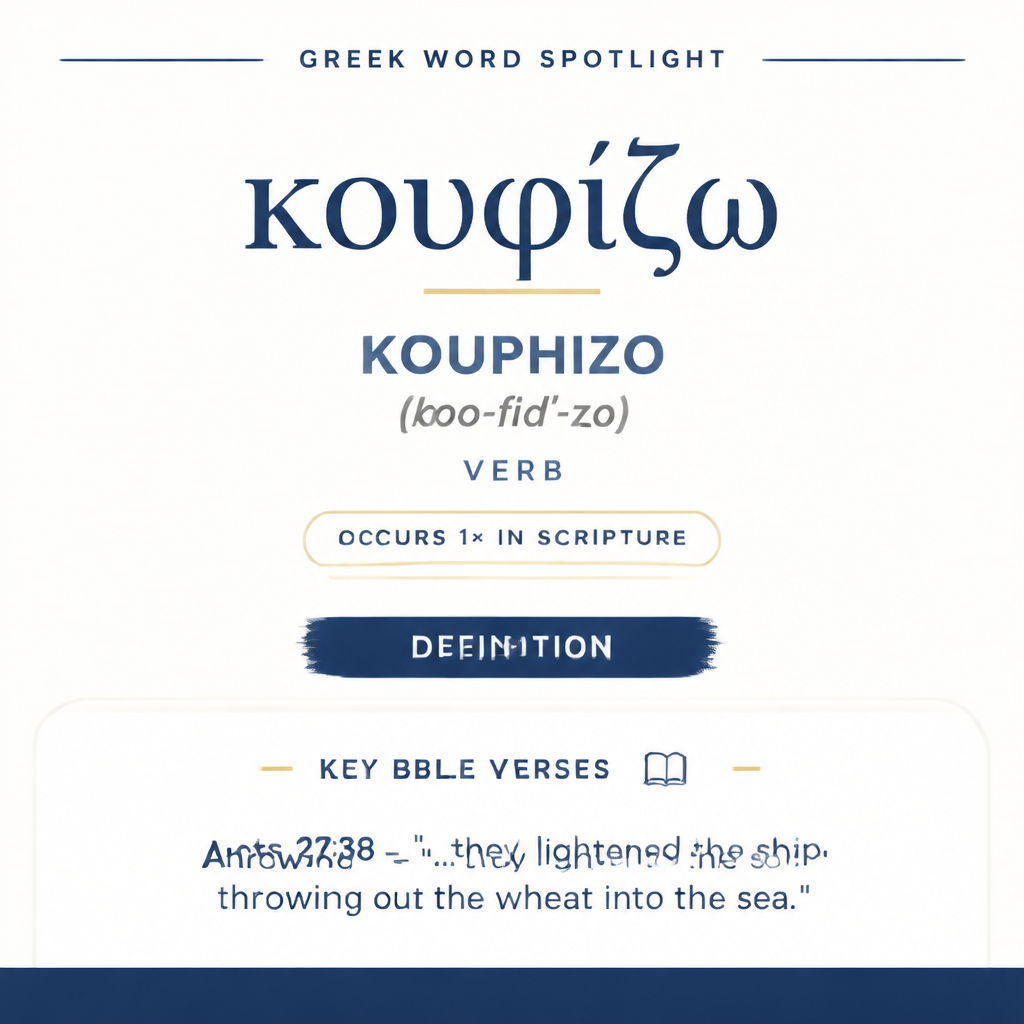
κουφίζω means “to lighten” and appears once in Scripture, in Acts 27:38.
Context in Acts
In Acts 27:38, they lightened the ship by throwing the wheat into the sea.
Learn More →κουφίζω means “to lighten,” and it appears in the narrative of a threatened voyage where a ship’s survival depends on reducing weight. Its single New Testament attestation places the verb in a concrete, urgent action carried out at sea.
Occurrences
“When they had eaten enough, they lightened the ship, throwing out the wheat into the sea.” (Acts 27:38)
In Acts 27:38, κουφίζω describes a deliberate measure taken after the passengers and crew “had eaten enough.” The timing matters within the sentence: only after they are strengthened by food do they take the costly step of making the vessel lighter. The verb is immediately explained by the following participial phrase, “throwing out the wheat into the sea,” which supplies the practical means by which the ship is lightened. Here κουφίζω is not an internal feeling or a metaphorical relief; it is a physical reduction of load accomplished by jettisoning cargo. The direct object is “the ship,” so the action’s target is the vessel’s burdened condition rather than the grain as a commodity. The scene presents “wheat” as the specific weight removed, and the sea as the place that receives what is discarded; the verb frames the act as a purposeful attempt to alter the ship’s situation by lessening what it carries.
The sentence also shows that κουφίζω can describe an action that is both practical and sacrificial. Wheat is valuable food, yet it becomes expendable when the ship’s safety is at stake. By pairing the verb with a concrete disposal (“throwing out the wheat”), the text depicts lightening as a strategic response to danger: the ship’s buoyancy and handling are implicitly treated as dependent on load, so lightening becomes a means of preserving life and making continued travel possible.

Sense and Usage
The sense “to lighten” is expressed in Acts 27:38 as a transitive action affecting a tangible object: “they lightened the ship.” The verb’s force lies in changing the ship’s condition from heavier to lighter by removing material weight. Because the sentence immediately specifies the method—discarding wheat—κουφίζω is used for a weight-reducing operation, not merely the abstract idea of becoming less heavy. The action is collective (“they”), suggesting coordinated effort rather than an isolated choice, and it is framed as a decisive step taken in the midst of crisis management at sea.
Within the verse, κουφίζω functions as the main verb for the second clause, balancing two key actions: eating enough and then lightening the ship. The narrative logic is sequential: nourishment precedes exertion. This sequencing gives the verb a practical texture—lightening is labor that follows preparation. The participle “throwing out” (as represented in English) serves to unpack what “lightened” entails in this moment, anchoring the verb to a specific kind of lightening: jettison. The result is that the meaning “to lighten” is not left vague; it is constrained by the action of removing cargo and the setting of a ship at sea.
The choice of object also shapes how the meaning is heard. Lightening “the ship” focuses on the vessel’s load-bearing state, where weight is a factor affecting the ship’s ability to endure the sea. The ship is treated as something that can be made lighter through human decision and action; weight is not a fixed attribute but a condition that can be altered by discarding what is on board. In this usage, “to lighten” carries a strongly situational nuance: it is a remedy applied to an immediate threat, using whatever weight is available to be removed. The wheat, though edible and presumably a planned provision, becomes the means by which the ship is lightened—showing that the verb naturally fits contexts where the “lighter” state is achieved through loss of goods.
Because the verse specifies “the wheat,” the usage also highlights that lightening is selective: a particular cargo is chosen for removal. The text does not describe a generalized reduction; it names a concrete commodity and a decisive disposal into “the sea.” This creates a vivid picture of lightening as irreversible. Once thrown into the sea, the wheat is beyond recovery; the ship is lighter precisely because something has been surrendered. Thus κουφίζω, while defined simply as “to lighten,” is shown here operating in a high-stakes setting where lightening is achieved through a costly but necessary action.
Imagery
Acts 27:38 attaches κουφίζω to the stark imagery of cargo disappearing into the sea. The word evokes the sound and motion of heavy sacks or stores being heaved overboard, and the immediate contrast between what the ship carried and what it must relinquish. In this single attestation, “to lighten” is not gentle or gradual; it is decisive and physical, tied to the urgent need to change the ship’s condition by removing weight.
Sources: Lexical data from Strong’s Exhaustive Concordance and the Translators Brief Lexicon of Extended Strongs for Greek (STEPBible, CC BY). Occurrence data from the Translators Amalgamated Greek New Testament (STEPBible, CC BY). Scripture quotations from the World English Bible (public domain).




