
Exploring the Meaning of Kore in Greek
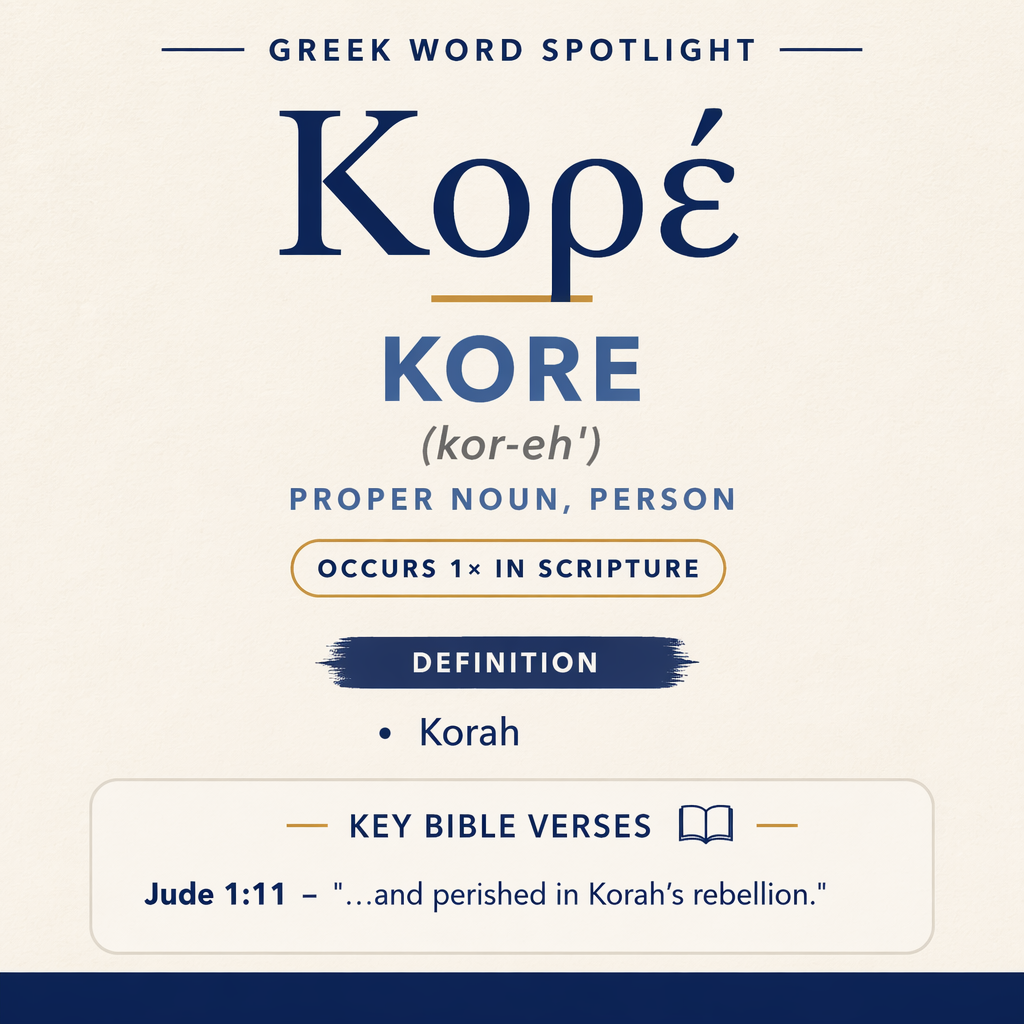
Κορέ (Kore) means “Korah” and appears once in Scripture, in Jude 1:11.
Κορέ means “Korah” and appears in the New Testament in Jude’s warning against a pattern of destructive choices. In its single use, the name functions as a shorthand for a remembered act of revolt and its outcome.
Occurrences
“Woe to them! For they went in the way of Cain, and ran riotously in the error of Balaam for hire, and perished in Korah’s rebellion.” (Jude 1:11)
In Jude 1:11, Κορέ appears in a brief but forceful triad of examples introduced by a prophetic “Woe.” The verse places “Korah’s rebellion” alongside “the way of Cain” and “the error of Balaam for hire,” presenting three named patterns that together depict moral collapse as a chosen path with a deadly end. Within this sentence, the name “Korah” is not presented as a biographical detail but as a label for a kind of event: a rebellion so characteristic that it can be invoked by a possessive phrase (“Korah’s rebellion”) without explanation.
The grammar of the line highlights consequence as well as action. The first two clauses stress motion and pursuit—“they went” and “ran riotously”—but the final clause stresses an end-point: “perished in Korah’s rebellion.” Here Κορέ anchors the final warning by tying the fate of the present subjects (“them”) to an earlier rebellion remembered for its ruin. The expression “perished in” makes the rebellion a setting or sphere in which destruction occurs, not merely a mistake that can be regretted later. By naming Korah, Jude supplies an emblem of rebellion that is not neutral or ambiguous; it carries the weight of a cautionary story, evoked to interpret the spiritual trajectory of those being denounced.
Within Jude’s rhetoric, Κορέ also contributes to the cumulative force of naming. Cain, Balaam, and Korah are not introduced as remote figures but as reference points that define “the way,” “the error,” and “the rebellion.” That is, Jude frames the opponents’ conduct as participation in recognizable patterns. “Korah” in particular is tied explicitly to “rebellion,” so the name works as a compact signal for opposition expressed in a way that is both willful and communal. The verse does not describe the rebellion’s details; instead, it relies on the name’s ability to summon the idea of revolt and its fatal outcome, making the warning terse and pointed.

Sense and Usage
As a proper name meaning “Korah,” Κορέ functions here by association: it identifies a remembered person in order to characterize a remembered kind of act—“rebellion”—and the kind of end it brings—“perished.” Jude employs the name as part of a moral taxonomy. “Way,” “error,” and “rebellion” are three categories of ruinous conduct, and each is intensified by attaching it to a well-known name. The name does not add a new action to the verse; it sharpens the action already stated by giving it a historical contour and a settled evaluation. In Jude’s line, “Korah” is not simply a participant in rebellion but a defining representative of it.
This usage shows how a proper noun can carry descriptive force without ceasing to be a name. Jude could have spoken in general terms about rebellion, but he chooses to specify “Korah’s rebellion,” which marks rebellion as a recognizable pattern with precedent. The possessive construction (“Korah’s”) personalizes the act, linking it to an origin-point and giving it a concrete referent. At the same time, the phrase is applied to others (“them”), so the name becomes a category label: the opponents are said to perish within the same kind of rebellion associated with Korah. In this way, Κορέ operates as a bridge between past and present, allowing Jude to interpret current behavior through the lens of a paradigmatic revolt.
Jude’s arrangement also makes the name part of a progression. The verse begins with “went,” then “ran riotously,” and ends with “perished.” The first two verbs picture active pursuit; the final verb pictures irreversible loss. In that structure, “Korah’s rebellion” belongs at the climax because it is paired with perishing. The name, therefore, contributes not only the idea of rebellion but also the sense that rebellion is not an abstract posture; it has an outcome that Jude considers settled and predictable. The verse presents “Korah’s rebellion” as the arena in which destruction happens, implying that entering such rebellion is to enter a space already marked by death.
The name also deepens Jude’s denunciation by strengthening the communal and defiant nuance of “rebellion.” “Error” can suggest deception or misjudgment, but “rebellion” suggests deliberate resistance. By linking perishing with “Korah’s rebellion,” Jude casts his opponents’ stance as more than private failure: it is a public, confrontational posture against rightful order, the kind of posture that has already been judged in the past. The verse does not spell out the targets of the rebellion; it simply uses the name to characterize it as a known revolt whose outcome stands as warning.
Finally, Κορέ functions within Jude’s compact style of allusion. The letter’s warning is compressed into a single sentence of three names and three descriptions. The name “Korah” is effective in that format because it can bear narrative weight without narrative retelling. Jude treats the name as sufficient to evoke the moral lesson he intends: rebellion leads to perishing. Thus, the proper noun serves Jude’s pastoral aim of identifying danger quickly and memorably, giving the audience a concise label for a fatal trajectory.
Imagery
In Jude 1:11, the imagery attached to Κορέ is stark: rebellion as a space where people “perished.” The verse does not portray the rebellion’s actions in detail; it portrays its end. By naming “Korah’s rebellion” at the point of perishing, Jude paints rebellion with the color of catastrophe, making the name resonate as a warning-sign within his “Woe.” The memory invoked by the name lends gravity to Jude’s verdict: those who follow this pattern do not merely stumble; they come to ruin within the rebellion they embrace.
Sources: Lexical data from Strong’s Exhaustive Concordance and the Translators Brief Lexicon of Extended Strongs for Greek (STEPBible, CC BY). Occurrence data from the Translators Amalgamated Greek New Testament (STEPBible, CC BY). Scripture quotations from the World English Bible (public domain).





