Exploring the Meaning of Korban in Greek
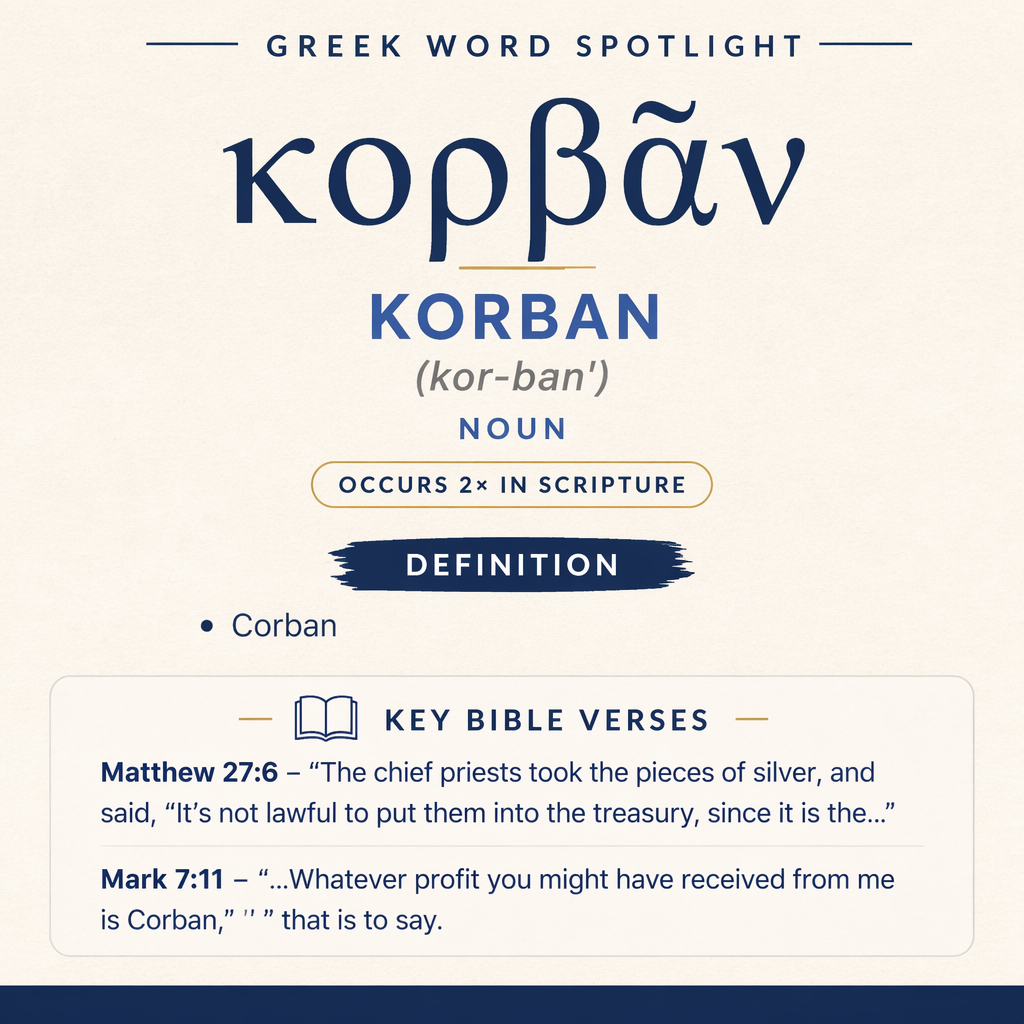
κορβᾶν means “Corban” and appears twice in Scripture: Matthew 27:6 and Mark 7:11.
Scripture Occurrences
This word occurs 2 times in Scripture, in Matthew 27:6 and Mark 7:11.
Learn More →Context Notes
In Matthew 27:6 it is connected with the chief priests and the treasury. In Mark 7:11 it appears in a statement addressed to one’s father or mother.
Learn More →κορβᾶν means “Corban” and appears in contexts dealing with money set within the sphere of religious giving. In the passages where it occurs, it is tied to questions of what may be placed into sacred funds and how an offering can be invoked in family obligations.
Occurrences
“The chief priests took the pieces of silver, and said, “It’s not lawful to put them into the treasury, since it is the price of blood.”” (Matthew 27:6)
In this scene the word sits in a setting dominated by the language of sacred finance: “chief priests,” “pieces of silver,” and “the treasury.” The verse itself turns on a moral-legal judgment—“It’s not lawful”—and the stated reason is the character of the money: “the price of blood.” Within that reasoning, κορβᾶν functions as a label for money viewed through a religious lens, money that would otherwise be handled as dedicated or depositable in a religious treasury. The priests’ decision is not about the amount of silver but about its eligibility for inclusion in a holy repository. The idea of Corban, as a recognized category of religiously handled property, supplies the background that makes the decision intelligible: some money is treated as suitable for the treasury, but this money is ruled out by its association with blood price. Thus the word’s contribution is to frame the dispute as one about the boundary between ordinary funds and funds treated as belonging within the sacred sphere.
“But you say, ‘If a man tells his father or his mother, “Whatever profit you might have received from me is Corban,” ’ ” that is to say, given to God,” (Mark 7:11)
Here κορβᾶν appears explicitly as a spoken designation: “If a man tells his father or his mother, ‘Whatever profit you might have received from me is Corban.’” The immediate social setting is the household—“his father or his mother”—and the immediate issue is potential benefit: “Whatever profit you might have received from me.” Corban in this verse operates as a reclassification of that benefit. Instead of remaining something that could be rendered to parents, it is verbally set into a religious category, and the verse supplies an interpretive apposition that fixes its force in the conversation: “that is to say, given to God.” The word therefore functions not merely as a description of an item but as an effective claim about its status—an offering-formula that alters what others may expect to receive. Its placement in direct speech underscores how Corban is invoked: it is not an abstract concept floating over the situation, but a term uttered to define what the speaker’s resources are considered to be.

Sense and Usage
Across these occurrences, “Corban” is the name for a recognized category of property associated with devotion to God, and that category exerts practical pressure on decisions about money. In Matthew 27:6, the category is assumed in the mention of “the treasury” and in the priests’ concern for what is “lawful” to place there. The logic depends on a distinction between funds that may be received into sacred storage and funds that must be excluded; “the price of blood” becomes a disqualifying characteristic, showing that Corban-status is not a mechanical label applied to any silver but something evaluated against moral and legal considerations in the handling of religious monies.
In Mark 7:11, the category is not presented as a matter of clerical handling but as a domestic declaration. The term is used to define “profit” that parents might expect, and the explanatory phrase “given to God” makes clear that Corban is not simply “religious” in a vague sense but points to a transfer or dedication framed as belonging to God. The word’s force here is interpersonal: it mediates between obligations (what a parent might “have received”) and a claimed devotion (what is “given to God”). The term’s role is therefore both classificatory and rhetorical—it marks something as devoted, and it is deployed in speech to justify a change in what is owed or delivered to others.
Taken together, these two contexts show Corban operating at two connected levels: institutional and relational. Institutionally, it is connected with a “treasury,” a place where money is stored under religious authority and governed by judgments about what is lawful. Relationally, it is connected with family claims and the management of benefit within kinship ties. The link between these is the shared assumption that naming something “Corban” situates it under a rule-set distinct from ordinary exchange. In one passage, the rule-set restricts what may enter sacred funds; in the other, the rule-set is appealed to in order to redirect a potential benefit away from parents and toward what is framed as belonging to God.
The way each verse speaks about Corban also highlights how the term carries an implicit boundary. In Matthew 27:6 the boundary is guarded by priestly judgment (“not lawful”), so Corban relates to communal norms about sacred property. In Mark 7:11 the boundary is invoked by an individual speaker (“If a man tells…”), so Corban relates to the power of designation—how a claim of dedication can be used to alter expectations in everyday relationships. The definition “Corban,” therefore, is not merely a label for a religious gift; it is a word that, in these narratives, marks a decisive shift in how money or profit is treated and to whom it is considered due.
Imagery
The imagery that gathers around κορβᾶν in these verses is concrete and financial: silver in hand and money in a treasury; a spoken declaration that converts “profit” into something “given to God.” In both scenes, Corban is not portrayed as an inward sentiment but as a status attached to tangible resources, raising the practical question of where that money belongs and what obligations it will or will not meet.
Sources: Lexical data from Strong’s Exhaustive Concordance and the Translators Brief Lexicon of Extended Strongs for Greek (STEPBible, CC BY). Occurrence data from the Translators Amalgamated Greek New Testament (STEPBible, CC BY). Scripture quotations from the World English Bible (public domain).