
Exploring the Meaning of Komao in Greek
κομάω means “be long-haired” and appears twice in Scripture, both in 1 Corinthians 11:14–15.
Scripture Occurrences
It occurs 2 times in Scripture, in 1 Corinthians 11:14 and 1 Corinthians 11:15.
Learn More →Context In Corinthians
In 1 Corinthians 11:14, long hair on a man is called a dishonor. In 1 Corinthians 11:15, long hair on a woman is called a glory and given for a covering.
Learn More →κομάω means “be long-haired.” It appears in Paul’s discussion of hair and honor in 1 Corinthians 11:14–15, where the condition of having long hair is evaluated differently for a man and for a woman.

Root and Related Words
κομάω is related to the noun kome (κόμη), “hair” (Strong’s G2864).

Occurrences
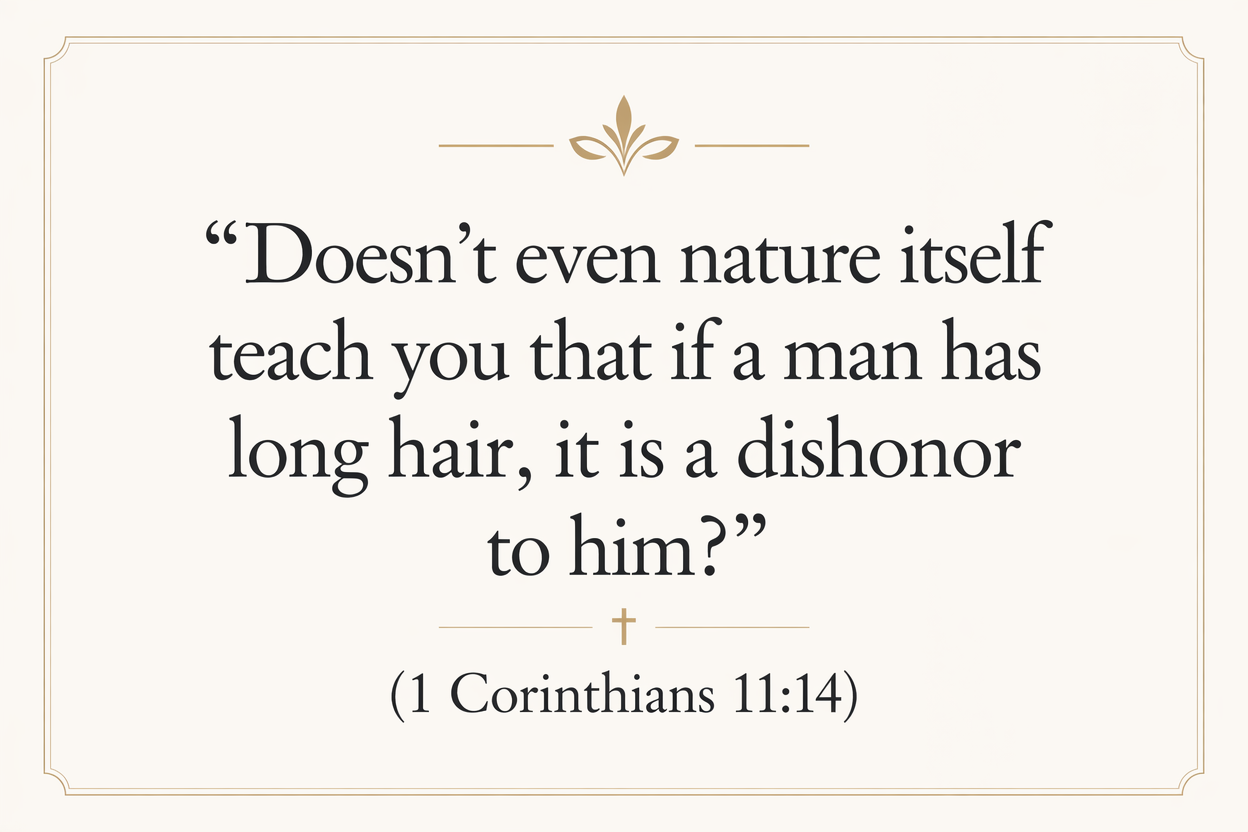
“Doesn’t even nature itself teach you that if a man has long hair, it is a dishonor to him?” (1 Corinthians 11:14)
Here κομάω frames “having long hair” as a recognizable, observable condition placed into a moral-social evaluation (“dishonor”). The verse sets the word inside a rhetorical question: the speaker appeals to what “nature itself” teaches and then states the case in conditional form (“if a man has long hair”). In this setting, κομάω does not stand alone as a neutral description; it is immediately tied to the public meaning assigned to that appearance (“it is a dishonor to him”). The clause makes long hair a marker that, in this argument, communicates something negative about a man’s standing. The force of the verb is practical and visible: it concerns what can be seen in ordinary life, and then interpreted as honorable or shameful.
“But if a woman has long hair, it is a glory to her, for her hair is given to her for a covering.” (1 Corinthians 11:15)
In the next verse κομάω is applied to a woman, again in a conditional construction (“if a woman has long hair”), but the evaluation reverses: “it is a glory to her.” The verb still points to the same outward condition—being long-haired—but its social meaning in the argument is opposite. The sentence gives a reason introduced by “for”: “her hair is given to her for a covering.” Within the verse’s own logic, the state expressed by κομάω aligns with an effect described in concrete terms, “a covering,” and with a positive assessment, “glory.” The word thus functions as the hinge between a visible feature (long hair) and an ascribed significance (glory), presented as fitting because hair itself serves as covering.
Sense and Usage
Across these two occurrences, κομάω is used to describe a sustained physical state rather than a momentary act: it is something a person “has” in appearance. The repeated “if” clauses show that the focus is the condition of being long-haired as a recognizable pattern, not simply a passing detail. In both verses the same outward condition becomes a premise in an argument about what is appropriate and what carries honor.
The immediate environment of κομάω in each verse supplies the interpretive frame. In 1 Corinthians 11:14 the state is weighed as “dishonor” when predicated of “a man”; in 11:15 the state is weighed as “glory” when predicated of “a woman.” The word therefore participates in a contrastive pairing: the same description is retained, while the subject changes and the evaluation changes. This makes κομάω a stable descriptive term inside a shifting social evaluation—stable in what it denotes (the long-haired condition), but flexible in what it signifies in context (dishonor/glory) because the passage assigns different outcomes depending on whether it is applied to a man or a woman.
The second occurrence also places the long-haired condition into a short explanatory chain: long hair relates to “hair” as such, and “hair” is described as “given … for a covering.” That reasoning ties the appearance named by κομάω to function (“a covering”) and then to value (“glory”). The verse’s phrasing treats hair not merely as ornamentation but as something that serves a purpose in the argument being advanced. Even there, κομάω remains a simple bodily descriptor; the broader weight comes from how the verse interprets that bodily descriptor within a framework of honor and propriety.
In both verses, the word is embedded in teaching that appeals to what is perceived as self-evident (“nature itself teach you”) and to what is regarded as given (“her hair is given to her”). κομάω therefore contributes to a style of reasoning that starts with observable features and moves toward normative conclusions. The verb’s simplicity—describing being long-haired—allows the passage to treat hair as a public, visible marker that can be discussed, judged, and linked to larger categories such as “dishonor” and “glory.”
Imagery
These verses attach strong imagery to κομάω by making hair a sign that can be read. In one line, long hair is pictured as a source of “dishonor” for a man; in the next, long hair is pictured as “glory” for a woman, with the added image of hair functioning “for a covering.” The word thus carries the concrete image of visible length, while the passage loads that image with social and evaluative weight.
Sources: Lexical data from Strong’s Exhaustive Concordance and the Translators Brief Lexicon of Extended Strongs for Greek (STEPBible, CC BY). Occurrence data from the Translators Amalgamated Greek New Testament (STEPBible, CC BY). Scripture quotations from the World English Bible (public domain).




