
Exploring the Meaning of Kolumbao in Greek
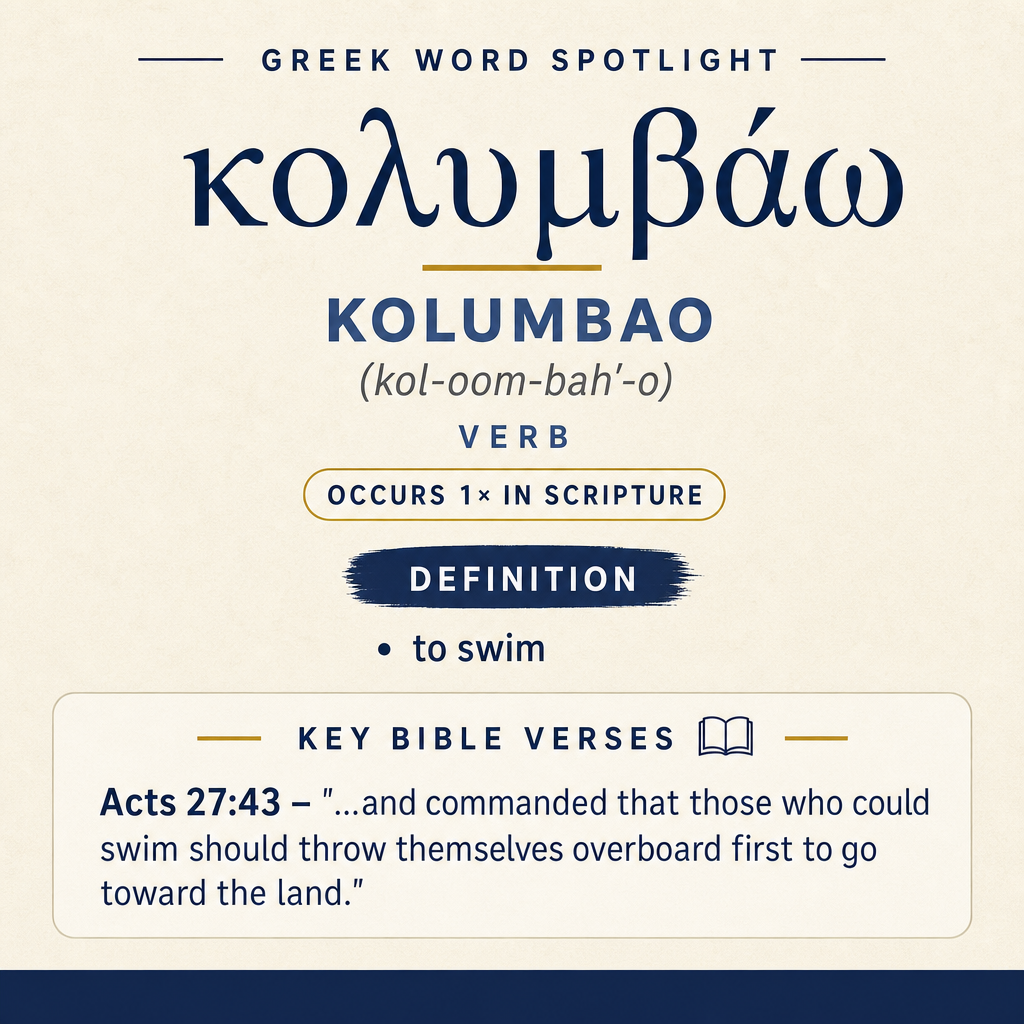
κολυμβάω means “to swim” and appears once in Scripture, in Acts 27:43.
Narrative Context
In Acts 27:43, it describes those who could swim, under the centurion’s command.
Learn More →κολυμβάω means “to swim” and is used once, in the shipwreck narrative of Acts 27:43. In that setting it marks a decisive, bodily action that separates those able to move through the sea from those who must reach land by other means.
Occurrences
“But the centurion, desiring to save Paul, stopped them from their purpose, and commanded that those who could swim should throw themselves overboard first to go toward the land;” (Acts 27:43)
In Acts 27:43 the verb appears inside a chain of commands issued by “the centurion,” whose stated aim is practical and immediate: “desiring to save Paul.” The crisis is already advanced; the order assumes a situation in which remaining aboard is no longer the safest option. Within that urgency, “those who could swim” are singled out as a distinct group and are told to “throw themselves overboard first to go toward the land.” The word therefore functions as a criterion of capability in an emergency: it identifies which people can undertake a direct passage through open water, and it defines the first wave of evacuation from the ship.
The instruction contains three linked movements: (1) identification—“those who could swim,” (2) decisive action—“should throw themselves overboard,” and (3) intended goal—“to go toward the land.” Swimming is not described as leisure or sport, but as a life-preserving means of travel when normal conveyance has failed. The adverbial idea “first” adds a practical sequencing: swimmers go ahead, presumably because they can make immediate progress without dependence on flotation or debris. In this single verse, κολυμβάω anchors the narrative at water level, highlighting the physical demands of reaching shore from a wrecked vessel and the triage-like logic of escape.

Sense and Usage
Because κολυμβάω is attested here only in a shipwreck evacuation, its sense is concrete and directional: swimming is movement through water with the purpose of reaching a destination (“toward the land”). The verb is framed by the conditional expression “those who could,” which treats swimming as a learned or possessed ability rather than a universal human capacity. In other words, the narrative uses the verb to sort the group by competence and to assign roles based on that competence.
In this context, swimming is also tied to initiative and immediacy. The command does not depict hesitant entry into the water; it requires a deliberate, forceful start—“throw themselves overboard.” The verb for swimming stands behind that order as the rationale for why this group can be commanded to take such a step: they have the ability to propel themselves in the sea in a way that moves them “toward the land.” The definition “to swim” is thus embedded in a broader sequence of problem-solving actions, where swimming becomes a practical means of survival rather than an incidental detail.
Although the verse does not elaborate on technique, distance, or conditions, its wording implies water between ship and shore and the necessity of traversing it. Swimming, as used here, is not merely being in the water but moving through it effectively enough to serve as a first and preferred method for reaching safety. The centurion’s command treats the swimmers as the most immediately mobile; their first departure can also be read as setting the pattern for the rest of the group’s escape efforts, even though the verse itself confines the instruction to those able to swim.
Imagery
The imagery carried by κολυμβάω in Acts 27:43 is vivid and unadorned: bodies entering the sea from a damaged ship and driving toward land. The verb evokes the stark line between vessel and shore—between danger and refuge—bridged not by a functioning boat but by human strength and skill in the water under command.
Sources: Lexical data from Strong’s Exhaustive Concordance and the Translators Brief Lexicon of Extended Strongs for Greek (STEPBible, CC BY). Occurrence data from the Translators Amalgamated Greek New Testament (STEPBible, CC BY). Scripture quotations from the World English Bible (public domain).




