Exploring the Meaning of Kolossaeus in Greek
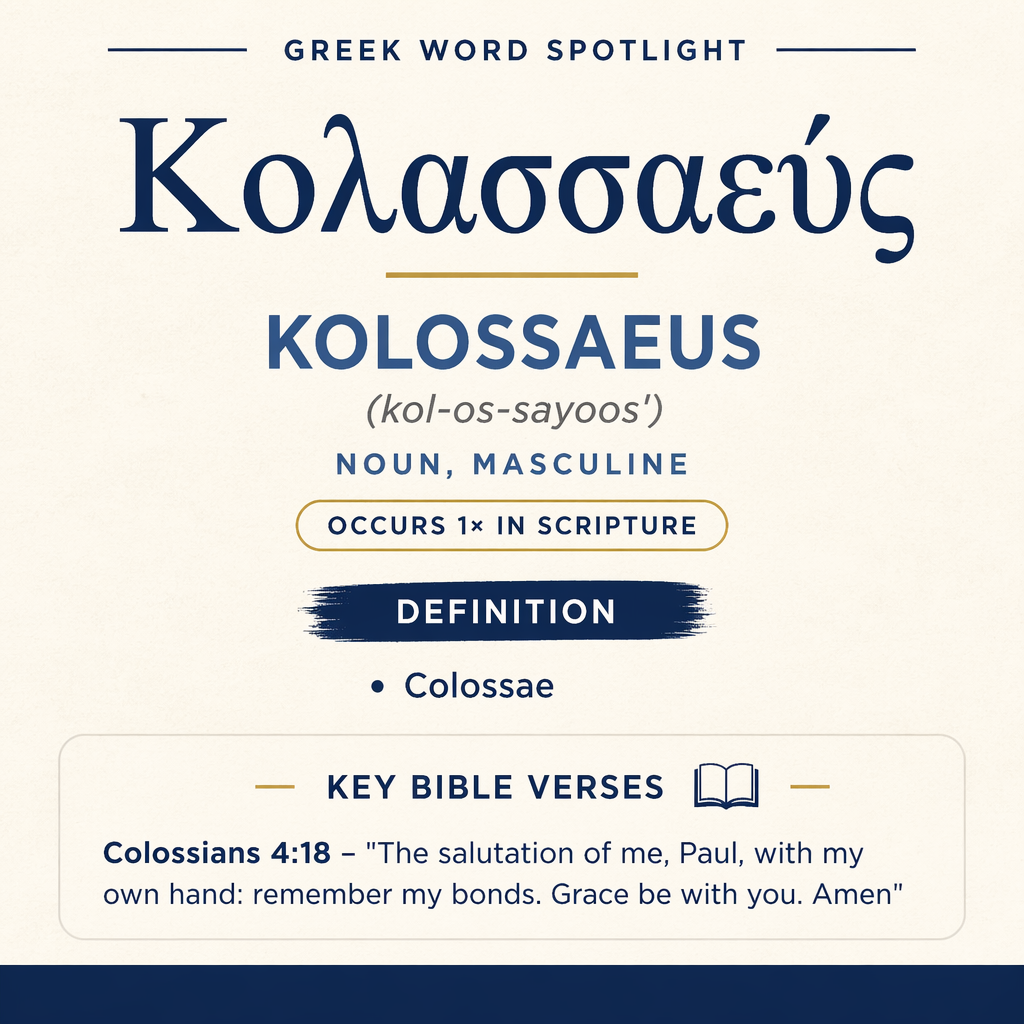
Κολασσαεύς means “Colossae” and appears once in Scripture, in Colossians 4:18.
Scripture Occurrence
This word occurs 1 time in Scripture. Its single occurrence is in Colossians 4:18.
Learn More →Context Note
In Colossians 4:18, the verse reads: “The salutation of me, Paul, with my own hand: remember my bonds. Grace be with you. Amen.”
Learn More →Kolossaeus means “Colossae” and appears once in the New Testament, in the closing lines of Colossians. In that final greeting, the word functions as a geographic name anchoring the letter’s farewell in a particular place and community.
Root and Related Words
Kolossaeus corresponds to the place-name Kolossai (Κολοσσαί), “Colossae” (Strong’s G2857). The relationship is one of derivation from the city’s name, yielding a form that points back to that locale as the defining reference.

Occurrences
“The salutation of me, Paul, with my own hand: remember my bonds. Grace be with you. Amen.” (Colossians 4:18)
In this closing line, Kolossaeus serves the letter’s concluding address by tying the farewell—“The salutation of me, Paul, with my own hand”—to the recipients associated with Colossae. The verse itself emphasizes authenticity (“with my own hand”), a personal request (“remember my bonds”), and a benediction (“Grace be with you”). Against that compact ending, the force of a word meaning “Colossae” is to locate this personal signature and blessing within a real, identifiable destination: the communication is not an abstract theological treatise but a written greeting sent to a specific community situated in Colossae.
The wording also highlights relational proximity across distance. Paul’s “own hand” and his request to be remembered create a sense of personal presence within the letter, even as the message must travel outward. The mention of “bonds” introduces a concrete circumstance shaping the correspondence; the addressees are called to hold that circumstance in mind. Kolossaeus, pointing to Colossae, frames the entire closing as something directed outward from the writer’s constrained situation to a known place where readers can respond in memory, prayerful concern, and reception of “Grace.”
Sense and Usage
As a term meaning “Colossae,” Kolossaeus operates as a place-reference rather than a descriptive adjective or a general label. Its contribution is to identify the destination associated with the letter, and therefore to strengthen the letter’s character as a specific communication between particular parties. Even when a verse’s surface wording focuses on signature, remembrance, and blessing, a word naming Colossae works in the background as an anchor: it indicates that the written, hand-authenticated salutation and the appeal to “remember” are directed toward an audience located in that named city.
This single attestation concentrates the word’s function into one rhetorical moment: the end of a letter. Endings often tighten and intensify personal elements—signature, brief requests, concise benedictions—and the place-reference fits that pattern by marking the final words as something meant to land in an actual community. “Grace be with you” is shaped as a blessing meant to rest upon real hearers in a real setting. Kolossaeus, by pointing to Colossae, keeps the benediction from floating free; it belongs to a church receiving a signed letter in a specific locale.
The same is true of the appeal, “remember my bonds.” Memory here is not generic recollection; it is requested from an identifiable group of recipients who can sustain that remembering as a shared obligation. A place-name in this setting signals that such remembrance is expected to take form within a community that has its own habits of reading, relaying, and holding the writer in mind. The word’s meaning therefore participates in the letter’s relational logic: a known sender, a known circumstance (“my bonds”), and a known destination (Colossae), all brought together in a final, concentrated sentence.
Imagery
Though Kolossaeus is a geographic term, the closing verse where it appears evokes a vivid scene of correspondence: a letter bearing a personal signature, a writer in “bonds,” and a blessing sent across distance. The place-reference to Colossae helps the reader imagine the letter arriving and being read aloud among recipients who can “remember” and receive “Grace,” not as abstractions, but as realities belonging to a particular city and its gathered believers.
Sources: Lexical data from Strong’s Exhaustive Concordance and the Translators Brief Lexicon of Extended Strongs for Greek (STEPBible, CC BY). Occurrence data from the Translators Amalgamated Greek New Testament (STEPBible, CC BY). Scripture quotations from the World English Bible (public domain).