
Exploring the Meaning of Kolossai in Greek
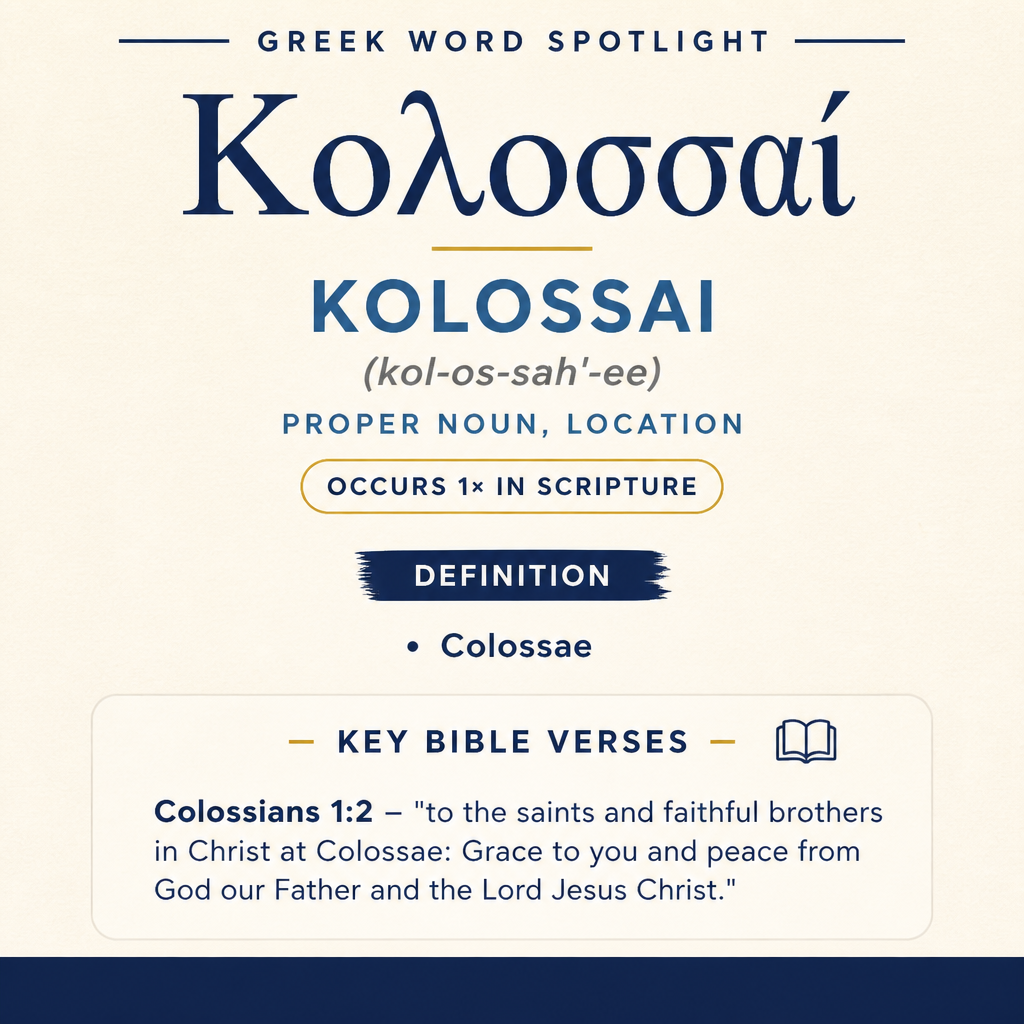
Κολοσσαί means Colossae and appears once in Scripture, in Colossians 1:2.
Biblical Usage
It occurs one time in the New Testament. The occurrence is in Colossians 1:2.
Learn More →Verse Context
In Colossians 1:2, Paul addresses “the saints and faithful brothers in Christ at Colossae.”
Learn More →Κολοσσαί names Colossae, appearing where Paul addresses a community of believers located there. In its lone New Testament use, the place-name anchors the greeting in a particular setting and audience.
Occurrences
“to the saints and faithful brothers in Christ at Colossae: Grace to you and peace from God our Father and the Lord Jesus Christ.” (Colossians 1:2)
Here Κολοσσαί functions as a geographic locator within the opening address. The sentence identifies the recipients as “the saints and faithful brothers in Christ” and then situates them “at Colossae,” tying their shared identity (“in Christ”) to a concrete place. The location is not incidental to the syntax: it helps distinguish this group from other assemblies by specifying where these “saints and faithful brothers” are found. The greeting that follows—“Grace to you and peace from God our Father and the Lord Jesus Christ”—is directed to that identified community, and the place-name helps define the scope of the blessing as this particular audience.

Because the address holds together both spiritual description (“saints,” “faithful,” “in Christ”) and local designation (“at Colossae”), Κολοσσαί participates in a dual framing: the recipients are portrayed as belonging to Christ while also belonging to a recognizable locale. The place-name thus contributes a note of concreteness to the letter’s opening line, presenting the message as correspondence with real addressees in a real setting rather than a general maxim detached from any community.

Sense and Usage
As a proper name meaning Colossae, Κολοσσαί operates as a fixed designation rather than a descriptive term. In Colossians 1:2 it appears in a formula typical of epistolary address: recipients are named, characterized, and located. The definitional force of the word is therefore straightforward—identifying the city—but its communicative role is richer: it sets the letter’s horizon by attaching the recipients’ communal identity to a specific place.
The wording “at Colossae” is especially instructive for how the place-name works. It is not presented as an abstract symbol but as the ordinary way of indicating where the addressed believers are. This allows the line to carry two kinds of belonging without confusion: “in Christ” marks the relational and devotional sphere of the community, while “at Colossae” marks its earthly address. Κολοσσαί thus helps keep the greeting from becoming vague or purely spiritualized; the blessing of “Grace… and peace” is spoken into a local context, to people who live and worship somewhere identifiable.
Because Κολοσσαί is used in direct address rather than narrative description, its effect is to establish a correspondence relationship: the writer speaks to a group in a named location. The place-name signals that what follows is meant for that audience as a community, not merely for scattered individuals. In this way, the word supports the social dimension implied by “brothers,” where familial language is attached to a location that gathers the family into a recognizable congregation within a city.
Even in a single attested use, Κολοσσαί exhibits the typical behavior of a toponym in the New Testament letters: it functions as a stable reference point that limits the addressees and clarifies the destination of the greeting. The word does not itself describe the community’s qualities; instead it supplies the coordinate that complements the moral and spiritual descriptors already present (“saints,” “faithful”). The combination of descriptors with location highlights how early Christian identity is spoken of both in terms of character and commitment and in terms of where that commitment is lived out.
Imagery
In Colossians 1:2 the imagery carried by Κολοσσαί is quiet and practical: a city as the setting for a community addressed by name. The verse presents grace and peace as arriving to a definite place—“at Colossae”—so that the blessing is imagined not as floating in the abstract but as directed toward a gathered people within a particular locale.
Sources: Lexical data from Strong’s Exhaustive Concordance and the Translators Brief Lexicon of Extended Strongs for Greek (STEPBible, CC BY). Occurrence data from the Translators Amalgamated Greek New Testament (STEPBible, CC BY). Scripture quotations from the World English Bible (public domain).





