Exploring the Meaning of Kleros in Greek
κλῆρος means “lot” and appears 12 times in Scripture, including the crucifixion accounts and several passages in Acts.
Core Meaning
κλῆρος is defined as “lot.” It is used for casting lots to make a decision.
Learn More →Gospel Scenes
In Matthew 27:35, Mark 15:24, Luke 23:34, and John 19:24, soldiers cast lots for Jesus’ clothing.
Learn More →Acts Usage
Acts uses κλῆρος for drawing lots (Acts 1:26) and for having “part” or “lot” (Acts 8:21).
Learn More →κλῆρος is the word for a “lot,” appearing in scenes where something is assigned, decided, or apportioned by casting lots, and also in statements that speak of a person’s “portion” in a ministry or matter. In the quoted passages it moves between a concrete act (casting lots) and the resulting allotment (a portion or share).
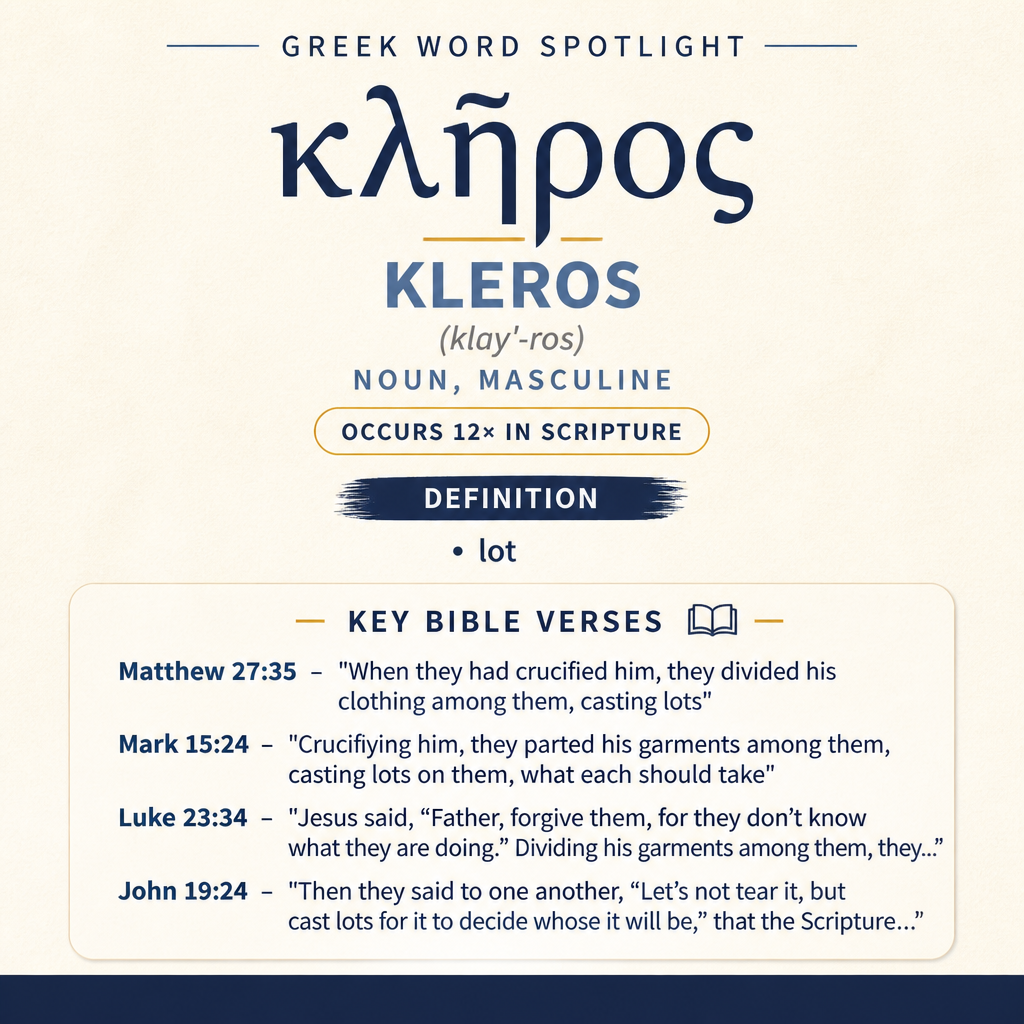
Occurrences
Matthew 27:35 — “When they had crucified him, they divided his clothing among them, casting lots,”
Here κλῆρος belongs to the soldiers’ distribution of Jesus’ clothing. The lot functions as the procedure by which the divided garments are assigned: the clothing is already in their possession and is being apportioned, and the cast lot provides the decision of who receives what.

Mark 15:24 — “Crucifying him, they parted his garments among them, casting lots on them, what each should take.”
Mark makes explicit what the casting accomplishes: it answers “what each should take.” κλῆρος is tied to the problem of fair (or at least determinate) allocation among several takers; the lot becomes the means by which an individual claim to a specific item is settled.
Luke 23:34 — “Jesus said, “Father, forgive them, for they don’t know what they are doing.” Dividing his garments among them, they cast lots.”
Luke places the casting of lots alongside Jesus’ prayer for forgiveness. Within the same moment, κλῆρος marks the soldiers’ action of assigning the garments while Jesus interprets their conduct as ignorant wrongdoing. The lot underscores the cool, procedural character of the division: the garments are not merely taken, but distributed by a deliberate method.
John 19:24 — “Then they said to one another, “Let’s not tear it, but cast lots for it to decide whose it will be,” that the Scripture might be fulfilled, which says, “They parted my garments among them. For my cloak they cast lots.” Therefore the soldiers did these things.”
In John the lot is presented as an alternative to tearing the garment: rather than damage it, they seek a decisive assignment—“to decide whose it will be.” κλῆρος is explicitly linked with decision and ownership, and the scene doubles the action (casting lots) with a stated outcome (who receives the cloak). The narrative also frames the soldiers’ use of lots as an enacted correspondence to the cited scriptural wording embedded in the verse.
Acts 1:17 — “For he was counted with us, and received his portion in this ministry.”
Here κλῆρος appears as “portion,” describing an allotment within “this ministry.” The idea of the lot is not the act of casting but the share that results: someone has a counted place and a received portion, language of inclusion and assigned participation rather than random selection.
Acts 1:26 — “They drew lots for them, and the lot fell on Matthias, and he was counted with the eleven apostles.”
This verse joins the procedure and its outcome. κλῆρος is both what is drawn (“They drew lots”) and the determinative result (“the lot fell on Matthias”). The lot is portrayed as publicly resolving the question of appointment, producing a clear assignment that leads immediately to being “counted with the eleven apostles.”
Acts 8:21 — “You have neither part nor lot in this matter, for your heart isn’t right before God.”
κλῆρος is paired with “part” to deny any share “in this matter.” The denial is grounded in an inward condition: “your heart isn’t right before God.” In this context the lot is not a random draw but a recognized portion of involvement or entitlement; the statement excludes someone from participation as a matter of moral-spiritual fitness.
Acts 26:18 — “to open their eyes, that they may turn from darkness to light and from the power of Satan to God, that they may receive remission of sins and an inheritance among those who are sanctified by faith in me.’”
Although κλῆρος is not translated with “lot” in this quotation, the verse’s phrasing of “an inheritance among those who are sanctified” speaks in the same direction as an allotted share. The movement described—turning, receiving remission, and receiving an inheritance—presents the portion as granted within a defined community (“among those who are sanctified”), emphasizing belonging and receipt rather than the mechanics of casting.
Colossians 1:12 — “giving thanks to the Father, who made us fit to be partakers of the inheritance of the saints in light,”
Here κλῆρος is expressed through “inheritance,” with attention on fitness and participation. The Father “made us fit” so that believers become “partakers” of a share that belongs to “the saints in light.” The lot-idea operates as a portion possessed and shared by a people, and the verse highlights the giver’s action as the basis for receiving that share.
1 Peter 5:3 — “not as lording it over those entrusted to you, but making yourselves examples to the flock.”
In this pastoral instruction, κλῆρος lies behind “those entrusted to you.” The sense of lot is carried in the idea of an allotted charge: leaders are warned against domineering control over the portion assigned to their care. The word’s contribution is the framing of a congregation as something assigned—an entrusted allotment—rather than a possession to be exploited.

Sense and Usage
Across these passages κλῆρος consistently anchors the notion of assignment. In the crucifixion narratives (Matthew 27:35; Mark 15:24; Luke 23:34; John 19:24) the lot is a concrete device for distributing goods: the soldiers’ casting transforms shared access to Jesus’ clothing into individual possession. John brings out the decision-making force of the lot most explicitly—“to decide whose it will be”—showing that κλῆρος is not merely a ritual action but a means to a settled result.
Acts uses the word in two related directions. In Acts 1:26, κλῆρος again appears in its overt, procedural form: lots are drawn and one “falls” to Matthias, producing a recognized placement among the apostles. But Acts 1:17 and Acts 8:21 press the word beyond the mechanics of drawing, speaking of “portion” and “lot” as a share in ministry or a share in a matter. In these lines κλῆρος points to assigned participation—something one can receive (“received his portion in this ministry”) or be denied (“neither part nor lot in this matter”). The denial in Acts 8:21 shows that κλῆρος can mark eligibility and belonging: a “lot” is a place one may or may not have, and the text grounds that inclusion in a heart that is “right before God.”
Acts 26:18 and Colossians 1:12 extend the same conceptual field into the language of inheritance and shared participation. Both verses speak of receiving an “inheritance” within a sanctified people, and Colossians ties that participation directly to divine enabling—being “made… fit.” Within the range of these quotations, κλῆρος therefore spans from a small, immediate decision about property (who gets the garment) to a larger, communal share (inheritance among the sanctified; inheritance of the saints in light). The underlying thread is the idea of an allotment—something determined, assigned, and then held as one’s share.
Finally, 1 Peter 5:3 shows how the imagery of allotment can shape relationships: the community under a leader’s care is an entrusted “lot,” and that framing places moral limits on leadership. The lot is not a platform for “lording it over” others, but a trust that calls for exemplary conduct.
Imagery
κλῆρος carries vivid, tactile imagery in the crucifixion scenes: garments are divided and a decision is produced by casting lots, turning suffering’s public spectacle into an occasion for calculated distribution (Matthew 27:35; Mark 15:24; Luke 23:34; John 19:24). The same word then supplies a quieter but weightier picture in the later writings: a person may have a “portion in this ministry” (Acts 1:17), may be excluded from any “lot in this matter” (Acts 8:21), may be counted among the recipients of an inheritance (Acts 26:18; Colossians 1:12), and may be charged not to domineer over an entrusted allotment of people (1 Peter 5:3).
Sources: Lexical data from Strong’s Exhaustive Concordance and the Translators Brief Lexicon of Extended Strongs for Greek (STEPBible, CC BY). Occurrence data from the Translators Amalgamated Greek New Testament (STEPBible, CC BY). Scripture quotations from the World English Bible (public domain).