
Who was Zerahiah in the bible?
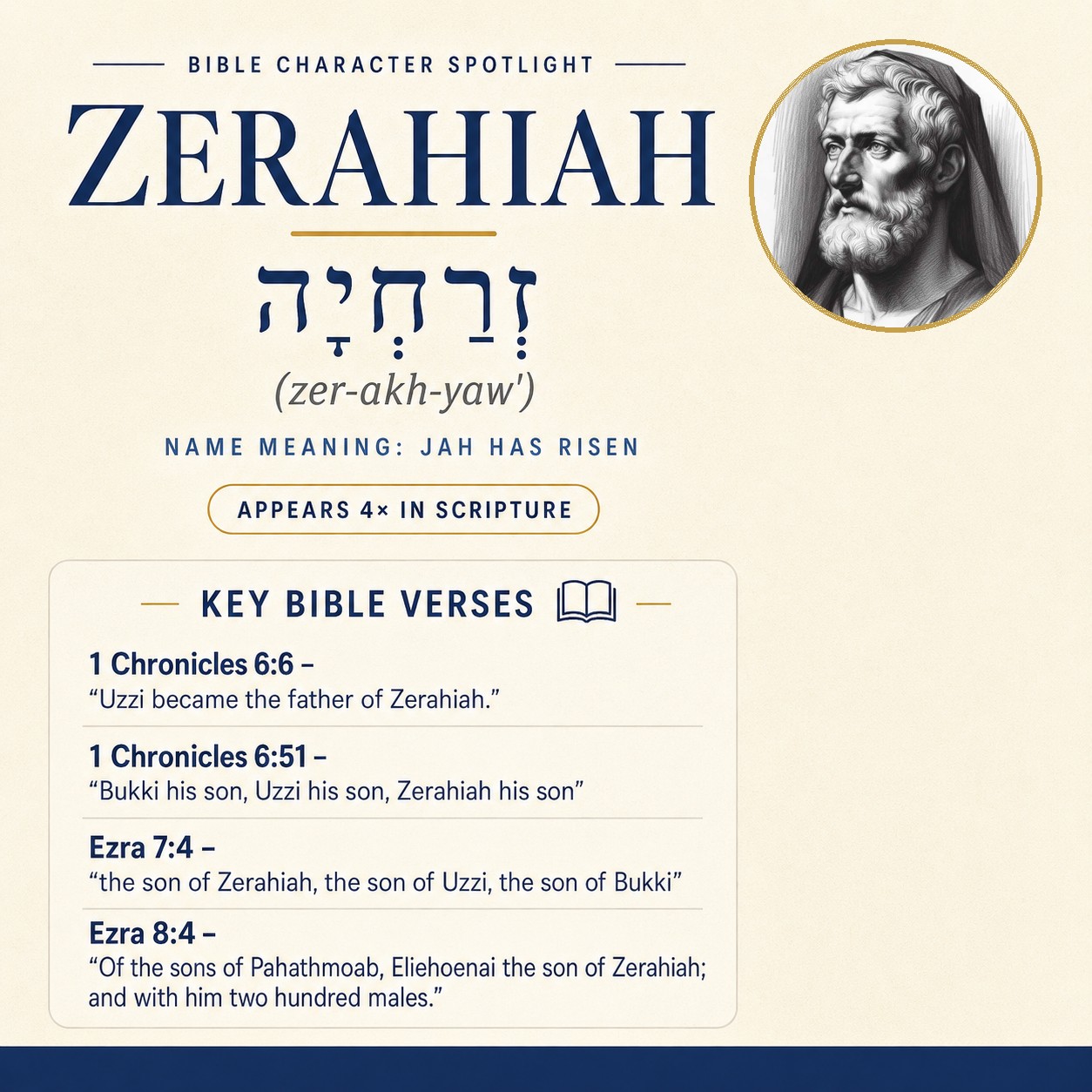
Zerahiah is a biblical name borne by two Israelites, appearing in genealogies in 1 Chronicles 6 and in lists in Ezra 7–8.
In Ezra’s Line
Ezra’s ancestry includes “the son of Zerahiah, the son of Uzzi, the son of Bukki” (Ezra 7:4). This places Zerahiah within the same genealogical chain named in 1 Chronicles 6:51.
Learn More →Father of Eliehoenai
A different Zerahiah is named as the father of Eliehoenai: “Eliehoenai the son of Zerahiah; and with him two hundred males” (Ezra 8:4). The lexicon gloss identifies Zerahiah as the name of two Israelites.
Learn More →Zerahiah (Zerachyah) is the name of two Israelites in Scripture. One Zerahiah appears in a priestly genealogy connected with Aaron’s line, and another is named as the father of Eliehoenai among “the sons of Pahathmoab.”
Zerahiah in Scripture
Zerahiah first appears in a genealogy in 1 Chronicles 6, where he is placed between Uzzi and Meraioth.
“Uzzi became the father of Zerahiah. Zerahiah became the father of Meraioth.” (1 Chronicles 6:6, WEB)
The surrounding verses present this line as part of the descendants of Aaron. The genealogy around Zerahiah begins with Aaron’s son Eleazar and proceeds through several generations to Uzzi and Zerahiah, then onward beyond him:
“Eleazar became the father of Phinehas, Phinehas became the father of Abishua,” (1 Chronicles 6:4, WEB)
“Abishua became the father of Bukki. Bukki became the father of Uzzi.” (1 Chronicles 6:5, WEB)
“Uzzi became the father of Zerahiah. Zerahiah became the father of Meraioth.” (1 Chronicles 6:6, WEB)
“Meraioth became the father of Amariah. Amariah became the father of Ahitub.” (1 Chronicles 6:7, WEB)
“Ahitub became the father of Zadok. Zadok became the father of Ahimaaz.” (1 Chronicles 6:8, WEB)
“Ahimaaz became the father of Azariah. Azariah became the father of Johanan.” (1 Chronicles 6:9, WEB)
Later in the same chapter, 1 Chronicles repeats the line in a more explicitly Aaronic setting. Before listing the names, the chapter speaks of Aaron and his sons performing priestly offerings and atonement according to Moses’ command:
“But Aaron and his sons offered on the altar of burnt offering, and on the altar of incense, for all the work of the most holy place, and to make atonement for Israel, according to all that Moses the servant of God had commanded.” (1 Chronicles 6:49, WEB)
Immediately afterward the genealogy is introduced as “the sons of Aaron,” and Zerahiah is named again, again as Uzzi’s son and Meraioth’s father:
“These are the sons of Aaron: Eleazar his son, Phinehas his son, Abishua his son,” (1 Chronicles 6:50, WEB)
“Bukki his son, Uzzi his son, Zerahiah his son,” (1 Chronicles 6:51, WEB)
“Meraioth his son, Amariah his son, Ahitub his son,” (1 Chronicles 6:52, WEB)
“Zadok his son, and Ahimaaz his son.” (1 Chronicles 6:53, WEB)
This repetition presents Zerahiah as one link in the hereditary line connected with Aaron’s descendants and their priestly service. In the immediate continuation of the chapter, the text turns to “their dwelling places” and specifies that these arrangements were “to the sons of Aaron, of the families of the Kohathites.”
“Now these are their dwelling places according to their encampments in their borders: to the sons of Aaron, of the families of the Kohathites (for theirs was the first lot),” (1 Chronicles 6:54, WEB)
In Ezra 7, Zerahiah appears again within a genealogy, this time as part of the ancestry of Ezra. The line given in Ezra 7 aligns with the priestly genealogy of 1 Chronicles 6, naming Zerahiah as the father of Meraioth and the son of Uzzi (with Bukki also named in the chain):
“the son of Amariah, the son of Azariah, the son of Meraioth,” (Ezra 7:3, WEB)
“the son of Zerahiah, the son of Uzzi, the son of Bukki,” (Ezra 7:4, WEB)
“the son of Abishua, the son of Phinehas, the son of Eleazar, the son of Aaron the chief priest—” (Ezra 7:5, WEB)
After this genealogy, the passage introduces Ezra and describes his role and travel. The narrative states:
“this Ezra went up from Babylon. He was a skilled scribe in the law of Moses, which Yahweh, the God of Israel, had given; and the king granted him all his request, according to Yahweh his God’s hand on him.” (Ezra 7:6, WEB)
It continues with the note that a group from Israel went up to Jerusalem, including various temple-associated groups:
“Some of the children of Israel, including some of the priests, the Levites, the singers, the gatekeepers, and the temple servants went up to Jerusalem in the seventh year of Artaxerxes the king.” (Ezra 7:7, WEB)
In Ezra 8, a Zerahiah is mentioned in a different setting: a list of family heads and their accompanying males who went with Ezra. Here Zerahiah is identified as the father of a man named Eliehoenai among “the sons of Pahathmoab.”
“Of the sons of Pahathmoab, Eliehoenai the son of Zerahiah; and with him two hundred males.” (Ezra 8:4, WEB)
This verse occurs within a broader catalog of groups and named leaders:
“Of the sons of Phinehas, Gershom. Of the sons of Ithamar, Daniel. Of the sons of David, Hattush.” (Ezra 8:2, WEB)
“Of the sons of Shecaniah, of the sons of Parosh, Zechariah; and with him were listed by genealogy of the males one hundred fifty.” (Ezra 8:3, WEB)
“Of the sons of Shecaniah, the son of Jahaziel; and with him three hundred males.” (Ezra 8:5, WEB)
“Of the sons of Adin, Ebed the son of Jonathan; and with him fifty males.” (Ezra 8:6, WEB)
“Of the sons of Elam, Jeshaiah the son of Athaliah; and with him seventy males.” (Ezra 8:7, WEB)
Within this list, “Zerahiah” functions simply as a patronymic identifier—Eliehoenai is called “the son of Zerahiah”—without further detail about Zerahiah’s own life or office in this passage.
Multiple bearers
The lexicon gloss identifies Zerahiah as a name borne by two Israelites, and the passages present two distinct contexts. (1) In 1 Chronicles 6 and Ezra 7, Zerahiah belongs to a priestly genealogy tied to Aaron: “Uzzi became the father of Zerahiah. Zerahiah became the father of Meraioth” (1 Chronicles 6:6), and in Ezra’s ancestry he appears as “the son of Zerahiah” within a line that culminates in “Aaron the chief priest—” (Ezra 7:5). (2) In Ezra 8:4, Zerahiah appears as the father of Eliehoenai in a returnee list: “Eliehoenai the son of Zerahiah” among “the sons of Pahathmoab” (Ezra 8:4). The texts do not explicitly identify these two references as the same person, and they occur in different kinds of lists serving different purposes.
Name and Meaning
The name is written in Hebrew script as זְרַחְיָה and transliterated Zerachyah, pronounced zer-akh-yaw’. According to the lexicon’s derivation, it is formed from elements associated with a “rising of light” (zerach) and “Jah” (Yahh), yielding the sense “Jah has risen.”
Observation
Across these passages, Zerahiah is presented through family connection: in one line he is the son of Uzzi and father of Meraioth (1 Chronicles 6:6), and in another he is known as the father of Eliehoenai (Ezra 8:4).
Frequently Asked Questions
What does the name Zerahiah mean?
Zerahiah means “Jah has risen.”
How many times does Zerahiah appear in the Bible?
Zerahiah appears 4 times.
Who was Zerahiah in the Bible?
Zerahiah is the name of two Israelites. One Zerahiah is listed in a genealogy as the son of Uzzi and the father of Meraioth (1 Chronicles 6:6).
Where is Zerahiah mentioned in a lineage list?
Zerahiah is named in a lineage in Ezra 7:4: “the son of Zerahiah, the son of Uzzi, the son of Bukki.”
Explore Further
If you found this page about Zerahiah interesting and would like to discover more about other biblical characters, explore our comprehensive Encyclopedia of Biblical Characters. For those looking to delve deeper into the Greek origins of these names and terms, our Greek Lexicon is an invaluable resource.
Sources: Name and occurrence data from Strong’s Exhaustive Concordance and STEPBible reference data (CC BY). Scripture quotations from the World English Bible (public domain).





