Who was Zelotes in the bible?
“Zelotes” refers to (1) Simon “who was called the Zealot” among the apostles (Luke 6:15; Acts 1:13), and (2) “zealous” people described in Acts and letters.

Where Mentioned
In Luke, Jesus “chose twelve, whom he also named apostles,” including “Simon, who was called the Zealot” (Luke 6:13,15). In Acts, the group in Jerusalem included “Simon the Zealot” (Acts 1:13).
Learn More →Name And Sense
The Greek term ζηλωτής (Zelotes) is linked by lexicon derivation to being eager, glossed “zealot.” Acts also speaks of believers “zealous for the law” (Acts 21:20).
Learn More →Zelotes is a Greek designation meaning a “zealot,” used in the New Testament both as a descriptive term for being eager/zealous and as a byname attached to one of Jesus’ apostles, “Simon … called the Zealot” (Luke 6:15; Acts 1:13).
Zelotes in Scripture
In Luke’s list of the twelve apostles, “Simon” is specifically identified by this title.
“When it was day, he called his disciples, and from them he chose twelve, whom he also named apostles:” (Luke 6:13, WEB)
“Matthew; Thomas; James, the son of Alphaeus; Simon, who was called the Zealot;” (Luke 6:15, WEB)
“Judas the son of James; and Judas Iscariot, who also became a traitor.” (Luke 6:16, WEB)
Luke immediately sets this choosing of apostles in a wider scene where Jesus is with the newly chosen group and a large crowd from multiple regions.
“He came down with them, and stood on a level place, with a crowd of his disciples, and a great number of the people from all Judea and Jerusalem, and the sea coast of Tyre and Sidon, who came to hear him and to be healed of their diseases;” (Luke 6:17, WEB)
“as well as those who were troubled by unclean spirits, and they were being healed.” (Luke 6:18, WEB)
In Acts, the same Simon appears again under the same designation, now among the group gathered in Jerusalem after Jesus’ ascension.
“You men of Galilee, why do you stand looking into the sky? This Jesus, who was received up from you into the sky, will come back in the same way as you saw him going into the sky.” (Acts 1:11, WEB)
“Then they returned to Jerusalem from the mountain called Olivet, which is near Jerusalem, a Sabbath day’s journey away.” (Acts 1:12, WEB)
“When they had come in, they went up into the upper room where they were staying; that is Peter, John, James, Andrew, Philip, Thomas, Bartholomew, Matthew, James the son of Alphaeus, Simon the Zealot, and Judas the son of James.” (Acts 1:13, WEB)
“All these with one accord continued steadfastly in prayer and supplication, along with the women, and Mary the mother of Jesus, and with his brothers.” (Acts 1:14, WEB)
The narrative context that follows places this gathering within a larger community of disciples.
“In these days, Peter stood up in the middle of the disciples (and the number of names was about one hundred twenty), and said,” (Acts 1:15, WEB)
“Brothers, it was necessary that this Scripture should be fulfilled, which the Holy Spirit spoke before by the mouth of David concerning Judas, who was guide to those who took Jesus.” (Acts 1:16, WEB)
Beyond these direct references to “Simon the Zealot,” the same Greek word family is also used as a descriptive term for being zealous. In Acts 21, the elders in Jerusalem describe Jewish believers as “zealous for the law” in a conversation with Paul.
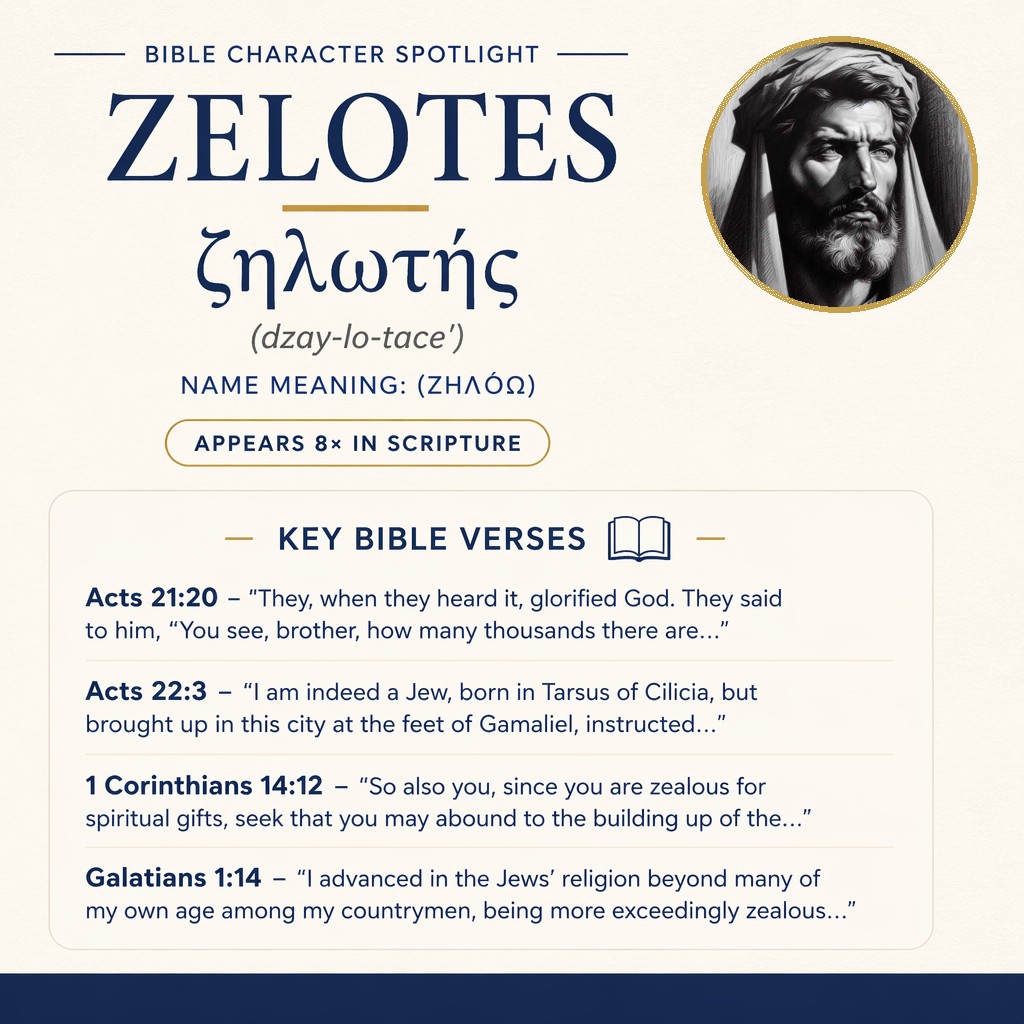
“They, when they heard it, glorified God. They said to him, “You see, brother, how many thousands there are among the Jews of those who have believed, and they are all zealous for the law.” (Acts 21:20, WEB)
The surrounding narrative in Acts 21 gives a full travel-and-arrival sequence leading to that statement and then describes events in Jerusalem. Paul and his companions travel by ship, stopping at multiple places, and eventually arrive at Jerusalem.
“When we had departed from them and had set sail, we came with a straight course to Cos, and the next day to Rhodes, and from there to Patara.” (Acts 21:1, WEB)
“Having found a ship crossing over to Phoenicia, we went aboard, and set sail.” (Acts 21:2, WEB)
“When we had come in sight of Cyprus, leaving it on the left hand, we sailed to Syria and landed at Tyre, for the ship was there to unload her cargo.” (Acts 21:3, WEB)
They stay with disciples at Tyre; then depart with prayer; then move through Ptolemais and Caesarea. In Caesarea they stay with Philip the evangelist, and a prophet named Agabus gives a warning using Paul’s belt.
“Having found disciples, we stayed there seven days. These said to Paul through the Spirit that he should not go up to Jerusalem.” (Acts 21:4, WEB)
“Kneeling down on the beach, we prayed.” (Acts 21:5, WEB)
“On the next day, we who were Paul’s companions departed, and came to Caesarea. We entered into the house of Philip the evangelist, who was one of the seven, and stayed with him.” (Acts 21:8, WEB)
“Coming to us and taking Paul’s belt, he bound his own feet and hands, and said, “The Holy Spirit says: ‘So the Jews at Jerusalem will bind the man who owns this belt, and will deliver him into the hands of the Gentiles.’ ”” (Acts 21:11, WEB)
Despite repeated pleas, Paul insists on going to Jerusalem.
“Then Paul answered, “What are you doing, weeping and breaking my heart? For I am ready not only to be bound, but also to die at Jerusalem for the name of the Lord Jesus.”” (Acts 21:13, WEB)
“When he would not be persuaded, we ceased, saying, “The Lord’s will be done.”” (Acts 21:14, WEB)
Arriving in Jerusalem, Paul meets with “James” and “all the elders,” reports what God has done among the Gentiles, and then hears their concern about rumors and their counsel about a vow. Their statement that many Jewish believers are “zealous for the law” is part of this meeting, and they instruct Paul in a plan intended to show that “you yourself also walk keeping the law.”
“When we had come to Jerusalem, the brothers received us gladly.” (Acts 21:17, WEB)
“The day following, Paul went in with us to James; and all the elders were present.” (Acts 21:18, WEB)
“When he had greeted them, he reported one by one the things which God had worked among the Gentiles through his ministry.” (Acts 21:19, WEB)
“Therefore do what we tell you. We have four men who have taken a vow.” (Acts 21:23, WEB)
“Then all will know that there is no truth in the things that they have been informed about you, but that you yourself also walk keeping the law.” (Acts 21:24, WEB)
Paul follows this counsel, going into the temple in purification. Near the end of the period, conflict erupts; Paul is seized; a citywide uproar follows; and Roman soldiers intervene, arresting him and bringing him toward the barracks as the crowd calls for his removal.
“Then Paul took the men, and the next day purified himself and went with them into the temple, declaring the fulfillment of the days of purification, until the offering was offered for every one of them.” (Acts 21:26, WEB)
“All the city was moved and the people ran together. They seized Paul and dragged him out of the temple. Immediately the doors were shut.” (Acts 21:30, WEB)
“Then the commanding officer came near, arrested him, commanded him to be bound with two chains, and inquired who he was and what he had done.” (Acts 21:33, WEB)
“for the multitude of the people followed after, crying out, “Away with him!”” (Acts 21:36, WEB)
At the end of the chapter, Paul asks permission to speak, identifies himself, and begins addressing the people “in the Hebrew language.”
“But Paul said, “I am a Jew, from Tarsus in Cilicia, a citizen of no insignificant city. I beg you, allow me to speak to the people.”” (Acts 21:39, WEB)
“When he had given him permission, Paul, standing on the stairs, beckoned with his hand to the people. When there was a great silence, he spoke to them in the Hebrew language, saying,” (Acts 21:40, WEB)
Paul later uses similar language about zeal in his own testimony and letters. He describes himself as “being zealous for God,” and also as “more exceedingly zealous for the traditions of my fathers.”
“I am indeed a Jew, born in Tarsus of Cilicia, but brought up in this city at the feet of Gamaliel, instructed according to the strict tradition of the law of our fathers, being zealous for God, even as you all are today.” (Acts 22:3, WEB)
“I advanced in the Jews’ religion beyond many of my own age among my countrymen, being more exceedingly zealous for the traditions of my fathers.” (Galatians 1:14, WEB)
Elsewhere, believers are described as being “zealous” in different directions: zeal for “spiritual gifts,” and zeal for “good works.”
“So also you, since you are zealous for spiritual gifts, seek that you may abound to the building up of the assembly.” (1 Corinthians 14:12, WEB)
“who gave himself for us, that he might redeem us from all iniquity, and purify for himself a people for his own possession, zealous for good works.” (Titus 2:14, WEB)
“Now who will harm you if you become imitators of that which is good?” (1 Peter 3:13, WEB)
Multiple Uses
The term Zelotes is used in two distinct ways in these passages. First, it is attached as a designation to a specific person: “Simon, who was called the Zealot” (Luke 6:15) and “Simon the Zealot” (Acts 1:13). Second, it appears as a descriptive term for zeal or eagerness: Jewish believers are “zealous for the law” (Acts 21:20), Paul is “being zealous for God” (Acts 22:3) and “more exceedingly zealous for the traditions of my fathers” (Galatians 1:14), and Christian communities are urged toward being “zealous for spiritual gifts” (1 Corinthians 14:12) and “zealous for good works” (Titus 2:14).
Name and Meaning
In Greek script the word is ζηλωτής, transliterated zelotes (also given with capitalization as Zelotes), pronounced “dzay-lo-tace’.” Lexically, it is derived from ζηλόω (zeloo), meaning to be eager, and is used with the sense “zealot.”
Observation
Across these passages, the same “zealous” language is applied to different objects—“the law” (Acts 21:20), “God” (Acts 22:3), “spiritual gifts” (1 Corinthians 14:12), and “good works” (Titus 2:14)—while “Simon … called the Zealot” appears within the named circle of the apostles (Luke 6:15) and among those who “continued steadfastly in prayer and supplication” (Acts 1:14).
Frequently Asked Questions
What does the name Zelotes mean?
Zelotes means “zealot.”
How many times does Zelotes appear in the Bible?
Zelotes appears 8 times total across the listed entries.
Who was Zelotes?
In Luke 6:15, “Simon” is called “the Zealot.” Acts 1:13 also lists “Simon” among those staying in the upper room.
Was there more than one person named Zelotes?
The word “zelotes” is used as a descriptor (“zealot”) in several passages (for example Acts 21:20 and Titus 2:14), and it is also used as a title for Simon in Luke 6:15.
Explore Further
If you found this page about Zelotes interesting and would like to discover more about other biblical characters, explore our comprehensive Encyclopedia of Biblical Characters. For those looking to delve deeper into the Greek origins of these names and terms, our Greek Lexicon is an invaluable resource.
Sources: Name and occurrence data from Strong’s Exhaustive Concordance and STEPBible reference data (CC BY). Scripture quotations from the World English Bible (public domain).