
Who was Zattu in the bible?
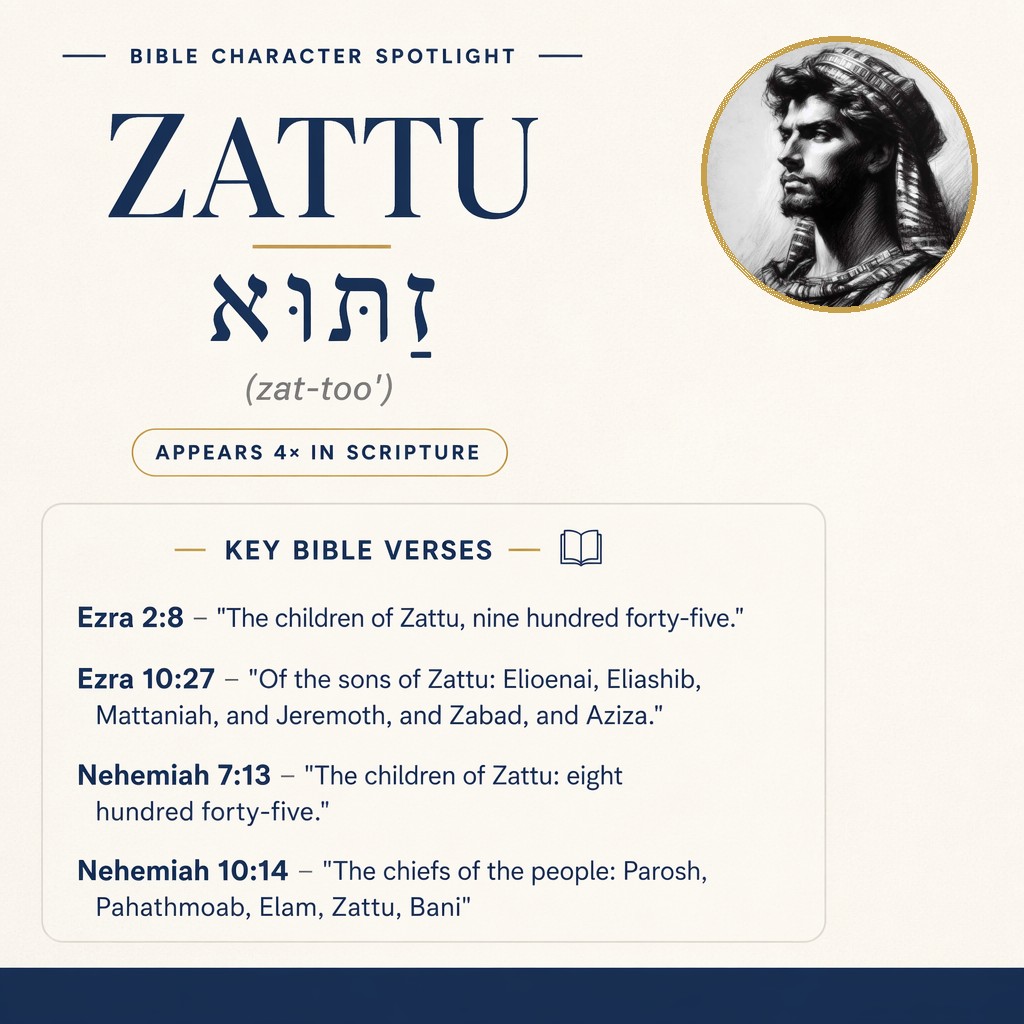
Zattu is an Israelite name found in Ezra and Nehemiah, appearing in lists of “the children of Zattu” and among “the chiefs of the people.”
Family Group Listed
A later list names “Of the sons of Zattu: Elioenai, Eliashib, Mattaniah, and Jeremoth, and Zabad, and Aziza” (Ezra 10:27). Nehemiah also counts “The children of Zattu: eight hundred forty-five” (Nehemiah 7:13).
Learn More →Chiefs of People
Zattu appears among leadership names: “The chiefs of the people: Parosh, Pahathmoab, Elam, Zattu, Bani,” (Nehemiah 10:14). The name’s derivation is uncertain (Strong’s).
Learn More →Zattu (זַתּוּא) is presented as the name of an Israelite family line (“the children of Zattu”) and also appears as a named leader among “the chiefs of the people.” The name’s derivation is uncertain in the lexicon material provided.
Zattu in Scripture
Zattu first appears in a numbered list of Israelite families identified as “children of” particular names. In this setting, Zattu is one of several adjacent family groups recorded together.
“The children of Pahathmoab, of the children of Jeshua and Joab, two thousand eight hundred twelve.” (Ezra 2:6, WEB)
“The children of Elam, one thousand two hundred fifty-four.” (Ezra 2:7, WEB)
“The children of Zattu, nine hundred forty-five.” (Ezra 2:8, WEB)
“The children of Zaccai, seven hundred sixty.” (Ezra 2:9, WEB)
“The children of Bani, six hundred forty-two.” (Ezra 2:10, WEB)
“The children of Bebai, six hundred twenty-three.” (Ezra 2:11, WEB)
In Ezra 2, Zattu functions as the ancestral identifier for a group counted at “nine hundred forty-five,” positioned among other similarly designated families. The text does not describe Zattu’s personal acts; it uses the name to mark a recognized household or clan within Israel.
Zattu appears again in Ezra 10 in a list that moves through several Israelite lines (“Of Israel”) and then gives “sons of” specific families. In the immediate surrounding context, the text first names individuals “Of the sons of Parosh,” then “Of the sons of Elam,” then “Of the sons of Zattu,” and continues on to other groups. The chapter segment’s narrative movement (as presented in the provided lines) is a structured enumeration: a heading (“Of Israel”), followed by successive family headings, each with associated individuals.
“Of Israel: Of the sons of Parosh: Ramiah, and Izziah, and Malchijah, and Mijamin, and Eleazar, and Malchijah, and Benaiah.” (Ezra 10:25, WEB)
“Of the sons of Elam: Mattaniah, Zechariah, and Jehiel, and Abdi, and Jeremoth, and Elijah.” (Ezra 10:26, WEB)
“Of the sons of Zattu: Elioenai, Eliashib, Mattaniah, and Jeremoth, and Zabad, and Aziza.” (Ezra 10:27, WEB)
“Of the sons of Bebai: Jehohanan, Hananiah, Zabbai, Athlai.” (Ezra 10:28, WEB)
“Of the sons of Bani: Meshullam, Malluch, and Adaiah, Jashub, and Sheal, Jeremoth.” (Ezra 10:29, WEB)
“Of the sons of Pahathmoab: Adna, and Chelal, Benaiah, Maaseiah, Mattaniah, Bezalel, and Binnui, and Manasseh.” (Ezra 10:30, WEB)
Within that ordered list, Zattu again functions as a family identifier. Ezra 10:27 does not describe Zattu directly; instead, it names six individuals as belonging to “the sons of Zattu”: “Elioenai, Eliashib, Mattaniah, and Jeremoth, and Zabad, and Aziza.” The repetition of “Of the sons of …” in the surrounding verses places Zattu among several Israelite groups treated in the same manner.
A parallel census-style listing appears in Nehemiah 7, again presenting “the children of” various families in sequence. Here the count attached to Zattu differs from Ezra 2, though the literary function is similar: Zattu is used to identify a recognized group within Israel.
“The children of Pahathmoab, of the children of Jeshua and Joab: two thousand eight hundred eighteen.” (Nehemiah 7:11, WEB)
“The children of Elam: one thousand two hundred fifty-four.” (Nehemiah 7:12, WEB)
“The children of Zattu: eight hundred forty-five.” (Nehemiah 7:13, WEB)
“The children of Zaccai: seven hundred sixty.” (Nehemiah 7:14, WEB)
“The children of Binnui: six hundred forty-eight.” (Nehemiah 7:15, WEB)
“The children of Bebai: six hundred twenty-eight.” (Nehemiah 7:16, WEB)
As in Ezra 2, the name Zattu anchors a count: “eight hundred forty-five.” The passage offers no further biographical detail about an individual named Zattu; the emphasis is on identifying the group and enumerating it among neighboring Israelite families.
Finally, Zattu appears in Nehemiah 10 in a different kind of list: not a census count of “children of,” but a roll of leadership described as “the chiefs of the people.” Zattu is included among other named chiefs in a sequence that continues beyond the single verse given.
“Zaccur, Sherebiah, Shebaniah,” (Nehemiah 10:12, WEB)
“Hodiah, Bani, and Beninu.” (Nehemiah 10:13, WEB)
“The chiefs of the people: Parosh, Pahathmoab, Elam, Zattu, Bani,” (Nehemiah 10:14, WEB)
“Bunni, Azgad, Bebai,” (Nehemiah 10:15, WEB)
“Adonijah, Bigvai, Adin,” (Nehemiah 10:16, WEB)
“Ater, Hezekiah, Azzur,” (Nehemiah 10:17, WEB)
In this context, “Zattu” is not phrased as “children of Zattu” but as a named entry among “the chiefs of the people.” The surrounding names overlap with those found as family designations elsewhere (for example, “Parosh,” “Pahathmoab,” and “Elam”), which fits the chapter’s practice (in the provided excerpt) of listing recognized leaders by name.
Multiple Bearers
The provided passages use “Zattu” in more than one way: (1) as an ancestral identifier for an Israelite family group (“the children of Zattu”) in Ezra 2:8 and Nehemiah 7:13; and (2) as a named chief listed among “the chiefs of the people” in Nehemiah 10:14. Ezra 10:27 also treats Zattu as the family identifier under which specific “sons of Zattu” are named.
Name and Meaning
The name is written in Hebrew as זַתּוּא, transliterated Zattuw’, and pronounced zat-too’. According to the lexicon information provided, its derivation is uncertain, and it is identified there as the name of an Israelite.
Observation
Across these passages, the name “Zattu” consistently marks a recognized place within Israel’s community life—counted among “the children of” particular families and also appearing among “the chiefs of the people” (Nehemiah 10:14).
Frequently Asked Questions
Who was Zattu in the Bible?
Zattu is identified as an Israelite. The name appears in lists such as “The children of Zattu” (Ezra 2:8; Nehemiah 7:13) and among “the chiefs of the people” (Nehemiah 10:14).
What does the name Zattu mean?
Zattu is a personal name of uncertain derivation, used of an Israelite.
How many times does Zattu appear in the Bible?
Zattu appears 4 times.
Which people are listed as sons of Zattu?
Ezra 10:27 lists these “sons of Zattu”: Elioenai, Eliashib, Mattaniah, Jeremoth, Zabad, and Aziza.
Explore Further
If you found this page about Zattu interesting and would like to discover more about other biblical characters, explore our comprehensive Encyclopedia of Biblical Characters. For those looking to delve deeper into the Greek origins of these names and terms, our Greek Lexicon is an invaluable resource.
Sources: Name and occurrence data from Strong’s Exhaustive Concordance and STEPBible reference data (CC BY). Scripture quotations from the World English Bible (public domain).





