Who was Uriel in the bible?
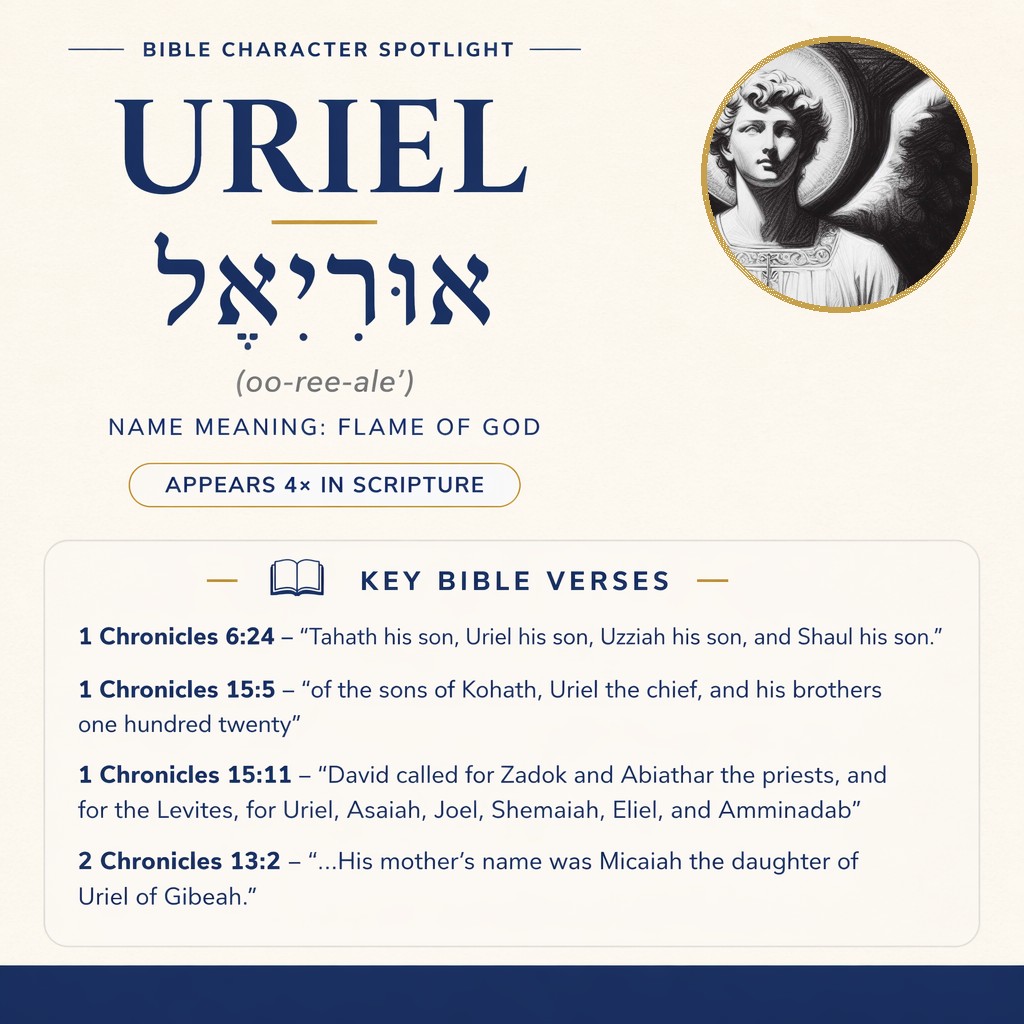
Uriel is the name of two Israelites mentioned in 1 Chronicles 6:24; 1 Chronicles 15:5,11; and 2 Chronicles 13:2.
Levitical Leader
In David’s assembly, “of the sons of Kohath, Uriel the chief, and his brothers one hundred twenty” (1 Chronicles 15:5). “David called for… the Levites, for Uriel…” (1 Chronicles 15:11).
Learn More →Family Reference
A genealogy states: “Tahath his son, Uriel his son, Uzziah his son, and Shaul his son” (1 Chronicles 6:24). Another Uriel is named in: “Micaiah the daughter of Uriel of Gibeah” (2 Chronicles 13:2).
Learn More →Uriel is a Hebrew name borne by two Israelites in the biblical text provided: one appears in a Levitical genealogy and later as a Kohathite leader in David’s assembly, and another is identified as “of Gibeah” as the father of Micaiah. The name is derived from Hebrew elements often paraphrased as meaning “flame of God.”
Uriel in Scripture
The first occurrence of the name appears within a genealogy connected to Kohath. In the sequence of descent, Uriel is placed between Tahath and Uzziah:
“Tahath his son, Uriel his son, Uzziah his son, and Shaul his son.” (1 Chronicles 6:24)
The immediate context frames this list under “The sons of Kohath,” moving through several generations before and after Uriel is mentioned:
“The sons of Kohath: Amminadab his son, Korah his son, Assir his son,” (1 Chronicles 6:22)
“Elkanah his son, and Ebiasaph his son, Assir his son,” (1 Chronicles 6:23)
“Tahath his son, Uriel his son, Uzziah his son, and Shaul his son.” (1 Chronicles 6:24)
“The sons of Elkanah: Amasai and Ahimoth.” (1 Chronicles 6:25)
Later, Uriel is named in connection with David’s efforts at Jerusalem regarding the ark of Yahweh. The narrative begins with David’s assembly of Israel and the gathering of priests and Levites for the purpose of bringing the ark to a prepared place:
“David assembled all Israel at Jerusalem, to bring up Yahweh’s ark to its place, which he had prepared for it.” (1 Chronicles 15:3)
“David gathered together the sons of Aaron and the Levites:” (1 Chronicles 15:4)
Within the enumeration of Levitical divisions and their leaders, Uriel is explicitly identified among “the sons of Kohath,” holding the role of chief, and accompanied by a stated number of “brothers”:
“of the sons of Kohath, Uriel the chief, and his brothers one hundred twenty;” (1 Chronicles 15:5)
The same section lists additional chiefs from other Levitical family lines, placing Uriel within a broader organized effort:
“of the sons of Merari, Asaiah the chief, and his brothers two hundred twenty;” (1 Chronicles 15:6)
“of the sons of Gershom, Joel the chief, and his brothers one hundred thirty;” (1 Chronicles 15:7)
“of the sons of Elizaphan, Shemaiah the chief, and his brothers two hundred;” (1 Chronicles 15:8)
“of the sons of Hebron, Eliel the chief, and his brothers eighty;” (1 Chronicles 15:9)
“of the sons of Uzziel, Amminadab the chief, and his brothers one hundred twelve.” (1 Chronicles 15:10)
Uriel is then named again when David calls together specific priests and Levites. The text pairs this call with David’s instruction about sanctification for the work of bringing up the ark:
“David called for Zadok and Abiathar the priests, and for the Levites, for Uriel, Asaiah, Joel, Shemaiah, Eliel, and Amminadab,” (1 Chronicles 15:11)
“and said to them, ‘You are the heads of the fathers’ households of the Levites. Sanctify yourselves, both you and your brothers, that you may bring the ark of Yahweh, the God of Israel, up to the place that I have prepared for it.’” (1 Chronicles 15:12)
David’s reason for emphasizing sanctification is tied to a previous failure to carry out the task “according to the ordinance.” His words explain that the earlier attempt brought divine anger because proper order was not followed:
“For because you didn’t carry it at first, Yahweh our God broke out in anger against us, because we didn’t seek him according to the ordinance.” (1 Chronicles 15:13)
The narrative concludes this segment by stating that the priests and Levites responded to David’s instruction and prepared themselves for the ark’s transport:
“So the priests and the Levites sanctified themselves to bring up the ark of Yahweh, the God of Israel.” (1 Chronicles 15:14)
A second bearer of the name appears in the reign notice about Abijah. In this passage, Uriel is identified by origin (“of Gibeah”) and by his familial connection as the grandfather of Abijah through Abijah’s mother Micaiah:
“He reigned three years in Jerusalem. His mother’s name was Micaiah the daughter of Uriel of Gibeah. There was war between Abijah and Jeroboam.” (2 Chronicles 13:2)
The surrounding context places this identification at the opening of a conflict narrative. The text introduces Abijah’s reign in relation to Jeroboam and immediately notes the outbreak of war:
“In the eighteenth year of king Jeroboam, Abijah began to reign over Judah.” (2 Chronicles 13:1)
“He reigned three years in Jerusalem. His mother’s name was Micaiah the daughter of Uriel of Gibeah. There was war between Abijah and Jeroboam.” (2 Chronicles 13:2)
“Abijah joined battle with an army of valiant men of war, even four hundred thousand chosen men; and Jeroboam set the battle in array against him with eight hundred thousand chosen men, who were mighty men of valor.” (2 Chronicles 13:3)
Multiple Bearers
The passages distinguish two individuals named Uriel.
1) Uriel in the Kohathite line. One Uriel appears in a genealogical chain associated with Kohath, placed as “Uriel his son” between Tahath and Uzziah (1 Chronicles 6:24). In the later narrative at Jerusalem, a Uriel is “the chief” among “the sons of Kohath” (1 Chronicles 15:5) and is one of the Levites whom David called as he instructed the Levitical heads to sanctify themselves for bringing up the ark (1 Chronicles 15:11–12). The text does not explicitly connect this chief to the earlier genealogy by a stated “son of” link in that chapter, but both references associate a Uriel with Kohathite context.
2) Uriel of Gibeah. Another Uriel is identified by location and family tie: “Uriel of Gibeah” whose daughter is named Micaiah, the mother of Abijah (2 Chronicles 13:2). This Uriel is presented as part of Abijah’s maternal lineage in a royal notice, not within the Levitical lists.
Name and Meaning
The Hebrew spelling given is אוּרִיאֵל, transliterated ‘Uwriy’el and pronounced oo-ree-ale’. The name’s derivation is explained from two Hebrew components: ’uwr (אוּר), “flame” (and by extension, in the plural, “the East”), joined with ’el (אֵל), “strength” or “mighty,” commonly used as a divine element; together these components are commonly paraphrased as meaning “flame of God.”
Observation
In the passages about David’s assembly, Uriel is presented among the Levitical leadership involved in preparing to “bring up the ark of Yahweh” (1 Chronicles 15:3, 15:5, 15:11–12), while in the reign notice of Abijah, Uriel of Gibeah appears as a point of lineage marking: “Micaiah the daughter of Uriel of Gibeah” (2 Chronicles 13:2).
Frequently Asked Questions
What does the name Uriel mean?
The name Uriel means “flame of God.”
How many times does Uriel appear in the Bible?
Uriel appears 4 times.
Who was Uriel?
Uriel is the name of two Israelites. One Uriel is listed in a genealogy in 1 Chronicles 6:24, and another is identified as “Uriel of Gibeah” in 2 Chronicles 13:2.
What role did Uriel have among the Levites in David’s time?
In 1 Chronicles 15:5, Uriel is called “the chief” of the sons of Kohath, with his brothers numbering one hundred twenty.
Explore Further
If you found this page about Uriel interesting and would like to discover more about other biblical characters, explore our comprehensive Encyclopedia of Biblical Characters. For those looking to delve deeper into the Greek origins of these names and terms, our Greek Lexicon is an invaluable resource.
Sources: Name and occurrence data from Strong’s Exhaustive Concordance and STEPBible reference data (CC BY). Scripture quotations from the World English Bible (public domain).