Who was Toah in the bible?
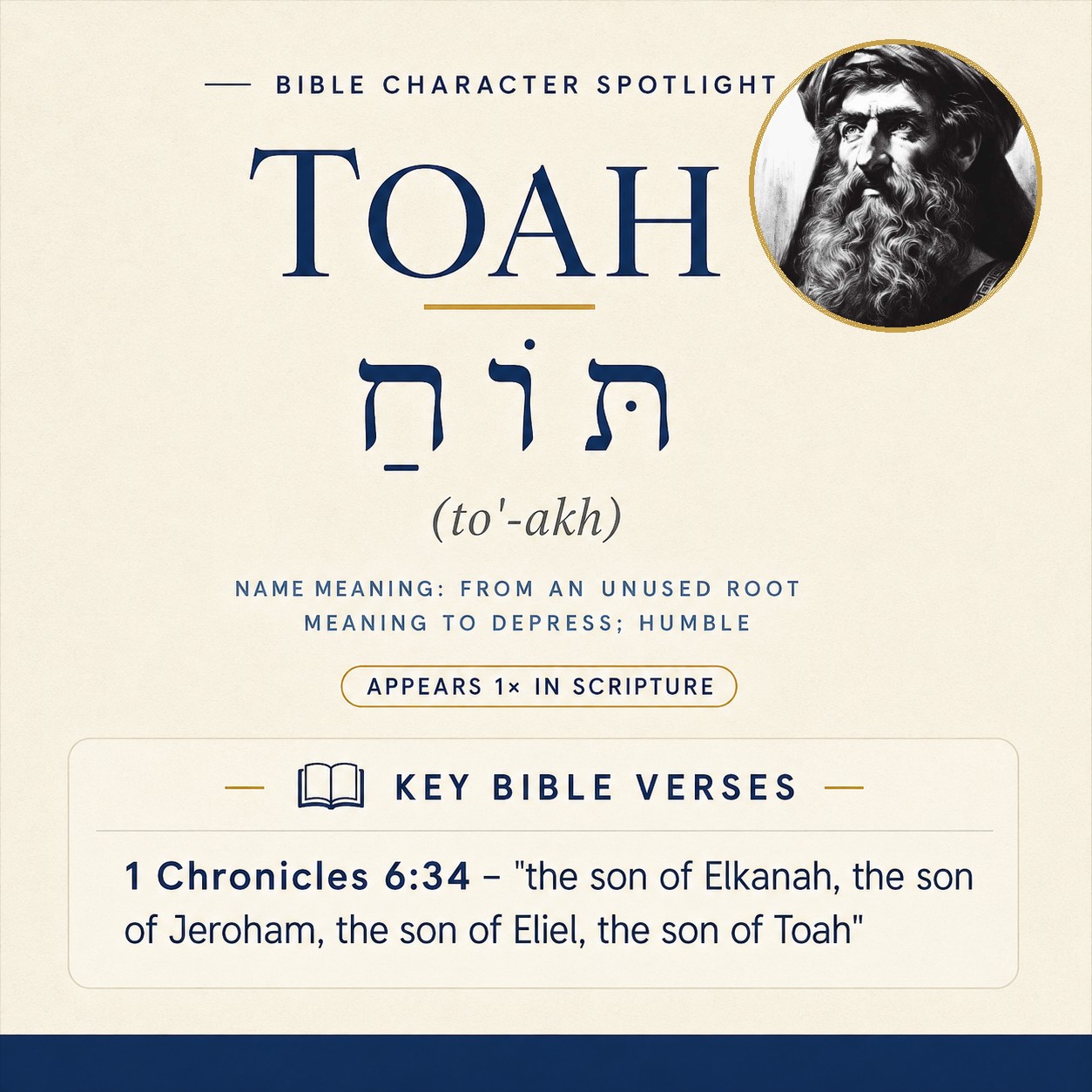
Toah is an Israelite named in a Kohathite genealogy in 1 Chronicles 6:34.

Where Mentioned
He appears in the genealogy: “the son of Eliel, the son of Toah,” (1 Chronicles 6:34, WEB).
Learn More →Name Meaning
Strong’s derives “Toah” (Towach) from an unused root meaning to depress or humble.
Learn More →Toah is named in Scripture as an Israelite within a genealogical line connected with those who ministered “with song” at the tabernacle. The name is glossed in a lexicon as belonging to “Toach, an Israelite,” and its derivation is associated with an unused root meaning “to depress; humble.”
Toah in Scripture
Toah appears once, in a passage that situates a line of descent among those appointed for musical service connected to the tabernacle and later the temple in Jerusalem. The setting describes ongoing ministry “before the tabernacle of the Tent of Meeting” and notes that this continued “until Solomon had built Yahweh’s house in Jerusalem,” with duties carried out “according to their order.”
“They ministered with song before the tabernacle of the Tent of Meeting, until Solomon had built Yahweh’s house in Jerusalem. They performed the duties of their office according to their order.” (1 Chronicles 6:32)
The line in which Toah is named is introduced as part of an ordered list: “These are those who served, and their sons.” The text then specifies that this service line comes “Of the sons of the Kohathites,” and begins the particular chain that leads to Heman “the singer.”
“These are those who served, and their sons. Of the sons of the Kohathites: Heman the singer, the son of Joel, the son of Samuel,” (1 Chronicles 6:33)
Toah is included within the successive “son of” statements that trace this ancestry. In the line as given, Toah stands as an ancestor of Eliel, Jeroham, Elkanah, and then the figure named just before this sequence begins.
“the son of Elkanah, the son of Jeroham, the son of Eliel, the son of Toah,” (1 Chronicles 6:34)
The genealogy continues beyond Toah, extending the line further back through additional names. Immediately after Toah, the next forebear named is Zuph, followed by another Elkanah, then Mahath, and Amasai.
“the son of Zuph, the son of Elkanah, the son of Mahath, the son of Amasai,” (1 Chronicles 6:35)
The list proceeds with another sequence that includes Elkanah, Joel, Azariah, and Zephaniah.
“the son of Elkanah, the son of Joel, the son of Azariah, the son of Zephaniah,” (1 Chronicles 6:36)
It then reaches further back through Tahath, Assir, Ebiasaph, and Korah.
“the son of Tahath, the son of Assir, the son of Ebiasaph, the son of Korah,” (1 Chronicles 6:37)
Within this chapter context, Toah’s role is not described by actions or speech but by placement in a documented lineage tied to organized service. The immediate narrative emphasis is on ordered ministry—those who “served,” their “sons,” and their performance of “the duties of their office according to their order” in connection with the tabernacle and Yahweh’s house in Jerusalem.
Name and Meaning
The name is written in Hebrew script as תּוֹחַ, transliterated Towach, and pronounced to’-akh. A lexicon connects it to an unused root with the sense “to depress; humble,” framing the name’s derivation in terms associated with humbling.
Observation
In the single occurrence where it is preserved, Toah is remembered as part of a carefully ordered genealogy set within the larger description of those who “ministered with song” and “performed the duties of their office according to their order.” (1 Chronicles 6:32–34)
Frequently Asked Questions
What does the name Toah mean?
The name Toah comes from a root meaning “to depress” or “humble.”
How many times does Toah appear in the Bible?
Toah appears 1 time.
Who was Toah?
Toah is identified as an Israelite.
How is Toah mentioned in 1 Chronicles 6:34?
In 1 Chronicles 6:34, Toah is named in a genealogy as an ancestor in the line “the son of Elkanah, the son of Jeroham, the son of Eliel, the son of Toah.”
Explore Further
If you found this page about Toah interesting and would like to discover more about other biblical characters, explore our comprehensive Encyclopedia of Biblical Characters. For those looking to delve deeper into the Greek origins of these names and terms, our Greek Lexicon is an invaluable resource.
Sources: Name and occurrence data from Strong’s Exhaustive Concordance and STEPBible reference data (CC BY). Scripture quotations from the World English Bible (public domain).