Who was Tabbaoth in the bible?
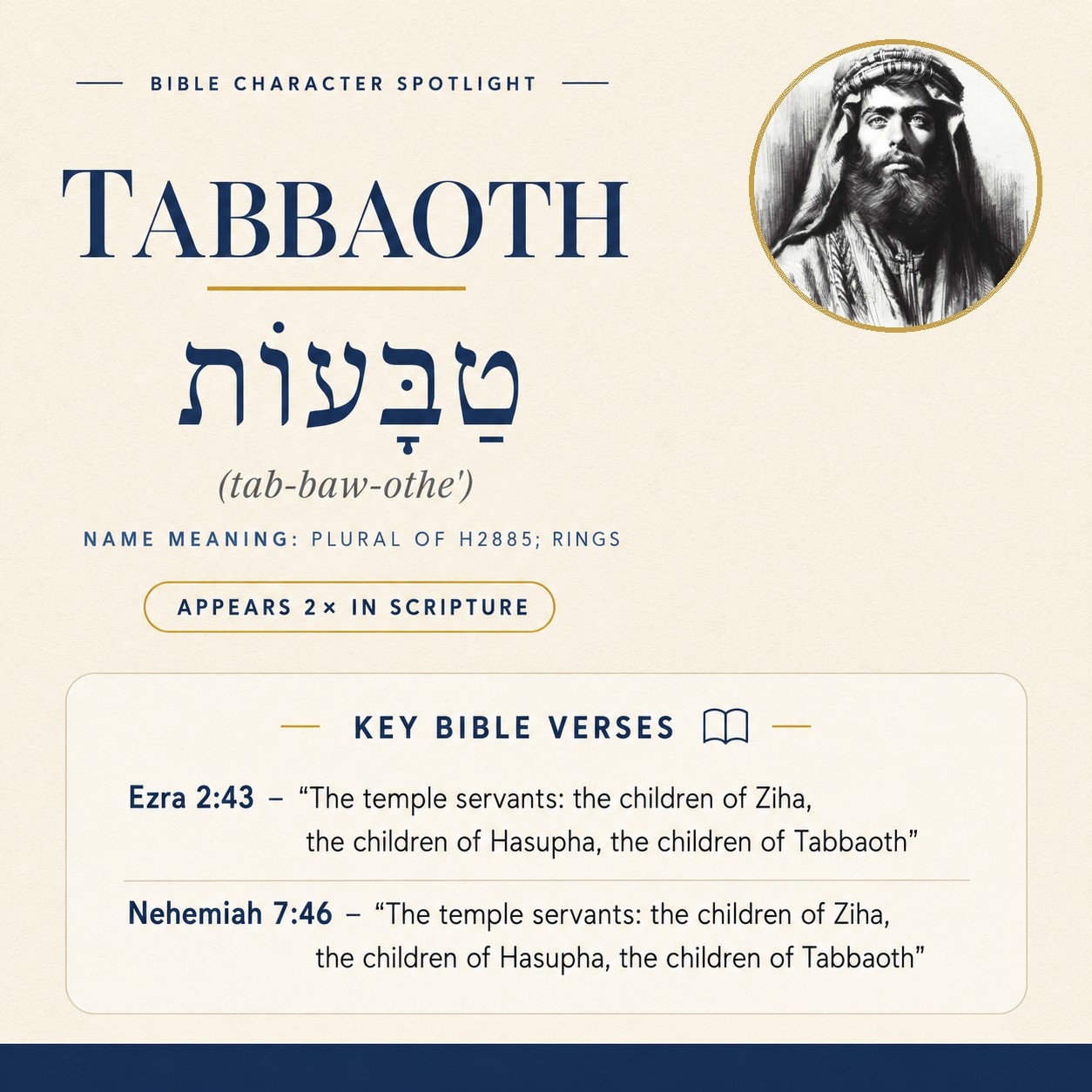
Tabbaoth is named among the temple servants in Ezra 2:43 and Nehemiah 7:46.
Where Mentioned
"The temple servants: the children of Ziha, the children of Hasupha, the children of Tabbaoth" (Ezra 2:43). The same wording appears in Nehemiah 7:46.
Learn More →Name Meaning
Strong’s gloss identifies Tabbaoth as one of the Nethinim and links the name to the idea of "rings" (Strong’s H2884).
Learn More →Tabbaoth is named among the “temple servants” (a group also described in the lexicon gloss as Nethinim) in the postexilic lists of Ezra and Nehemiah. The name is derived from a Hebrew term connected with “rings,” from a word used of a seal impressed into wax.
Tabbaoth in Scripture
Tabbaoth appears only as a family name within lists that record various groups connected with temple life. In Ezra 2, the list moves through singers and gatekeepers before naming temple servants, placing Tabbaoth in that setting.
“The singers: the children of Asaph, one hundred twenty-eight.” (Ezra 2:41, WEB)
“The children of the gatekeepers: the children of Shallum, the children of Ater, the children of Talmon, the children of Akkub, the children of Hatita, the children of Shobai, in all one hundred thirty-nine.” (Ezra 2:42, WEB)
Immediately following these groups, Ezra’s list introduces the temple servants and includes “the children of Tabbaoth” alongside other families.
“The temple servants: the children of Ziha, the children of Hasupha, the children of Tabbaoth,” (Ezra 2:43, WEB)
The listing continues with additional families of temple servants.
“the children of Keros, the children of Siaha, the children of Padon,” (Ezra 2:44, WEB)
“the children of Lebanah, the children of Hagabah, the children of Akkub,” (Ezra 2:45, WEB)
“the children of Hagab, the children of Shamlai, the children of Hanan,” (Ezra 2:46, WEB)
Nehemiah 7 preserves a parallel sequence. As in Ezra, singers and gatekeepers are named first, then the temple servants. In this setting, Tabbaoth again appears only as a family designation, “the children of Tabbaoth.”
“The singers: the children of Asaph: one hundred forty-eight.” (Nehemiah 7:44, WEB)
“The gatekeepers: the children of Shallum, the children of Ater, the children of Talmon, the children of Akkub, the children of Hatita, the children of Shobai: one hundred thirty-eight.” (Nehemiah 7:45, WEB)
“The temple servants: the children of Ziha, the children of Hasupha, the children of Tabbaoth,” (Nehemiah 7:46, WEB)
The list then continues beyond Tabbaoth with other temple-servant families.
“the children of Keros, the children of Sia, the children of Padon,” (Nehemiah 7:47, WEB)
“the children of Lebana, the children of Hagaba, the children of Salmai,” (Nehemiah 7:48, WEB)
“the children of Hanan, the children of Giddel, the children of Gahar,” (Nehemiah 7:49, WEB)
In both books, Tabbaoth is not presented as an individual acting in a narrative scene but as the ancestral name of a subgroup within the temple servants. The repeated phrasing—“the temple servants … the children of Tabbaoth”—locates Tabbaoth among families associated with temple service in these registries.
Name and Meaning
The name is written in Hebrew as טַבָּעוֹת, transliterated Tabba’owth and pronounced tab-baw-othe’. According to the Strong’s-based derivation, it is the plural form of a related word meaning “rings,” connected in turn to a component word (tabba’ath, טַבַּעַת) used of a seal, described as something pressed down into wax.
Observation
Across both lists, Tabbaoth is remembered only through the continuing identity of “the children of Tabbaoth” among “The temple servants” (Ezra 2:43; Nehemiah 7:46).
Frequently Asked Questions
What does the name Tabbaoth mean?
The name Tabbaoth means “rings.”
How many times does Tabbaoth appear in the Bible?
Tabbaoth appears 2 times.
Who was Tabbaoth?
Tabbaoth is named as one of the Nethinim (temple servants). Ezra 2:43 and Nehemiah 7:46 list “the children of Tabbaoth” among the temple servants.
Where is Tabbaoth mentioned?
Tabbaoth is mentioned in Ezra 2:43 and Nehemiah 7:46.
Explore Further
If you found this page about Tabbaoth interesting and would like to discover more about other biblical characters, explore our comprehensive Encyclopedia of Biblical Characters. For those looking to delve deeper into the Greek origins of these names and terms, our Greek Lexicon is an invaluable resource.
Sources: Name and occurrence data from Strong’s Exhaustive Concordance and STEPBible reference data (CC BY). Scripture quotations from the World English Bible (public domain).