
Who was Silas in the bible?
Silas appears in Acts as a “chief” brother and prophet, sent from Jerusalem to Antioch and later chosen by Paul for travel and ministry.

What He Did
“Judas and Silas, also being prophets themselves, encouraged the brothers with many words and strengthened them” (Acts 15:32). Paul later “chose Silas and went out” (Acts 15:40).
Learn More →Name Form
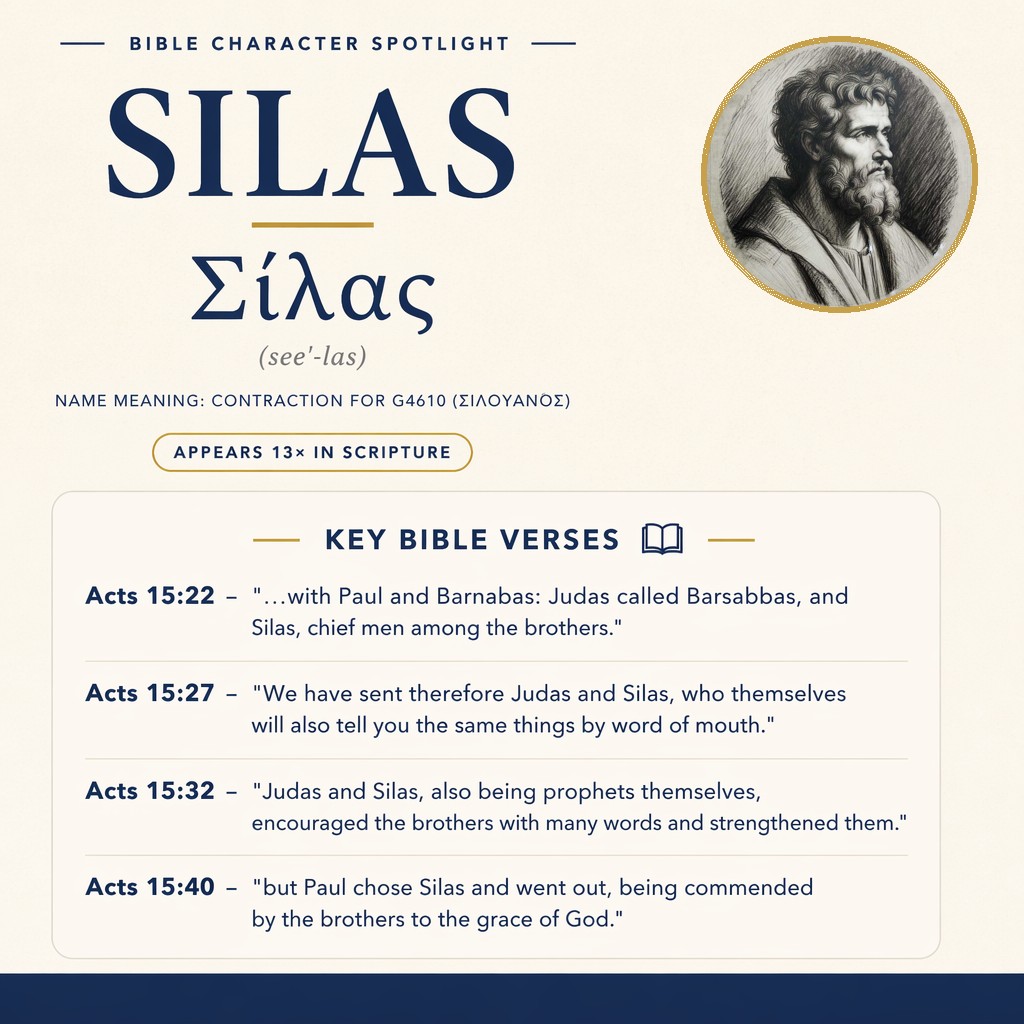
The lexicon notes Silas as a contracted form related to “Silouanos (Silvanus).” In Acts he is named “Silas” (e.g., Acts 15:22).
Learn More →Silas is a man presented in Acts as a leading brother and prophet who was chosen by the apostles and elders to carry an official message to Gentile believers and who later traveled with Paul. The name “Silas” is a Greek form that functions as a contraction of “Silouanos” (Silvanus), according to the supplied lexicon gloss.
Silas in Scripture
Silas first appears in the account of a dispute about circumcision and salvation. “Some men came down from Judea and taught the brothers, ‘Unless you are circumcised after the custom of Moses, you can’t be saved’” (Acts 15:1). In response, Paul and Barnabas, “and some others of them,” were appointed “to go up to Jerusalem to the apostles and elders about this question” (Acts 15:2). After “much discussion” (Acts 15:7), the apostles and elders, with the whole assembly, resolved to send a letter to Gentile believers, and they chose Silas as one of the messengers.
“Then it seemed good to the apostles and the elders, with the whole assembly, to choose men out of their company, and send them to Antioch with Paul and Barnabas: Judas called Barsabbas, and Silas, chief men among the brothers.” (Acts 15:22)
The letter explains that some had troubled Gentile believers with demands for circumcision and law-keeping, though no such command had been given (Acts 15:24). It states that the decision “seemed good to the Holy Spirit, and to us,” and it sets out “no greater burden” than specific necessities (Acts 15:28–29). Judas and Silas are explicitly commissioned not only to deliver the letter but also to communicate its content orally.
“We have sent therefore Judas and Silas, who themselves will also tell you the same things by word of mouth.” (Acts 15:27)
When the messengers arrived in Antioch and the letter was read, the believers “rejoiced over the encouragement” (Acts 15:31). Silas is then described not merely as a courier but as a prophetic speaker who strengthened the community.
“Judas and Silas, also being prophets themselves, encouraged the brothers with many words and strengthened them.” (Acts 15:32)
After spending time there, Judas and Silas were “sent back with greetings from the brothers to the apostles” (Acts 15:33). The narrative then recounts a sharp disagreement between Paul and Barnabas about taking John called Mark (Acts 15:37–39). The result is that Barnabas sailed to Cyprus with Mark, while Paul selected Silas as his companion for continued work among assemblies.
“But Paul chose Silas and went out, being commended by the brothers to the grace of God.” (Acts 15:40)
As Paul and Silas traveled, they encountered opposition severe enough that they were seized and brought before authorities.
“But when her masters saw that the hope of their gain was gone, they seized Paul and Silas, and dragged them into the marketplace before the rulers.” (Acts 16:19)
In confinement, Acts depicts them engaged in prayer and worship that was audible to others.
“But about midnight Paul and Silas were praying and singing hymns to God, and the prisoners were listening to them.” (Acts 16:25)
At a climactic moment in that episode, the jailer (as presented in the narrative) approaches them in fear.
“He called for lights, sprang in, fell down trembling before Paul and Silas,” (Acts 16:29)
Silas continues to be named with Paul as their work moves into other regions. In Thessalonica, some people respond positively to their message: “Some of them were persuaded and joined Paul and Silas” (Acts 17:4). When opposition arises, “The brothers immediately sent Paul and Silas away by night to Beroea” (Acts 17:10), where “they went into the Jewish synagogue” upon arrival (Acts 17:10). Shortly thereafter, the movement of Paul differs from that of Silas: Paul is sent toward the sea, while Silas remains behind with Timothy.
“Then the brothers immediately sent out Paul to go as far as to the sea, and Silas and Timothy still stayed there.” (Acts 17:14)
Those escorting Paul bring him to Athens and convey instructions for Silas and Timothy to rejoin him quickly.
“But those who escorted Paul brought him as far as Athens. Receiving a commandment to Silas and Timothy that they should come to him very quickly, they departed.” (Acts 17:15)
Later, Silas and Timothy are said to come down from Macedonia to rejoin Paul, and their arrival coincides with intensified testimony.
“But when Silas and Timothy came down from Macedonia, Paul was compelled by the Spirit, testifying to the Jews that Jesus was the Christ.” (Acts 18:5)
Across these passages, Silas is consistently portrayed as a “chief” brother entrusted with official communication, a prophet who speaks encouragement, and a close associate of Paul through travel, conflict, imprisonment, and public ministry.
Name and Meaning
In Greek script the name is written Σίλας, transliterated Silas and pronounced “see’-las.” The supplied lexicon explanation states that Silas is a contraction of Σιλουανός (Silouanos), a form associated with the component name Silvanus.
Observation
Acts links Silas’s recognized standing (“chief men among the brothers,” Acts 15:22) with a ministry of building up believers: “Judas and Silas… encouraged the brothers with many words and strengthened them” (Acts 15:32).
Frequently Asked Questions
What does the name Silas mean?
Silas is a contracted form of “Silouanos.”
How many times does Silas appear in the Bible?
Silas occurs 13 times.
Who was Silas?
Silas is a man named in Acts who was sent with Judas to Antioch and later chosen by Paul as a traveling companion (Acts 15:27; Acts 15:40). He is also described as a prophet who encouraged and strengthened the brothers (Acts 15:32).
What happened with Paul and Silas in prison?
About midnight, Paul and Silas were praying and singing hymns to God while the prisoners listened (Acts 16:25).
Explore Further
If you found this page about Silas interesting and would like to discover more about other biblical characters, explore our comprehensive Encyclopedia of Biblical Characters. For those looking to delve deeper into the Greek origins of these names and terms, our Greek Lexicon is an invaluable resource.
Sources: Name and occurrence data from Strong’s Exhaustive Concordance and STEPBible reference data (CC BY). Scripture quotations from the World English Bible (public domain).





