Who was Seba in the bible?
Seba (also spelled Sheba) is a biblical name applied to multiple figures and a place, appearing in genealogies (1 Chronicles 1) and in the narrative of Sheba son of Bichri (2 Samuel 20).

Rebel Leader
“There happened to be there a wicked fellow, whose name was Sheba, the son of Bichri, a Benjamite” (2 Samuel 20:1), and “all the men of Israel went up from following David, and followed Sheba” (2 Samuel 20:2). He was delivered when “They cut off the head of Sheba the son of Bichri” (2 Samuel 20:22).
Learn More →Place and Traders
A place-name appears in “Beersheba (or Sheba)” (Joshua 19:2). Sheba is also described commercially: “The traders of Sheba and Raamah were your traders” (Ezekiel 27:22).
Learn More →Seba (also appearing as Sheba in some passages) is a biblical name borne by more than one figure and also used for a place. In the provided verses, Seba/Sheba appears (1) in genealogical lists as the name of several early progenitors and (2) as the name of an individual, “Sheba the son of Bichri,” who opposed King David.
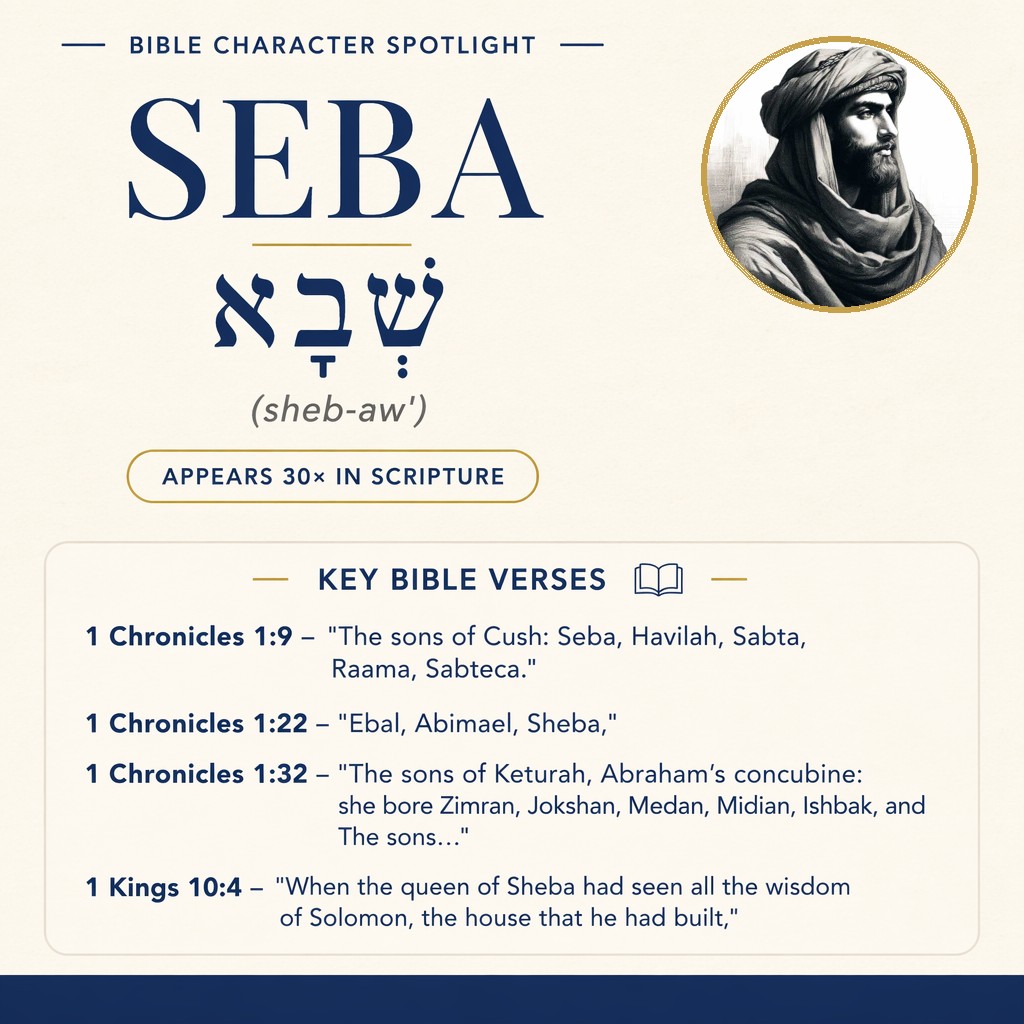
Seba in Scripture
Genealogical bearers of the name. In 1 Chronicles, Seba (spelled “Seba” or “Sheba” in the cited text) appears in multiple genealogical lines.
“The sons of Cush: Seba, Havilah, Sabta, Raama, Sabteca. The sons of Raamah: Sheba and Dedan.” (1 Chronicles 1:9)
Within the same chapter, a “Sheba” also appears among Joktan’s descendants:
“Ebal, Abimael, Sheba,” (1 Chronicles 1:22)
And another “Sheba” appears among the descendants of Jokshan (named in connection with Keturah):
“The sons of Jokshan: Sheba and Dedan.” (1 Chronicles 1:32)
The queen of Sheba. “Sheba” also identifies the realm of a queen who visited Solomon. The provided verses describe her response to Solomon’s wisdom and the gifts exchanged.
“When the queen of Sheba had seen all the wisdom of Solomon, the house that he had built,” (1 Kings 10:4)
“She gave the king one hundred twenty talents of gold, and a very great quantity of spices, and precious stones. Never again was there such an abundance of spices as these which the queen of Sheba gave to king Solomon.” (1 Kings 10:10)
“King Solomon gave to the queen of Sheba all her desire, whatever she asked, in addition to that which Solomon gave her of his royal bounty. So she turned and went to her own land, she and her servants.” (1 Kings 10:13)
2 Chronicles parallels this presentation:
“When the queen of Sheba had seen the wisdom of Solomon, the house that he had built,” (2 Chronicles 9:3)
“She gave the king one hundred and twenty talents of gold, spices in great abundance, and precious stones. There was never before such spice as the queen of Sheba gave to king Solomon.” (2 Chronicles 9:9)
“King Solomon gave to the queen of Sheba all her desire, whatever she asked, in addition to that which she had brought to the king. So she turned, and went to her own land, she and her servants.” (2 Chronicles 9:12)
Sheba as a trading people/region. In Ezekiel, “Sheba” appears among trading partners characterized by luxury goods.
“The traders of Sheba and Raamah were your traders. They traded for your wares with the chief of all spices, and with all precious stones, and gold.” (Ezekiel 27:22)
“Haran, Canneh, and Eden, the traders of Sheba, Asshur and Chilmad, were your traders.” (Ezekiel 27:23)
In another oracle, “Sheba, and Dedan” appear among those who question an invading force’s intent.
“Sheba, and Dedan, and the merchants of Tarshish, with all the young lions of it, will ask you, ‘Have you come to take the plunder? Have you assembled your company to take the prey, to carry away silver and gold, to take away livestock and goods, to take great” (Ezekiel 38:13)
Sheba (Seba) the son of Bichri. A different “Sheba” is a specific man presented in narrative detail in 2 Samuel 20. He is introduced as a disruptive figure who openly rejects allegiance to David.
“There happened to be there a wicked fellow, whose name was Sheba, the son of Bichri, a Benjamite; and he blew the trumpet, and said, ‘We have no portion in David, neither have we inheritance in the son of Jesse. Every man to his tents, Israel!’ ” (2 Samuel 20:1)
The effect is immediate: many Israelites abandon David to follow him, while Judah remains with the king.
“So all the men of Israel went up from following David, and followed Sheba the son of Bichri; but the men of Judah joined with their king, from the Jordan even to Jerusalem.” (2 Samuel 20:2)
David responds by ordering a mustering of Judah and then authorizing pursuit when delay occurs. David states a fear of greater danger from Sheba than from Absalom, and commands decisive action.
“David said to Abishai, ‘Now Sheba the son of Bichri will do us more harm than Absalom did. Take your lord’s servants, and pursue after him, lest he get himself fortified cities, and escape out of our sight.’ ” (2 Samuel 20:6)
Joab’s forces, including “the Cherethites and the Pelethites, and all the mighty men,” go out from Jerusalem “to pursue Sheba the son of Bichri” (2 Samuel 20:7). On the way, Joab kills Amasa and then continues the pursuit:
“So he struck him with it in the body, and shed out his bowels to the ground, and didn’t strike him again; and he died. Joab and Abishai his brother pursued Sheba the son of Bichri.” (2 Samuel 20:10)
After Amasa’s body is moved from the road, “all the people went on after Joab, to pursue Sheba the son of Bichri” (2 Samuel 20:13). The narrative then traces Sheba’s flight and the army’s siege of a city where he has taken refuge.
A “wise woman” from the besieged city negotiates with Joab. Joab clarifies that the army’s aim is not destruction but surrender of Sheba, identifying him and describing his offense directly.
“The matter is not so. But a man of the hill country of Ephraim, Sheba the son of Bichri by name, has lifted up his hand against the king, even against David. Just deliver him, and I will depart from the city.” (2 Samuel 20:21)
The woman agrees, promising, “Behold, his head will be thrown to you over the wall” (2 Samuel 20:21). She then persuades the people to act, and the episode ends with Sheba’s death and the dispersal of his support.
“Then the woman went to all the people in her wisdom. They cut off the head of Sheba the son of Bichri, and threw it out to Joab. He blew the trumpet, and they were dispersed from the city, every man to his tent. Then Joab returned to Jerusalem to the king.” (2 Samuel 20:22)
Additional uses tied to H7652. A “Sheba” appears in a list of “brothers of their fathers’ houses” in 1 Chronicles 5.
“Their brothers of their fathers’ houses: Michael, Meshullam, Sheba, Jorai, Jacan, Zia, and Eber, seven.” (1 Chronicles 5:13)
Also, “Sheba” can designate a place name in the territorial listing in Joshua.
“They had for their inheritance Beersheba (or Sheba), Moladah,” (Joshua 19:2)
Multiple Bearers
The supplied references attach the name Seba/Sheba to distinct subjects:
1) Seba among Cush’s sons: “The sons of Cush: Seba…” (1 Chronicles 1:9).
2) Sheba in Joktan’s line: “Ebal, Abimael, Sheba,” (1 Chronicles 1:22).
3) Sheba in Jokshan’s line: “The sons of Jokshan: Sheba and Dedan.” (1 Chronicles 1:32).
4) The queen of Sheba’s realm, presented through her visit and gifts to Solomon (1 Kings 10:4, 10, 13; 2 Chronicles 9:3, 9, 12).
5) Sheba as traders/merchants associated with “spices,” “precious stones,” and “gold” (Ezekiel 27:22–23), and as speakers who question an invasion’s purpose (Ezekiel 38:13).
6) Sheba the son of Bichri, a Benjamite labeled “a wicked fellow” who gathers followers away from David and is ultimately delivered to Joab (2 Samuel 20:1–2, 6–7, 10, 13, 21–22).
7) Sheba in a family list: “Michael, Meshullam, Sheba…” (1 Chronicles 5:13).
8) Sheba as a place name in “Beersheba (or Sheba)” (Joshua 19:2).
Name and Meaning
Two Hebrew spellings underlie the English forms. One is written שְׁבָא (transliteration Sheba’; pronunciation sheb-aw’), described in the supplied lexicon gloss as “of foreign origin,” and associated there with “the name of three early progenitors of tribes and of an Ethiopian district.” The other is written שֶׁבַע (transliteration sheba’; pronunciation sheh’-bah), derived (per the supplied note) from the same root as H7651 and connected with the sense “seven,” with the component word sheba’ (שֶׁבַע) meaning “seven (as the sacred full one).” In the verses given, these forms correspond to multiple individuals and a place, including “Beersheba (or Sheba)” (Joshua 19:2) and “Sheba the son of Bichri” (2 Samuel 20:1).
Brief Observation
Within narrative, “Sheba the son of Bichri” is defined chiefly by public rejection of David—“We have no portion in David” (2 Samuel 20:1)—and by the swift, collective unraveling of his cause when he is surrendered: “they were dispersed… every man to his tent” (2 Samuel 20:22).
Frequently Asked Questions
What does the name Seba mean?
Seba (Sheba) is used as a name for early progenitors of tribes and for an Ethiopian district.
How many times does Seba appear in the Bible?
Seba/Sheba appears 30 times total across the two Hebrew entries listed (21 + 9).
Who was Seba?
Seba (Sheba) is named among “the sons of Cush” in 1 Chronicles 1:9. The name Sheba is also used for the queen of Sheba who came to Solomon (1 Kings 10:4; 2 Chronicles 9:3), and for Sheba son of Bichri who was followed by men of Israel against David (2 Samuel 20:2).
Was there more than one person named Seba?
Yes. The name is applied to multiple individuals and places, including early progenitors of tribes, the queen of Sheba (1 Kings 10:4), Sheba son of Bichri (2 Samuel 20:2), and a place listed as Beersheba (or Sheba) (Joshua 19:2).
Explore Further
If you found this page about Seba interesting and would like to discover more about other biblical characters, explore our comprehensive Encyclopedia of Biblical Characters. For those looking to delve deeper into the Greek origins of these names and terms, our Greek Lexicon is an invaluable resource.
Sources: Name and occurrence data from Strong’s Exhaustive Concordance and STEPBible reference data (CC BY). Scripture quotations from the World English Bible (public domain).