
Exploring the Meaning of Keiria in Greek
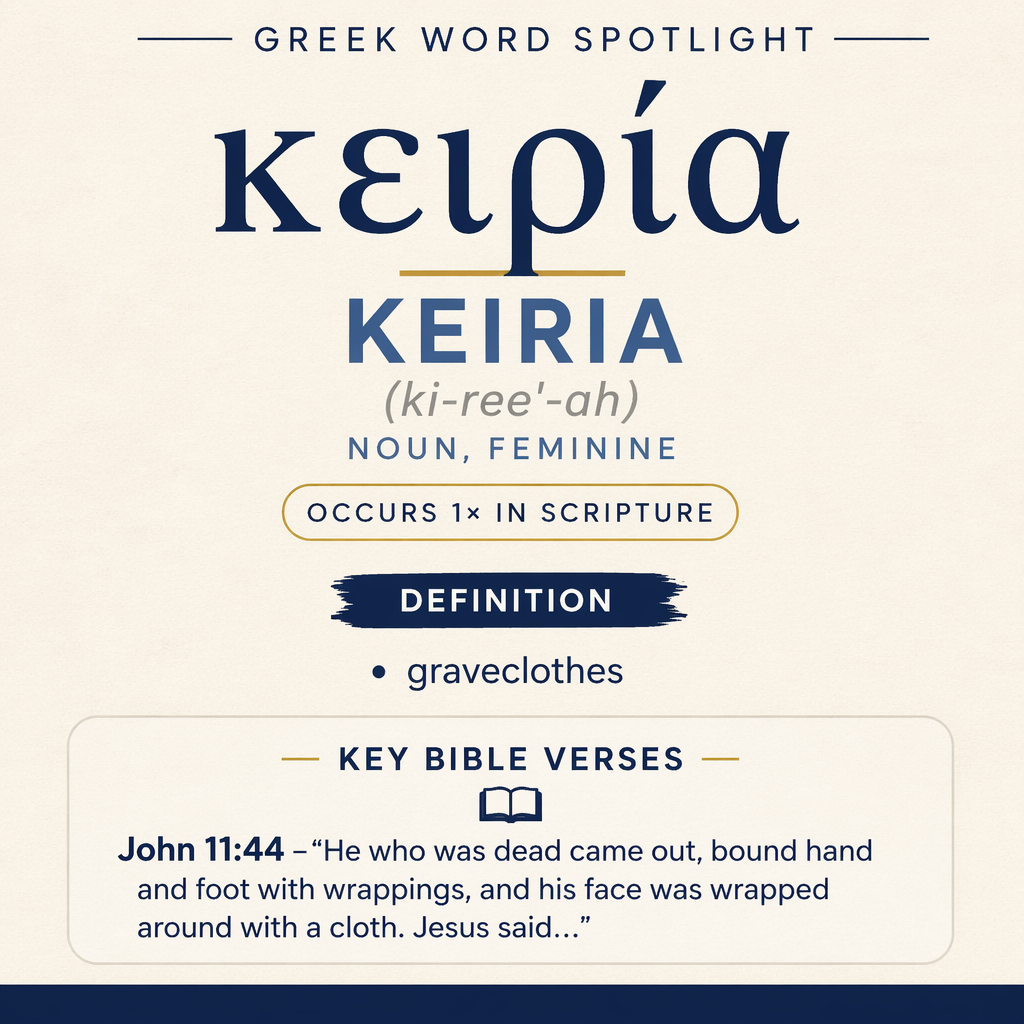
κειρία means “graveclothes” and appears once in Scripture in John 11:44.
Context in John
John 11:44 describes the dead man coming out bound hand and foot with wrappings, and his face wrapped with a cloth.
Learn More →κειρία refers to graveclothes, and it appears in the account of Lazarus coming out from the tomb in John 11:44. In that scene, the term belongs to the concrete details that describe a body still bound in burial materials even as life has returned.
Occurrences
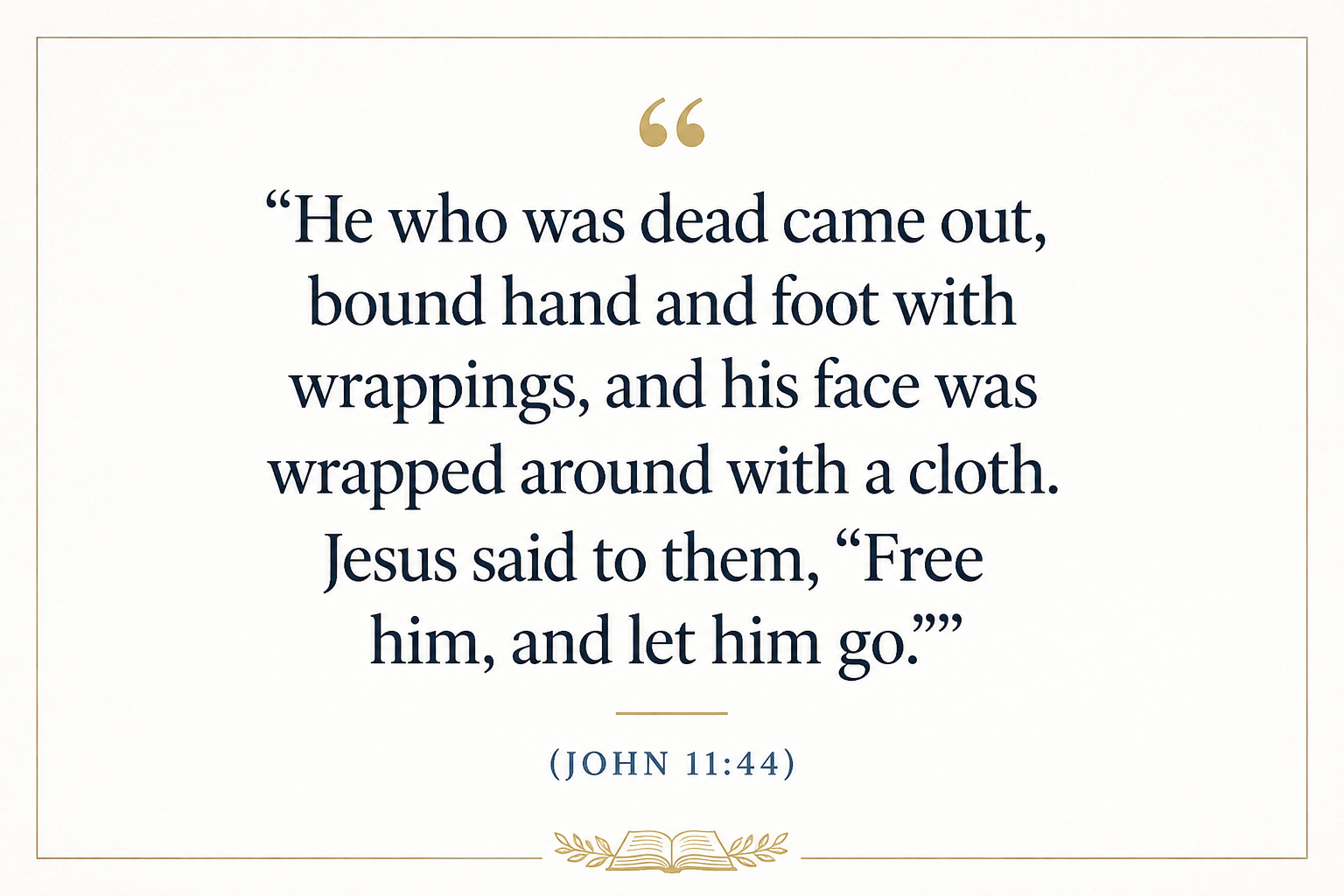
“He who was dead came out, bound hand and foot with wrappings, and his face was wrapped around with a cloth. Jesus said to them, “Free him, and let him go.”” (John 11:44)
In John 11:44, κειρία functions as the visible sign that Lazarus has emerged in the condition of someone recently buried. The verse presents a sequence of tightly observed details: Lazarus comes out, yet he is “bound hand and foot with wrappings,” and even his face is “wrapped around with a cloth.” The word stands within this portrayal of binding and covering, evoking the physical constraints of burial materials on the limbs. The description does not treat the wrappings as incidental; rather, they are central to the moment’s tension—Lazarus is out, but still restrained.
The command that follows, “Free him, and let him go,” shows what the graveclothes practically require: removal. The wrappings in view are not merely evidence of the past event of burial; they are an immediate obstacle to movement and ordinary interaction. The narrative implies that others must intervene—Lazarus does not simply walk away unassisted. In this way κειρία helps the verse hold together two realities in the same instant: the dead man has come out, yet the marks of death’s handling of his body remain on him until they are taken off.

Sense and Usage
The definition “graveclothes” suits the term’s use here because the scene depends on the recognizability of burial equipment. The word belongs to the ordinary, tactile world of cloth and binding: hands and feet are tied up, and the face is covered. Even without extended description of texture or material, the verse presents the wrappings as something that encircles and immobilizes, suggesting not just clothing but a restricting set of coverings associated with a corpse.
Within John 11:44, the graveclothes are part of the boundary between the state of death and the restoration of normal life. Lazarus is described first by what he was—“He who was dead”—and then by what he does—he “came out.” κειρία occupies the middle ground between those two descriptions: they are the outward remnants of burial still clinging to someone who is now living. That placement gives the word a particular narrative weight. It is not used for general apparel, nor to contribute color to a setting; it is used to show that the one emerging is truly the one who had been buried, and that his present condition still bears the physical imprint of that burial.
The verse also distinguishes two kinds of coverings in a single breath: “wrappings” on hands and feet, and “a cloth” around the face. κειρία is associated with the binding of the extremities, while the separate mention of a face covering adds specificity to the burial state. This division of detail guides the reader’s imagination toward a fully wrapped figure whose mobility and visibility are limited. The command “Free him” directly answers the predicament created by such graveclothes: if he is to “go,” the bindings must be removed. Thus the word’s sense is inseparable from action—graveclothes are not merely seen; they must be dealt with, undone, and taken away to allow the restored man to re-enter ordinary life.
Because κειρία occurs here in a context of binding (“bound hand and foot”) and freeing (“Free him”), its usage leans toward the practical function of graveclothes as restraints rather than as decorative or honorific items. They are portrayed as the expected apparatus of burial, but their presence becomes inappropriate once life has returned, highlighting the mismatch between Lazarus’s renewed vitality and the lingering trappings of death. The word therefore carries an implicit contrast within the verse itself: burial wrappings belong to the dead, yet here they cling to one who is alive and standing outside the tomb.
Imagery
The imagery attached to κειρία in John 11:44 is intensely concrete: a man stepping out while still wrapped, hands and feet bound, and the urgent instruction to remove what binds him. The graveclothes are a visual marker that the scene is not merely about coming out of a place, but about coming out of death’s conditions. The verse leaves the reader with a simple, memorable picture—wrappings that once enclosed a corpse now must be loosened so that the restored man can be released into freedom of movement: “Free him, and let him go.”
Sources: Lexical data from Strong’s Exhaustive Concordance and the Translators Brief Lexicon of Extended Strongs for Greek (STEPBible, CC BY). Occurrence data from the Translators Amalgamated Greek New Testament (STEPBible, CC BY). Scripture quotations from the World English Bible (public domain).




