
Exploring the Meaning of Katepheia in Greek
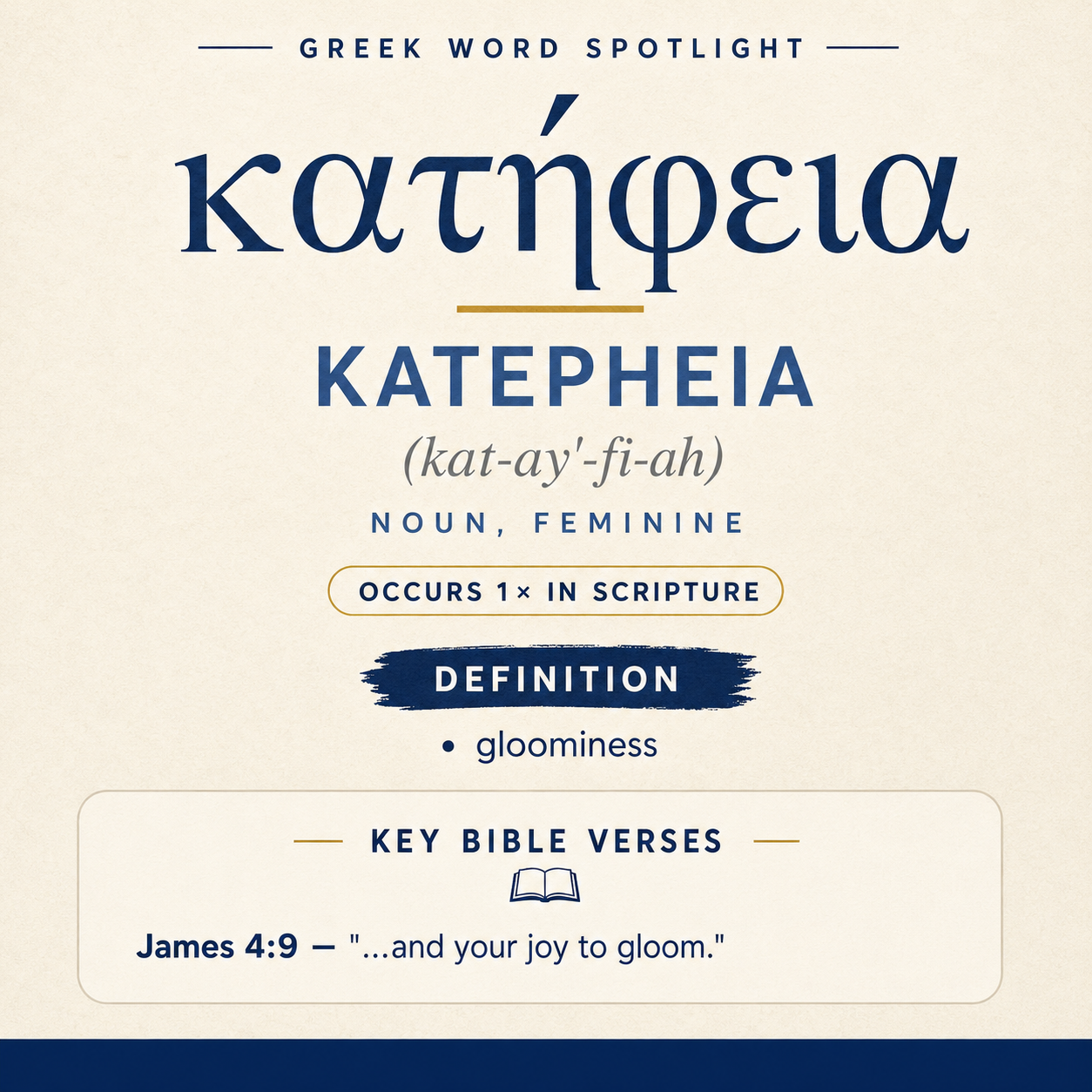
κατήφεια (Katepheia) means “gloominess” and appears once in Scripture, in James 4:9.
κατήφεια names “gloominess,” and it appears once in the New Testament, in James’s call to a posture of lament. In that setting it stands as the dark counterpart to joy, marking an emotional and social turn from levity to a sobered grief.
Root and Related Words
Strong’s associates κατήφεια with κατά (kata, “according to”; Strong’s G2596) and φαίνω (phaino, “to shine/appear”; Strong’s G5316). In that linkage, the word’s form is presented as built from elements connected with “according to” and “to shine/appear,” a pairing that frames its shape within the wider Greek vocabulary without changing the specific sense attested in Scripture.

Occurrences
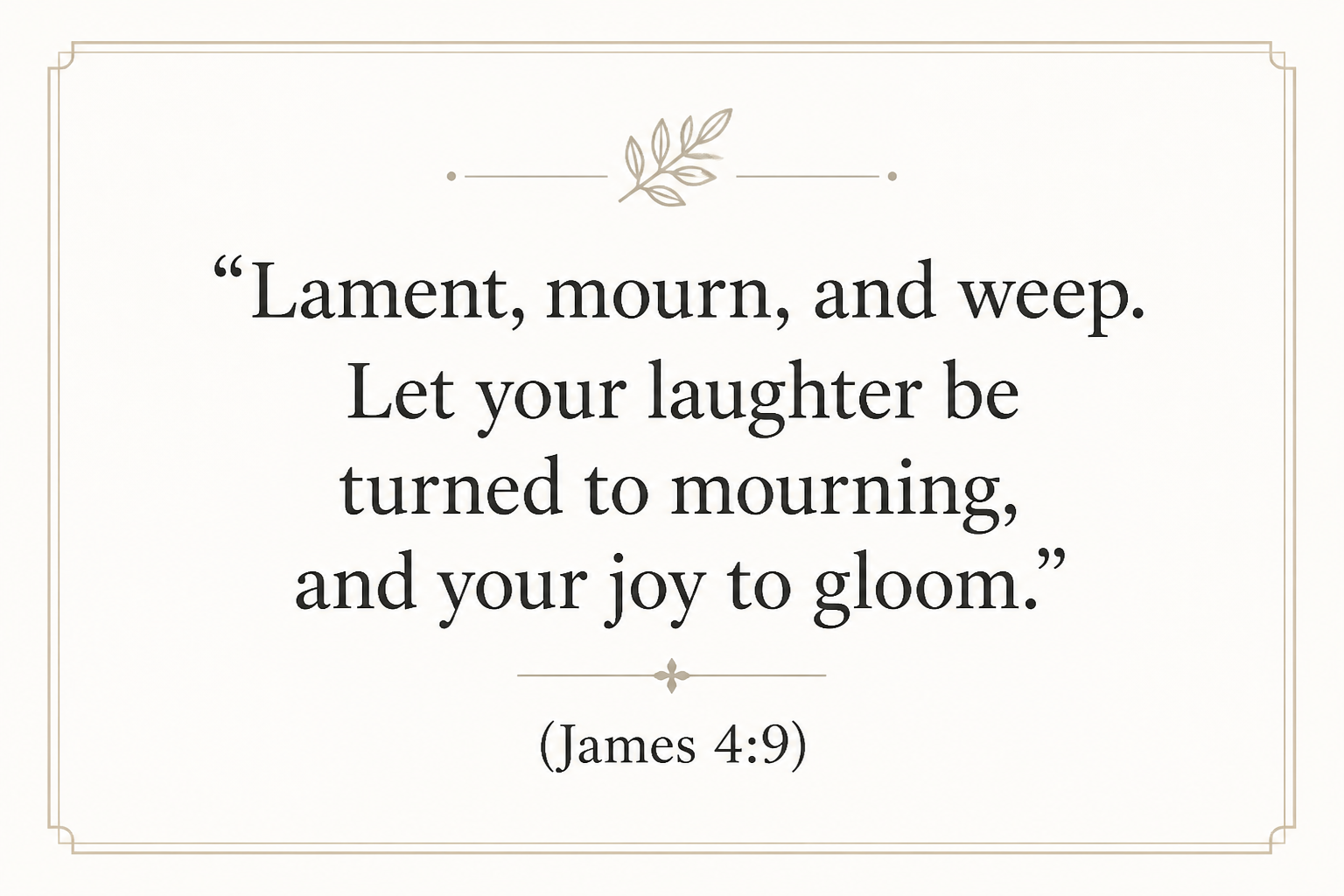
“Lament, mourn, and weep. Let your laughter be turned to mourning, and your joy to gloom.” (James 4:9)
In James 4:9, κατήφεια is the endpoint of a sequence of imperatives and reversals. The verse begins with three blunt commands—“Lament, mourn, and weep”—which stack near-synonyms to press a single point: the community is to take on an openly sorrowful demeanor. The second sentence then expresses that same demand by describing a change of state: “Let your laughter be turned to mourning, and your joy to gloom.” In that parallelism, κατήφεια stands opposite “joy” just as “mourning” stands opposite “laughter.” The word functions as the destination of a transformation: joy is not merely diminished or restrained; it is converted into an affect that reads as darkened and heavy.
The pairing “joy…gloom” also places κατήφεια in the realm of visible or socially perceptible mood. Laughter and mourning are not only inner feelings but actions and expressions: laughter can be heard, mourning can be observed. By aligning “joy” with “laughter” and “gloom” with “mourning,” the verse presents gloominess as something that fits a public posture appropriate to the admonition. The sentence does not isolate the word as a private internal sentiment; it sets it within communal behavior shaped by James’s urgent commands.
James’s construction, “Let your…be turned,” treats the shift as decisive and intentional. Within the verse’s tight logic, κατήφεια is not introduced as a passing cloud over a happy disposition but as the fitting emotional register of repentance-like seriousness. The word therefore bears rhetorical weight: it names the far end of the emotional swing James requires, giving the instruction a sharpened edge by choosing a term that can sit in firm antithesis to “joy.”
Sense and Usage
As “gloominess,” κατήφεια in James 4:9 denotes a condition of darkened mood that matches grief-language and stands in deliberate contrast to positive mirth. The verse locates this gloominess in a triad of sorrow-terms (“Lament, mourn, and weep”) and anchors it in a pair of transformations (“laughter…to mourning,” “joy…to gloom”). That framing helps clarify how the word operates: it is not merely the absence of happiness, but the presence of a somber heaviness that coheres with lamentation.
The parallel structure of the line also suggests the contour of the word’s semantic force in this context. “Mourning” is the noun chosen to receive transformed “laughter,” and “gloom” is the noun chosen to receive transformed “joy.” In ordinary experience, laughter is an outward expression and joy is an inward condition; the verse links both to corresponding negative states. κατήφεια thus functions as a named destination for the inner change: where joy had been the prevailing inner tone, gloominess becomes the new settled mood that corresponds to the outward expressions of lament and weeping.
Because the verse commands the change rather than merely describing it, κατήφεια here is ethically charged in its usage: it is presented as an appropriate, even required, response in the situation James addresses. The imperative style (“Lament, mourn, and weep”) and the permissive/causative phrasing (“Let your…be turned”) make gloominess serve as the vocabulary for a demanded seriousness. The word therefore carries not only emotional color but also rhetorical function: it intensifies James’s exhortation by insisting on a complete reversal of tone.
Even within this single occurrence, the word’s placement beside “mourning” provides a context for its texture. Mourning can include ritualized, visible grief; gloominess, as James pairs it, matches that atmosphere and sustains it as a continuing mood. The verse’s cadence moves from commands (lament/mourn/weep) to outcomes (mourning/gloom), and κατήφεια occupies the final slot, leaving the reader with a concluding note of sober darkness. In that way, the term is not incidental; it is climactic, shaping the emotional resolution of the exhortation.
Imagery
James 4:9 paints its instruction in sensory, everyday terms: laughter replaced by mourning, joy replaced by gloom. Within that picture, κατήφεια evokes the atmosphere of a face and community no longer bright with levity but shadowed by grief, matching the audible and visible signs implied by “weep” and “mourn.”
Sources: Lexical data from Strong’s Exhaustive Concordance and the Translators Brief Lexicon of Extended Strongs for Greek (STEPBible, CC BY). Occurrence data from the Translators Amalgamated Greek New Testament (STEPBible, CC BY). Scripture quotations from the World English Bible (public domain).




