
Exploring the Meaning of Katexousiazo in Greek
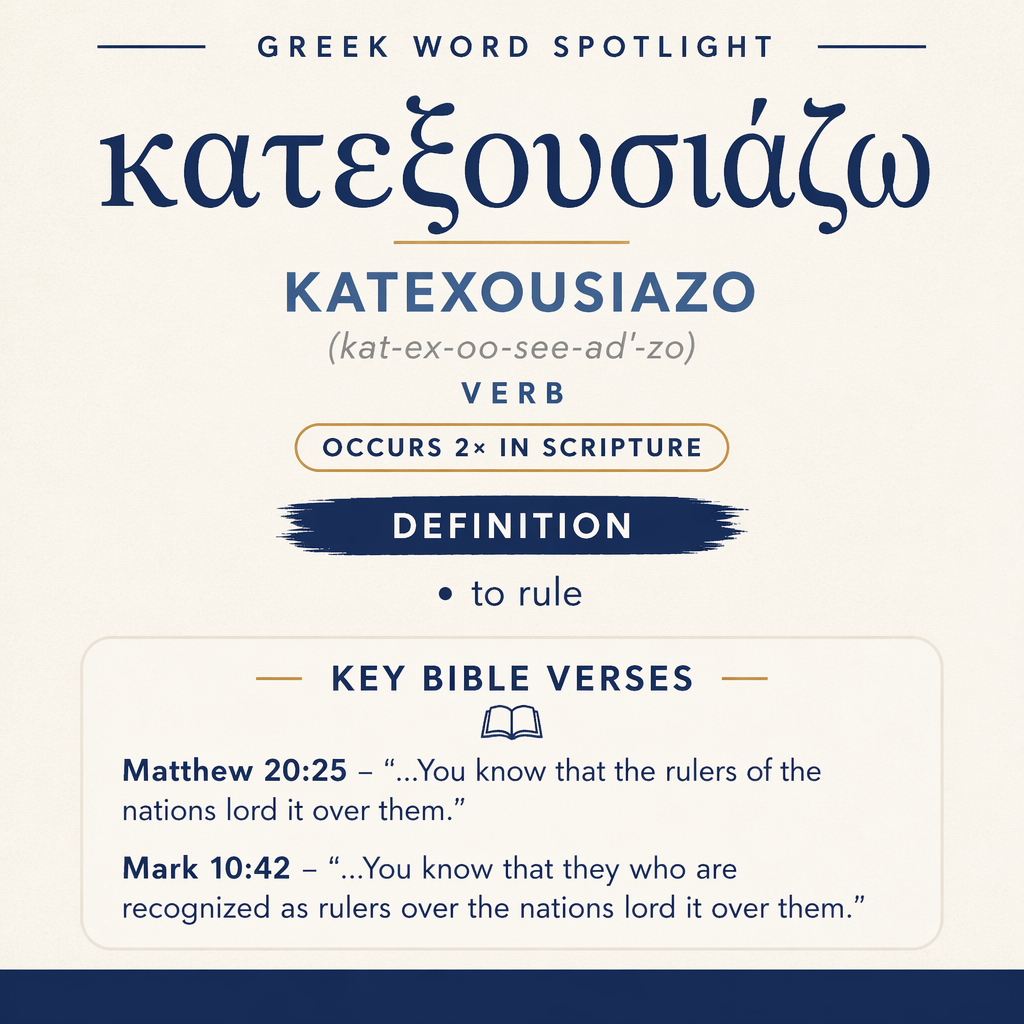
κατεξουσιάζω means “to rule” and appears twice in Scripture, in Matthew 20:25 and Mark 10:42.
Scripture Occurrences
This verb occurs 2 times in Scripture: Matthew 20:25 and Mark 10:42.
Learn More →Context in Gospels
In both passages, Jesus describes how rulers of the nations “lord it over” others.
Learn More →κατεξουσιάζω means “to rule.” It appears in Jesus’ teaching in Matthew 20:25 and Mark 10:42, where he describes how political power is commonly exercised among the nations.
Root and Related Words
κατεξουσιάζω is related to the verb exousiazo (ἐξουσιάζω), “to have authority” (Strong’s G1850), and to kata (κατά), “according to” (Strong’s G2596).

Occurrences
“But Jesus summoned them, and said, “You know that the rulers of the nations lord it over them, and their great ones exercise authority over them.”” (Matthew 20:25)
In this scene Jesus “summoned them,” drawing his followers close to address their shared awareness of how rule typically looks in the wider world: “the rulers of the nations” act in ways that “lord it over” others. Within that description, κατεξουσιάζω supplies the action attributed to “their great ones.” These are the socially elevated figures who, by virtue of their recognized standing, put rule into practice as an exertion directed “over them”—over the people beneath them. The verb therefore functions as a concrete descriptor of governance as something enacted by the powerful upon others, not merely possessed in theory. In the rhythm of the sentence it stands parallel to “lord it over,” reinforcing the picture of rule as an active, downward pressure from those at the top of a hierarchy onto those below.
The wording “their great ones” also frames this ruling as a characteristic behavior of those considered great in that setting: those who are elevated are the same ones who carry out the act. The phrase “over them” gives the verb its relational direction, focusing the reader not on administrative structures but on the interpersonal experience of being ruled—people are on the receiving end of this action. The statement is presented as common knowledge (“You know”), so κατεξουσιάζω here marks a familiar pattern of rule that Jesus assumes his hearers can readily recognize.
“Jesus summoned them, and said to them, “You know that they who are recognized as rulers over the nations lord it over them, and their great ones exercise authority over them.”” (Mark 10:42)
Mark’s setting is closely aligned: again Jesus “summoned them,” and again he appeals to what they already “know” about public power. Here, however, the description begins with those “recognized as rulers over the nations,” explicitly placing the behavior of ruling within a social framework of acknowledged status. In this portrayal, κατεξουσιάζω describes what “their great ones” do in that recognized order: they “exercise authority over them.” As in Matthew, the verb is situated among verbs of dominance (“lord it over”), showing rule as something performed, with a clear “over” relation between great ones and those ruled.
The phrase “recognized as rulers” adds nuance to the immediate scene: the exercise of rule is not depicted as accidental or hidden, but as the expected conduct of those publicly identified with leadership. κατεξουσιάζω therefore contributes to the portrayal of public rulership as an exertion aligned with recognized rank. The repetition of “over them” keeps the focus on how the action lands on others. It depicts rule in terms of how it is felt and experienced: a pattern where power moves from the great toward those beneath them, shaping the social dynamic between leaders and the led.
Sense and Usage
Across these two sayings, κατεξουσιάζω (“to rule”) is used in a narrow, consistent way: it describes the way “great ones” among “the nations” act toward others. The word is not abstracted into a discussion of legitimacy, office, or the right to govern; instead, it is anchored in observable conduct. Rule is pictured as something leaders do “over” other people—rule as exertion, an active stance that imposes direction from above.
The parallel structure in both verses places κατεξουσιάζω alongside “lord it over,” making the sense of ruling concrete and relational. In each saying, the action is tied to social stratification: “rulers” and “great ones” on one side, and “them” on the other. That repeated “them” matters for how the verb is heard. It casts ruling not as a self-contained trait of the ruler but as an act that establishes and maintains a particular relationship between parties. In these scenes, to rule is to act in a manner that assumes and enforces distance between those considered great and those who are subject to them.
The immediate discourse setting also shapes the force of the verb. Jesus introduces the description with “You know,” presenting this kind of rule as the normal, recognizable pattern among the nations. The verb therefore carries the weight of a familiar model of governance, a stereotype of how power is commonly exercised. In both passages the audience is meant to identify the pattern quickly: rulers “lord it over,” and great ones “exercise authority.” κατεξουσιάζω serves that quick recognition, naming the act of ruling as it typically appears in the public sphere described.
Finally, the subject “their great ones” frames this ruling as characteristic behavior associated with greatness in those contexts. Greatness, in the picture Jesus sketches, expresses itself through the performance of rule. κατεξουσιάζω thus functions not merely as a label for leadership, but as a vivid verb that portrays what the powerful do in ordinary political life: they rule over others.
Imagery
The imagery carried by κατεξουσιάζω in these sayings is the lived experience of hierarchy. “Rulers of the nations” and “great ones” stand above, and their action reaches down “over them.” The word participates in a picture of rule as pressure from the top of a social order, exercised in a way that others can feel, recognize, and name.
Sources: Lexical data from Strong’s Exhaustive Concordance and the Translators Brief Lexicon of Extended Strongs for Greek (STEPBible, CC BY). Occurrence data from the Translators Amalgamated Greek New Testament (STEPBible, CC BY). Scripture quotations from the World English Bible (public domain).





